

The brutal effects of war have long prompted efforts to limit suffering and preserve humanity in times of conflict. Across cultures, religions, and legal traditions, people have sought to restrain violence and preserve a measure of humanity in conflict. Yet the emergence of modern humanitarianism in the nineteenth century marked a turning point: compassion became increasingly organized, codified, and institutionalized. Against the backdrop of industrialized warfare, technological change, and growing public awareness of battlefield suffering, new forms of humanitarian action began to take shape.
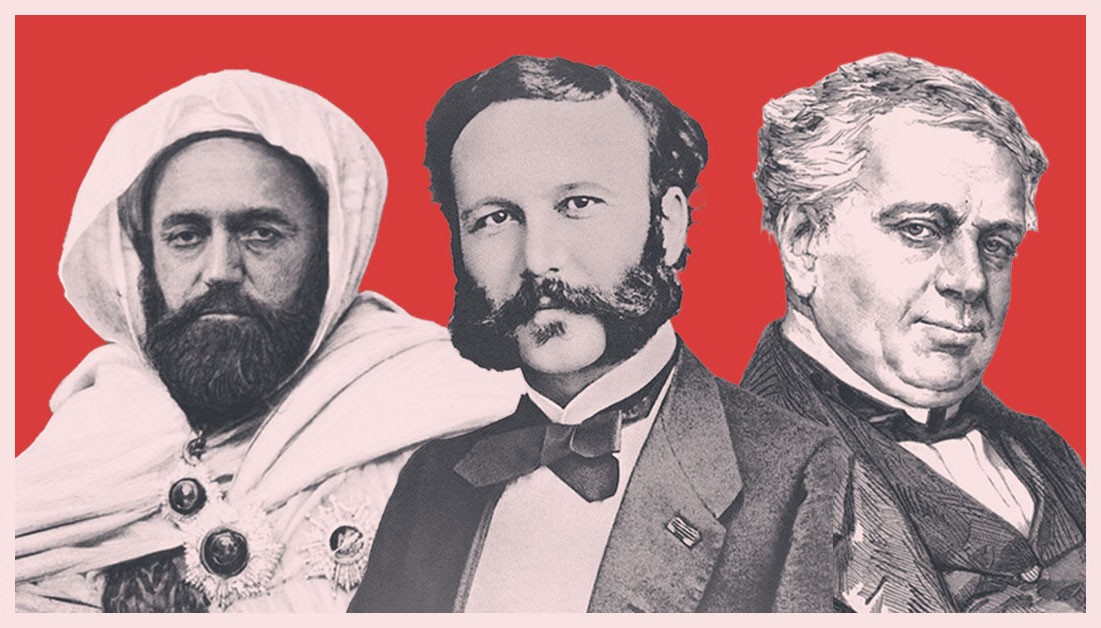
In this post, ICRC experts Anastasia Kushleyko, Cédric Cotter, and Ahmed Al-Dawoody revisit the contributions of Swiss businessman Henry Dunant, Russian philanthropist Anatole Demidoff, and Algerian scholar and leader Emir Abdelkader. Through their efforts to protect prisoners of war, care for the wounded, and uphold humane treatment during conflict, these three figures demonstrated that humanitarian principles were neither confined to one region nor rooted in a single tradition. The authors argue that modern humanitarianism emerged through converging ideas, networks, and practices across different societies, and that revisiting these histories can help reaffirm the universal character of humanitarian principles today.
By the middle of the nineteenth century, Europe had entered a paradoxical period of incredible technological and communication advances. Technological “progress” on the battlefield translated into unprecedented carnage. Rifled muskets and conical and explosive bullets, were killing and maiming people on a scale unknown since the Napoleonic era. At the same time, new media, such as telegraphy, illustrated newspapers, and soldiers’ letters, carried the reality of suffering from the battlefield directly into homes. The wounded and dying no longer seemed like abstract figures elsewhere, but sons, husbands, and brothers.[1]
This merger of industrial violence and public visibility created fertile ground for what contemporaries called “military philanthropy”.[2] Figures such as Florence Nightingale, Clara Barton, and Grand Duchess Elena Pavlovna promoted the idea that compassion must enter the battlefield. Writers and thinkers from Dickens and Hugo to Engels, Marx, Bertha von Suttner, and Tolstoi increasingly focused on suffering and social injustice. Pacifist associations and charitable societies flourished. As Pierre Boissier observed, it was “as if society was suddenly stricken with remorse for its victims”.[3]
Henry Dunant’s shock at Solferino in 1859 did not arise in a vacuum. His ideas resonated because the air was already thick with humanitarian aspiration and the ambition to organize compassion across borders and give it permanence, neutrality, and universal scope. His thinking was shaped by others who had already begun to practice transnational humanitarianism, including the Russian prince Anatole Demidoff in Europe and Emir Abdelkader in the Muslim world. Their examples demonstrated that even amid violence, humanity could prevail.
Anatole Demidoff: a prince of universal charity
Anatole Demidoff (1813–1870), Prince of San Donato, inherited one of the greatest fortunes in Europe from a dynasty of extremely wealthy Russian industrialists. Demidoff had a strong sense of social responsibility, funding hospitals, workers’ homes, and charitable institutions, and sponsoring scientific expeditions and various artistic projects.
The Crimean War (1853–1856) transformed his philanthropic stance into a distinctly humanitarian one. Appalled by the fate of prisoners of war, Demidoff privately created an agency in early 1854 whose purpose was radically simple and radically new: to locate prisoners on all sides, document their names and places of detention, transmit news to their families, send money and supplies, and negotiate improvements in their conditions. Using his extensive diplomatic, business, and artistic networks across Europe, Demidoff established a system of “correspondents” who located prisoners, transmitted letters, negotiated improvements in detention conditions, and even visited them – an unprecedented scope for such an informal humanitarian endeavor at the time.[4]
After reading A Memory of Solferino, Demidoff contacted Dunant to support his initiative while urging him to extend humanitarian concern to prisoners of war, whom he described as suffering morally as much as physically through separation from their families and homeland. Writing from Paris, Demidoff argued that, through “letters from their homes, news of their families, useful information, and money transfers… their condition can be greatly improved”.[5]
At the founding assembly of the International Committee of the Red Cross (ICRC) in 1863, Dunant mentioned Demidoff’s proposal, but it failed to gain support from the delegates at the time. The new institution confined itself to the wounded, deeming prisoners a matter for states.
Yet Demidoff’s argument impressed Dunant. A year later, he returned to the issue with renewed force, and as a result, in 1864, the Committee extended its concern to wounded prisoners of war.[6] This evolution marked a decisive victory for Demidoff’s vision. Long before international law recognized prisoners as subjects of legal protection, a person of ideas and commitment had shown that their suffering could be meaningfully alleviated through neutral action and simple humanity.
Emir Abdelkader: a warrior-scholar of humane conduct
Emir Abdelkader (1808-1883), often regarded as the father of modern Algeria, was an Islamic scholar, poet, statesman, and military leader. The life and struggles of the Emir exemplified both chivalry and humanitarianism. His humanitarian values were deeply rooted in over a millennium of humanitarian principles developed by Islamic jurists.
In his fight against the French occupation of Algeria, Abdelkader reportedly established rules to ensure the humane treatment of prisoners of war and punish abuses against them. In the words of his direct descendant, the late Ambassador Idriss Jazairy, Abdelkader “developed in 1842 … his Code for the Protection of Prisoners. He summoned, in the midst of the war, a congress of 300 of his most important decision makers and had this revolutionary code adopted… The Emir’s Code also prohibited mistreatment of prisoners and the killing of unarmed enemy soldiers or prisoners… the code recognized prisoners’ right even to have a chaplain and to share the same material conditions as the Emir’s own troops.”[7]
Professor Mostapha Cherif explains that Abdelkader wrote to the bishop of Algeria requesting that a chaplain be sent to the Emir’s detention facilities to minister to the French prisoners of war, provided military information was not disclosed. The chaplain’s roles reportedly included providing spiritual support and corresponding with prisoners’ families to alleviate the hardship of captivity. Abdelkader also promised that chaplains would be protected and treated with the utmost respect.[8]
Although there is apparently no evidence of any connection between Abdelkader and Demidoff, they each established mechanisms to ensure the humane treatment of prisoners of war in 1842 and 1854, respectively. Dunant visited Algeria in the 1850s for business purposes and became aware of Abdelkader’s humanitarian efforts. Abdelkader earned widespread global recognition and admiration for his humanity, both during his lifetime and after his death, from world leaders, writers, and poets such as President Abraham Lincoln, Queen Victoria, Tsar Alexander II, Sultan Abdelmajid I, Napoleon III, the Vatican, Robert Browning, and William Makepeace Thackeray.[9]
Henry Dunant: the architect of organized humanitarianism
Almost everything has already been said about Henry Dunant. His trip to Italy for colonial business reasons in June 1859, the trauma of discovering the consequences of the Battle of Solferino, his commitment on the spot to help the wounded, the writing of A Memory of Solferino a few years later, or the creation of the ICRC in February 1863 have generated numerous books, chapters, and have become a mythical story in the history of humanitarianism.
In his book, Dunant formulated two ideas that quickly materialized: relief societies to assist the wounded in wartime, and an international treaty protecting both the wounded and those caring for them. In October 1863, an international conference organized by the founders of the ICRC led to the creation of what would become National Red Cross Societies and, later, the International Red Cross and Red Crescent Movement. Less than a year afterwards, the first Geneva Convention was signed. In a little more than five years, a traumatic experience had given rise to the world’s largest humanitarian movement and the first modern treaty on international humanitarian law (IHL).
Why did Henry Dunant’s ideas succeed in being transformed into action, and eventually garner such posterity?
Dunant’s ideas succeeded in part because he was surrounded by individuals whose military, legal, medical, and organizational expertise transformed moral vision into practical action. General Guillaume Henri Dufour brought military authority and prestige; Gustave Moynier had the organizational skills and perseverance to turn ideas into practice; and surgeons Louis Appia and Théodore Maunoir lent medical legitimacy.
A second explanation is Dunant’s ability to promote his ideas with energy and enthusiasm. Once A Memory of Solferino was published, he actively shared his book with the most important people of the time. He multiplied meetings and correspondence throughout Europe. Dunant had the ability to promote his vision to others and proved he was an excellent networker.
Demidoff, though unable to attend the October 1863 conference for health reasons, exchanged correspondence with Dunant that helped circulate and discuss his proposals there.
Although there is no evidence that Dunant and Abdelkader ever met, they shared a common acquaintance, Charles Eynard, who helped secure Abdelkader’s release from detention in France in 1852. Eynard believed Dunant’s Notice on the Regency of Tunis would interest Abdelkader, whom Dunant admired and compared to the Numidian king Jugurtha, noting the parallels between resistance to Roman rule in North Africa and Abdelkader’s struggle against French occupation:
“His grandson Jugurtha sustained for seven years, as is well known, a bitter struggle against the Romans, all the Numidians of the cities and mountains having rallied to him, just as in our own day the Arab and Kabyle populations of Algeria have joined forces around Emir Abdel-Kader to resist the French. However, Jugurtha, who has so much in common with the modern Arab chief, died of starvation at Rome at the age of fifty-four, in a damp and foul dungeon into which the vengeance of the Romans had plunged him, while Abd-el-Kader, thanks to the illustrious Emperor who now governs France, peacefully ended his extraordinary existence in Broussa.”[10]
Conclusion: modern humanitarianism in the making
In the mid-nineteenth century, three men from different countries, with very disparate social backgrounds, beliefs and political visions, felt the same indignation at human suffering and committed themselves to improving the fate of those affected by war.
Dunant, Abdelkader, and Demidoff were not alone, however. During the Crimean War, Florence Nightingale organized care for wounded British soldiers; Ferdinando Palasciano and Henry Arnault proposed the neutralization of medical care for the wounded; and Francis Lieber developed rules governing the conduct of hostilities and the protection of victims of war. Similar humanitarian ideas emerged simultaneously in different parts of the world and would eventually shape both IHL and the ICRC’s mandate. We invite readers to think of comparable figures and humanitarian traditions from their own countries and histories, many of which may still await wider recognition within the collective memory of humanitarianism.
More than 160 years later, these personal trajectories may seem very distant and linked to bygone times. However, they remain highly relevant.
For instance, even though IHL emerged in a particular historical and cultural context, the humanitarian principles that underpin it are truly global and universal. The Red Cross and the Geneva Conventions were born in Switzerland as a result of various contingencies, but their creation could also have happened elsewhere.
These pioneers also addressed concrete problems with practical and pragmatic responses. In this sense, they anticipated IHL’s substance, which is not a philosophical body of law, but rather the formalization of concrete means to help and protect people affected by armed conflicts.
Their personal or collective commitment from that time remains just as valuable today. In the mid-nineteenth century, people felt a responsibility to respond to the suffering caused by war. Many stepped forward to drive change without holding political office. Members of civil society imagined and organized major humanitarian undertakings, just as they came up with the idea of creating what would become modern international humanitarian law.
Echoing these earlier calls for action, the ICRC today continues to promote respect for IHL through the Global Initiative to Galvanize Political Commitment to International Humanitarian Law. While the primary responsibility for respecting and ensuring respect for IHL lies with parties to the conflict, protecting this humanitarian heritage remains a collective responsibility.
Evoking these three historical figures reminds us of the humanity that nestles in every human heart, through time, place, and culture. More than 160 years later, the legacies of Dunant, Demidoff, and Abdelkader continue to resonate across borders, cultures, and traditions. The fact that three ICRC colleagues from different countries came together to reflect jointly on these histories and write this post is itself a reminder that humanitarianism has never belonged to one nation or civilization alone, but to a shared human impulse to protect dignity in times of war.
References
[1] See more on the intellectual and social environment of the time and its contribution to the emergence of humanitarian ideas: Daniel Palmieri, “An Institution Standing the Test of Time? A Review of 150 Years of the History of the International Committee of the Red Cross,” International Review of the Red Cross, Vol. 94, No. 888 (2012), p. 1273. Marion Harroff-Tavel, Preface in Préludes et pionniers — Les précurseurs de la Croix-Rouge, 1840–1860, ed. Roger Durand and Jacques Meurant, with the collaboration of Youssef Cassis, Geneva, Société Henry Dunant, Collection Henry Dunant No. 5, 1991, p. 414. Daniel Palmieri, “Post tenebras lux: New perspectives on the foundation of the Red Cross,” in Wolfgang U. Eckart and Philipp Osten (eds), Schlachtschrecken – Konventionen. Neuere Medizin- und Wissenschaftsgeschichte, Vol. 20, Herbolzheim: Centaurus Verlag & Media, 2011, p. 18.
[2] Palmieri, “Post tenebras lux”, p. 18.
[3] Boissier, Pierre, From Solferino to Tsushima – History of the International Committee of the Red Cross, Geneva, Henry Dunant Institute, 1985, p. 345.
[4] Marie-Pierre Rey, “Le prince Anatole Demidoff, la Crimée et le Comité international d’aide aux prisonniers de guerre,” in Marie-Pierre Rey, Jean-François Figeac and Éric Anceau (eds), La Guerre de Crimée, première guerre contemporaine, Paris, Classiques Garnier, 2025, p. 170.
[5] Anatole Demidoff a Henry Dunant, Paris, 29 septembre 1863, ICRC archive.
[6] Rey, p. 174.
[7] Idriss Jazairy, “The heritage of the Emir Abd el Qader el Jazairy or the Universality of Islamic values”, Lecture by Ambassador Idriss Jazairy, 15 February 2017, Oxford Centre for Islamic Studies, Oxford University, 15 February 2017.
[8] See Mostapha Cherif, “Conférence Introductive: L’émir Abdelkader Précurseur Du Droit Humanitaire”, L’émir Abdelkader Et Le Droit International Humanitaire, Colloque international, Algeria, ICRC, 2013, p. 7.
[9] Idriss Jazairy, “The heritage of the Emir Abd el Qader el Jazairy or the Universality of Islamic values”, Lecture by Ambassador Idriss Jazairy, 15 February 2017, Oxford Centre for Islamic Studies, Oxford University, 15 February 2017.
[10] Son petit-fils Jugurtha soutint pendant sept ans, comme on le sait, une lutte acharnée contre les Romains, tous les Numides des villes et des montagnes s’étant ralliés à lui, de même que de nos jours les populations arabes et kabyles de l’Algérie se liguèrent, autour de l’Emir Abdel-Kader, pour résister aux Français. Mais Jugurtha qui a tant de rapports d’ailleurs avec le chef arabe moderne, mourut de faim à Rome à l’âge de cinquante-quatre ans, dans un cachot humide et infect où la vengeance des Romains l’avait plongé, tandis qu’Abd-el-Kader, grâce à l’illustre Empereur qui gouverne aujourd’hui la France, termine paisiblement à Broussa son existence extraordinaire (https://gallica.bnf.fr/ark:/12148/bpt6k6209787t, p. 5-6).
See also
- Pierre Krähenbühl, Sixty years on: why the Fundamental Principles must be lived, not just remembered, October 23, 2025
- Ellen Policinski, War’s long legacy: the continued importance of the Geneva Conventions 75 years later, August 8, 2024
- Jacob Coffelt, Codifying IHL before Lieber and Dunant: the 1820 treaty for the regularization of war, April 4, 2024
- Keltoum Irbah, Vincent de Paul: A groundbreaking humanitarian, August 14, 2019