
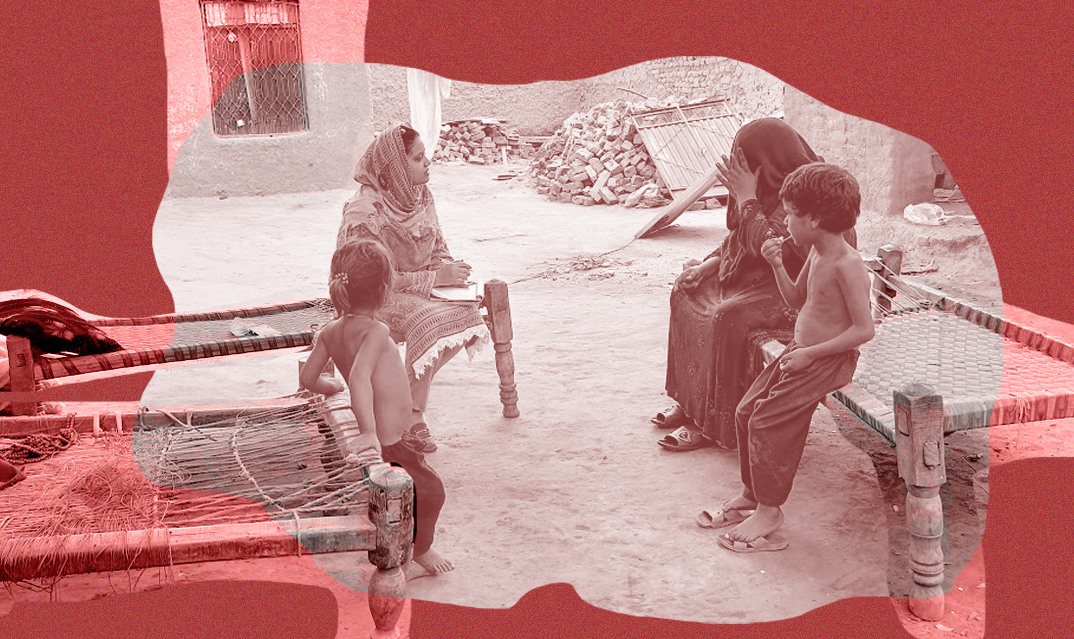
Climate change is intensifying water insecurity in fragile urban settings, where ageing infrastructure, rapid urbanization, and inequality already strain access to essential services. In Peshawar, Pakistan, a city hosting generations of Afghan refugees and facing growing water scarcity, climate pressures have reduced river flow, damaged infrastructure for water, sanitation and hygiene (WASH), and increased waterborne disease. These impacts fall most heavily on refugees, informal settlement residents, and other marginalized communities with limited access to safe and reliable water and sanitation services.
In this post, part of our new series “Delivering for people in an evolving humanitarian landscape”, Sundus Tehreem Shahzad Khattak draws on qualitative research with government officials, residents and humanitarian practitioners in Pakistan to argue that effective, climate-resilient WASH projects do more than deliver services; they safeguard a spectrum of human rights, including dignity, safety from violence, and economic opportunity. She contends that meeting legitimate community expectations requires moving beyond siloed, short-term interventions toward formalized, multi-stakeholder collaboration that places local knowledge, gender responsiveness, and long-term sustainability at the centre of humanitarian action in an era of climate uncertainty and urban fragility.
The call for this series poses a deceptively simple question: What should people affected by fragility, regional instability, and climate stress reasonably expect from the humanitarian system? My research into climate-resilient water, sanitation, and hygiene (WASH) projects in the urban, climate-vulnerable context of Peshawar, Pakistan, suggests that the answer must evolve. In a world where geopolitical shifts, funding pressures, and climate impacts converge, affected communities should expect a humanitarian response that is not merely immediate, but fundamentally resilient, equitable, and rights-protecting.
Peshawar is not defined by active armed conflict. However, it is deeply shaped by decades of regional instability, hosting generations of Afghan refugees, and by the daily realities of urban fragility. As the capital of Khyber Pakhtunkhwa province, it is a city of over three million people, with rapid, often unplanned urbanization. Here, the humanitarian landscape is defined not by frontlines, but by the convergence of four interrelated problems: first, a climate-induced water crisis that has reduced river flow by 15 percent and increased waterborne diseases by 30 percent; second, ageing, under-maintained infrastructure where less than five percent of the population is connected to sewerage systems; third, chronic intermittent supply, with the city losing an estimated 67 percent of its water supplies; and fourth, starkly unequal access, where refugees and residents of informal settlements are systematically excluded from reliable services.
My qualitative case study, involving in-depth interviews with a government official, a female resident, and an international NGO practitioner, explored the long-term effects of WASH projects implemented since the 1990s. The findings offer three grounded reflections on what people in such settings should reasonably expect.
1. Expect that climate adaptation is central, but not the only driver
First, affected communities should expect that humanitarian programming acknowledges climate change as a critical threat multiplier, but also that it addresses the immediate, non-climate drivers of water insecurity. The data from Peshawar is stark. Between 2015 and 2021, the flow of the Kabul River decreased by an estimated 15 percent. In a single year, 2020, floods damaged approximately 20 percent of the city’s WASH infrastructure, while waterborne diseases increased by 30 percent due to climate-altered temperature and precipitation patterns.
However, focusing only on climate would miss the bigger picture. The same participants described ageing pipes that leak up to 40 percent of treated water, pumping stations that fail daily, and a sewerage network that serves less than five percent of the population. Intermittent supply, often just two to three hours per day, means that households must store water in unsafe conditions, leading to contamination. Moreover, Afghan refugees and residents of informal settlements are systematically excluded from formal connections, forcing them to buy expensive tanker water or rely on unprotected wells.
A humanitarian system fit for purpose must therefore ensure that a project like a water supply scheme is not only climate-resilient, designed for future floods and droughts, but also addresses governance failures, infrastructure decay, and unequal access. My research found a clear evolution in this regard. Early projects, such as the Peshawar Water Supply and Sanitation Project from 1994 to 1999, lacked climate adaptation and saw significant infrastructure failure. In contrast, the Climate-Resilient Wastewater Management System from 2019 to 2021, designed with flood-resistant features and diversified water sources, was reported to have 90 percent infrastructure effectiveness during extreme weather. Yet even that project could not solve the daily reality of intermittent supply for refugees living in informal settlements.
This is not merely a technical detail; it is a matter of whether a community’s access to safe water and their right to health and dignity can withstand both the next climate shock and the ordinary failures of governance. The expectation of affected people must be that humanitarian and development actors work together to strengthen not only infrastructure but also the institutions, policies, and equity frameworks that determine who gets water and who does not.
2. Expect humanitarian action to protect a broader spectrum of rights, especially for the most marginalized
Second, people in these settings should expect that the definition of “humanitarian impact” expands beyond immediate survival metrics to encompass the full spectrum of human rights, and that this applies equally to refugees, informal settlers, and long-term residents. The traditional focus on water quantity and disease rates, while essential, misses a critical part of the story. The women and children of Peshawar, who bear the primary burden of water collection and household sanitation, experience WASH in profoundly gendered ways. But their experiences differ sharply depending on legal status and housing tenure.
A female resident of a formal neighbourhood said: “Before the new water scheme, I would leave my home before dawn to fetch water. Now, my daughter has time to attend school, and I no longer fear for her safety on those dark paths.”
However, a refugee woman living in an informal settlement described a different reality: “We have no connection to the network. We buy water from a tanker, 500 rupees for 500 litres, and it is not always clean. My daughters miss school to wait for the tanker. There is no toilet. We go to the canal at night. I am afraid for them.”
The research revealed that effective, climate-resilient WASH projects directly impact what I call “emergent human rights”. This includes:
- Dignity and privacy: a woman’s right to dignity is upheld when she has access to a safe, private sanitation facility, rather than facing the shame and risk of open defecation or unsafe canal use.
- Protection from violence: her right to safety is strengthened when she no longer has to walk long distances at dawn or dusk, journeys that expose women and girls to harassment and assault. This is especially acute for refugee women in informal settlements without street lighting.
- Education and economic opportunity: her right to education and livelihood is realised when time saved from water collection is invested in school or income-generating activities. A government official noted a 40 percent increase in girls’ primary school enrolment from 1990 to 2021, directly attributing this to improved WASH facilities and reduced time burdens. However, this benefit has not reached refugee girls in informal settlements.
- Participation: her right to participate in community decision-making is advanced when WASH projects actively involve women in planning and management, rather than treating them as passive beneficiaries. Refugee women are almost entirely excluded from these processes.
A humanitarian system that fails to measure and prioritize these outcomes, and that fails to disaggregate data by legal status and settlement type, is failing to see the full reality of people’s lives. The expectation must be that humanitarian actors understand these interconnections and design interventions that actively advance, rather than merely not undermine, the full spectrum of human rights for everyone, regardless of their refugee or informal settlement status.
3. Expect a system built on genuine, equitable partnership that addresses governance failures
Third, and perhaps most fundamentally, people should expect a humanitarian system that is built on genuine, equitable, and well-resourced multi-stakeholder collaboration, one that explicitly tackles the governance failures that perpetuate inequality. My research confirmed that no single actor can build climate-resilient, equitable WASH systems alone. The most effective projects were those where the Government of Khyber Pakhtunkhwa’s policy framework and resources were strategically combined with the technical expertise of international NGOs, the funding of donors, and, most critically, the local knowledge and ownership of communities themselves, including refugee and informal settlement representatives.
The Rainwater Harvesting and Groundwater Recharge Project, running from 2020 to the present, a collaboration between the government, INGOs, and local communities, stands as a successful example. It diversified water sources and enhanced the region’s resilience to drought. The Community-led Total Sanitation Program, running since 2004, demonstrates how community ownership, when genuinely supported, can sustain outcomes over decades.
However, the research also highlighted persistent challenges that go beyond funding. These include:
- Intermittent supply and ageing infrastructure: even where new infrastructure is built, old pipes and irregular pumping schedules undermine reliability.
- Unequal access for refugees and informal settlements: formal WASH projects rarely extend to unregistered settlements, leaving a large population dependent on expensive, unsafe alternatives.
- Coordination difficulties: a government official listed “Limited Financial Resources”, “Poor Infrastructure”, and “Institutional Capacity Limitations” as major hurdles. An INGO practitioner added that “low levels of climate change awareness” and weak coordination between stakeholders continue to undermine effectiveness.
- Tokenistic participation: refugee and informal settlement women are often excluded from decision-making forums.
People should expect that their participation, including the participation of the most marginalized, is not tokenistic but is embedded in project design from the outset, and that the partnerships delivering aid are as resilient as the infrastructure they build. This means formalizing coordination mechanisms that explicitly include refugee and informal settlement representatives; addressing power imbalances between international and local actors, and between formal residents and marginalized groups; ensuring that funding models support long-term operation and maintenance, not just short-term construction; and building genuine capacity at the local level, including for refugee community organizations, not just delivering services.
The dilemmas we must confront
These expectations surface uncomfortable dilemmas that the humanitarian system must confront. When resources are scarce, who decides whether to prioritize climate-resilient infrastructure for formal neighbourhoods over extending basic services to informal settlements? When governments lack capacity or political will to include refugees, how do international actors balance respect for sovereignty with the humanitarian principle of impartiality? When genuine community participation slows implementation, how do we reconcile efficiency with equity?
My research does not offer easy answers to these questions. But it does suggest that these dilemmas cannot be avoided by retreating into technical, apolitical programming. The choices are real, and they must be made transparently and accountably, with the meaningful participation of the people they affect, including those living in the shadows of informal settlements.
From “delivering to” to “delivering for”: grounded in the realities of Peshawar
The phrase “from delivering to, to delivering for” captures an essential shift, but it must be grounded in the specific findings of this research. In Peshawar, “delivering to” means building a climate-resilient wastewater system that serves formal residents while ignoring the refugee woman who still walks to the canal at night. It means reporting a 40 percent increase in girls’ school enrolment without asking why refugee girls are not in those classrooms. It means holding multi-stakeholder coordination meetings in which no one from the informal settlements has a seat.
“Delivering for” means something different. It means designing every WASH project with two questions: Does this intervention reduce the gap in access between formal and informal residents? And does it actively protect the rights of the most marginalized women and children? It means that climate resilience is not an add-on but a non-negotiable design standard, and that governance reform, infrastructure rehabilitation, and equitable access are pursued with equal urgency.
What people in a place like Peshawar should reasonably expect is a humanitarian system that has learned the lessons of the past three decades. They should expect interventions that are climate-resilient by design, rights-protecting in their scope, and equitable in their reach. They should expect that their voices, including those of refugees and informal settlement dwellers, are not merely heard but heeded, and that their safety, dignity, and agency are placed at the centre of humanitarian action.
Meeting this expectation is not merely an aspirational goal; it is an operational imperative. As the humanitarian landscape continues to evolve, shaped by climate change, shifting geopolitics, urbanization, and persistent inequality, our ability to deliver on this promise will determine whether we are truly delivering for people, or simply delivering to them.
The people of Peshawar, its long-term residents, its refugee communities, and its informal settlement dwellers, and millions like them in fragile, urban, climate-vulnerable settings around the world, deserve nothing less.
See also
- Lina Aburas, When the perpetrator is the climate, March 19, 2026
- Catherine-Lune, Amir Khouzam, Climate action in conflict and fragile settings: closing the implementation gap, November 12, 2024
- Catherine-Lune, Amir Khouzam, Responding to climate risks in conflict settings: in search of solutions, November 23, 2023
- Jody M. Prescott, Robin Lovell and Team Sandhurst, Gender inequality, armed conflict and climate change: why militaries can and should map compounded risk, September 29, 2022