

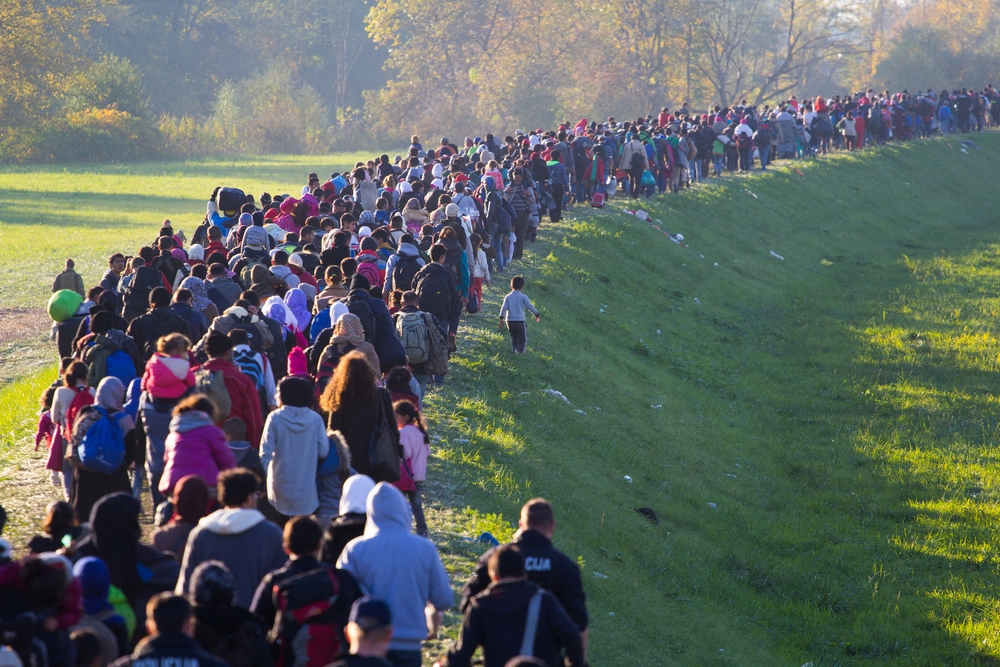
By the end of 2024, the Office of the United Nations High Commissioner for Refugees estimated that 123.2 million people worldwide were forcibly displaced as a result of persecution, conflict, violence, human rights violations and events seriously disturbing public order. If a large-scale conflict erupts, the intensity, scale and tempo of military operations will only worsen this trend, impacting not only those displaced but also receiving communities, and potentially those staying behind. International humanitarian law’s (IHL) rules seek to prevent displacement due to armed conflict – while respecting people’s agency and genuine will to move – and to reduce harms to civilians, including displaced populations.
In this post, part of the “Complying with IHL in large-scale conflict” series, ICRC Legal Advisers Matt Pollard and Helen Obregón explore the humanitarian challenges related to movement, mass displacement and the rupturing of family ties that would inevitably arise in such conflicts. It also looks at some of the practical measures that states can – and should – take to be prepared to meet these challenges and to comply with their obligations under IHL and under other relevant bodies of international law. Advance planning, already in peacetime, is essential for IHL to provide effective protection if such a conflict breaks out.
Large-scale armed conflicts typically result in huge numbers of civilians on the move. The size of these population movements risks overwhelming the systems meant to protect, support and manage them, not only within countries but also across borders into neighboring countries and possibly beyond. This in turn exacerbates the risks of harm arising from the conduct of hostilities, poor conditions in transit or in temporary places of shelter, or loss of contact between families.
Displacement in such contexts is also likely to be protracted. The conflict may last for years and people may be unable to return home even after the fighting ends. The magnitude of destruction and damage to cities and critical infrastructure, the impact on the social fabric of a society, and other obstacles often make it challenging to find durable solutions in cases of mass displacement.
International humanitarian law (IHL) seeks to reduce these harms. It allows for voluntary movement of civilians, subject to potentially significant restrictions on movement, while preventing, minimizing and regulating involuntary displacement. It requires humane treatment of all persons in all circumstances and provides specific safeguards for those displaced. IHL furthermore requires states to seek to keep family members together, for instance, in the context of evacuation or internment. It provides for practical measures to ensure that those who are separated for any reason related to the conflict can remain in contact and potentially reunite, and that no one goes missing.
Our post draws on the recently updated ICRC Commentary on the Fourth Geneva Convention (GC IV) to underscore how states can prepare in advance to ensure that these IHL protections are effective and efficient in the event of a large-scale international armed conflict. Other international obligations of the state should also be taken into account, including for example under international human rights law and the Vienna Conventions applicable to diplomatic and consular officials and related persons (e.g. here, paras 2664 and 2667–8).
Who is protected?
IHL protects each and every human being affected by armed conflict. Some rules apply to everyone, while others apply to specific groups of people. Many GC IV provisions on the protection of civilians in international armed conflict apply to “protected persons”. The Convention defines “protected persons” as covering, with some exceptions, foreign nationals in the hands of a party to the conflict. It does not, however, include people already protected by one of the other Geneva Conventions, such as prisoners of war. Most customary IHL rules, as well as Part II of GC IV and relevant provisions of Additional Protocol I (API), are not restricted to “protected persons” and apply more generally.
Voluntary movement
When an armed conflict breaks out, foreigners living in an affected country may wish to return home, or to go somewhere else. Protected persons have the right to leave the territory of a party to the conflict, and for their departure to take place in satisfactory conditions as regards safety, hygiene, sanitation and food. Certain protected persons also have the right to leave occupied territory, but the Convention excludes nationals of the state whose territory is occupied from this right, leaving a significant gap that is difficult to reconcile with humanitarian concerns. In both cases, permission to leave can however be refused if the “departure is contrary to the national interests of the State”. Refusals can only be imposed in accordance with regular procedures, including reconsideration by a court or administrative board.
A state can impose restrictions on internal movement within its own territory or territory it occupies. Security measures such as restricting travel between internal regions, instituting checkpoints, and imposing reporting requirements, may be adopted to the extent the conflict makes them necessary. The requirement of necessity entails that they be proportionate to a lawful purpose (see here). The application of restrictive measures must furthermore comply with general requirements of the Convention and other IHL rules, such as the prohibition of adverse distinction on grounds such as race, religion or political opinion (e.g. here and here). IHL furthermore specifically limits the circumstances in which protected persons can be forced through such measures to stay in an area particularly exposed to the dangers of war (here and here).
Provisions on the right to leave are not restricted to particular destinations or means of transport and thus apply equally to departures by sea. The full range of potentially relevant rules under various bodies of international law, including the law of naval warfare, are beyond the scope of this post (but see here and here). However, states’ obligations to search for, collect and evacuate, and respect shipwrecked, missing, or dead civilians at sea are an important example (e.g. Articles 8–11, 32–34 API).
If a state is preparing for the possibility of large-scale armed conflict, it should ensure that the right to leave territory it controls, and the associated substantive and procedural guarantees, are recognized in domestic legal and policy frameworks. Clear instructions and procedures should be put in place to enable civilians to leave areas affected by hostilities, without undue delay, and to seek shelter, food and healthcare. Any provisions for restrictions on departures or on internal movement should be reviewed to ensure they are consistent with IHL.
Forced movements and mass displacement
Armed conflicts are among the main causes of displacement – often due to violations of IHL (and/or IHRL), and large-scale conflicts, whether on land or at sea, could trigger mass displacement. Many IHL rules, including on the conduct of hostilities and on humanitarian relief, can help reduce some of the root causes of displacement. IHL also contains specific rules on the evacuation, transfer and deportation of civilians, which distinguish between potentially lifesaving (and permissible) evacuations and unlawful movements.
GC IV prohibits parties to armed conflicts from forcibly transferring protected persons within, and deporting them from, occupied territory, regardless of the motive. Customary IHL extends this to the entire civilian population of an occupied territory. This prohibition applies immediately, even in the case of a very short occupation (here, paras 391-393), and indeed even during the invasion phase (here, para. 1140 and here, para. 3162). Forcible transfers or deportations can be direct or indirect (here, paras 3171-3173).
The only exception to this prohibition is the temporary evacuation of civilians from an area for their security or for imperative military reasons (but never outside the occupied territory, except if materially impossible to do so otherwise). These grounds must be interpreted narrowly and justified by valid and compelling reasons – in good faith (see here, paras 3191-3195). All evacuations must also comply with several conditions and safeguards for the well-being of the persons concerned, including ensuring humane conditions of evacuation, providing proper accommodation to evacuees, and avoiding family separation. Finally, evacuees must be transferred back to their homes as soon as the circumstances necessitating their removal no longer exist. The property rights of displaced people must also be protected.
Beyond this explicit prohibition, other IHL rules, for instance those stemming from the principle of precautions, may require parties to allow civilians to leave to safer areas whenever feasible or to evacuate civilians. Under GC IV, parties must endeavour to conclude agreements for the removal from besieged or encircled areas of several categories of persons. In addition, several rules set specific limits and safeguards relating to the evacuation, transfer and deportation of children (e.g. here and here). All evacuations must comply with the prohibition of forcible transfer or deportation and with relevant IHL rules, including the principle of non-refoulement (here paras 3039-3046) and the prohibition of adverse distinction. From a practical perspective, evacuations are best organized when warring parties agree on procedures that adhere to humanitarian considerations that allow for a safe and dignified movement (e.g. here, pp. 53-56). In all cases, civilians and persons hors de combat who, for whatever reason, stay in place remain protected by IHL and must not be attacked. They must be protected from incidental harm and treated humanely in accordance with international law.
To prepare for mass displacement and for evacuations during large-scale conflicts, states must ensure that relevant IHL rules are understood and integrated in domestic legal and policy frameworks. States should put in place appropriate contingency planning – with clear institutional mandates and sufficient resources – in coordination with the armed forces and other relevant government stakeholders, including civil defence organizations. In case of mass cross-border displacement, inter-state cooperation and coordination should also take place. In regions where the prospect of large-scale naval warfare looms, plans should also consider specific challenges arising for maritime evacuations, including due to the ocean’s vastness (e.g. here, pg. 59).
In planning, states should guarantee the availability of safe evacuation routes (e.g. by establishing humanitarian corridors) and of adequate conditions and services throughout evacuations and upon arrival at destinations. Moreover, states should also put in place measures to prevent family separation during evacuations, to maintain or restore family links and to search for those missing due to the conflict (see below). If carrying out security screenings to maintain the civilian and humanitarian character of sites, these must comply with IHL and other applicable law, particularly rules on humane treatment and on deprivation of liberty. Finally, in their planning, states need to appropriately consider those who may require special attention, including persons with disabilities, unaccompanied children, older persons and persons in institutional care.
Family links, the missing, and the dead
The general obligation to respect family life as far as possible is a customary IHL rule, and is reflected in numerous specific treaty provisions. For instance, GC IV requires states to respect the “family rights” of protected persons in all circumstances. In this context, states should adopt a broad understanding of family (here, paras 2129–2130).
In international armed conflict, everyone in a Party’s territory or occupied territory is to “be enabled to give news of a strictly personal nature to members of their families, wherever they may be, and to receive news from them”. If the ordinary postal services are not in a position to fulfil this role, parties must consult with a neutral intermediary, such as the ICRC’s Central Tracing Agency (see below), to find a solution. States should consider technological developments when interpreting this obligation, ensuring that the civilian population has access to the widest possible range of means of communication (here, paras 2138–2140).
Disruption of ordinary postal and telecommunications services is particularly likely in large-scale conflicts. Accordingly, states’ contingency plans should enable continued exchange of family news, including across borders, in such circumstances. This could include initiating, if necessary, the consultations prescribed by Article 25 before a serious disruption occurs. If censorship will be imposed, plans must provide for adequate resources to ensure it will not result in undue delays (here, paras 2133, 2137).
Parties to the conflict are further required to “facilitate enquiries made by members of families dispersed owing to the war, with the object of renewing contact with one another and of meeting, if possible”. API, where applicable, strengthens this rule, requiring that Parties to the conflict facilitate the actual reunion of dispersed families in every possible way. The Convention and Protocol recognize the role played by humanitarian organizations (such as the ICRC and National Red Cross and Red Crescent Societies) in facilitating such contact and reunion.
One overarching aim of these and other rules is to uphold the right of families to know the fate of their relatives (here, pp. 24–27). To prevent persons from going missing and help ensure families know the fate of family members, the Geneva Conventions provide for a system of collection, centralization and transmission of information about both military personnel and civilians. Such obligations apply to protected persons, i.e. those in the hands of a Party to the conflict of which they are not nationals, without geographic restriction and thus can also be relevant at sea (here, para. 1038).
Notably, upon the outbreak of a conflict and in all cases of occupation, each of the Parties must establish a national information bureau (NIB) (here). The function of the NIB is to collect, centralize and transmit prescribed information, including to a “Central Agency”, which the ICRC has always operated in practice – a role confirmed in API and in the Red Cross and Red Crescent Movement’s Statutes.
States are also required to search for persons who have gone missing and to provide family members with any information about their fate, including whether they have died – even after a conflict has ended (e.g. here and here). Under API, a role is again explicitly foreseen for the ICRC’s CTA. IHL also includes obligations regarding respect and recovery of the dead, and requiring the collection of information about them with a view to identification (e.g. here, here and here). Obligations relating to the missing and the dead are also relevant for those who may be lost at sea (see e.g. Articles 8–11, 32–34 API).
Conclusion
IHL includes a wide range of rules designed to preserve the possibility for civilians to move voluntarily, to protect them against unnecessary forced movement and mass displacements, and to require their humane treatment and protect family links. These rules can only achieve their intended aims if they are interpreted and implemented in good faith, through effective measures. This, in turn, requires states to incorporate such measures in relevant planning, legal and policy frameworks, and resource allocation decisions. Humanitarian impacts can best be addressed by preventing and avoiding armed conflict in the first place. When preparations for large-scale conflict are nevertheless seen as necessary, issues of movement, mass displacement and maintaining family links need to be considered.
See also
- Ellen Policinski, Complying with IHL in large-scale conflicts: How should states prepare to allow and facilitate delivery of humanitarian relief?, December 4, 2025
- Ansha Krishnan and Eve Massingham, Complying with IHL in large-scale conflict: navigating complexities in the Asia-Pacific, September 4, 2025
- Dominique Loye, An evitable catastrophe: reclaiming humanity from the nuclear brink, August 7, 2025