When people go missing in war, their absence lingers far beyond the battlefield – splintering families, deepening social divides, and haunting political transitions. Yet amid this grief, the families of the missing often become unlikely peacebuilders: their search for truth draws them across old front lines, transforming pain into connection and personal loss into a collective force for reconciliation.
In this post, Jill Stockwell, Simon Robins, and Martina Zaccaro explore how families of the missing – through shared advocacy and dialogue – can reshape divided societies. Drawing on ICRC research from Bosnia and Herzegovina, Cyprus, and Nepal, they show how families who once faced each other as enemies now work side by side, using their moral authority and lived experience to foster empathy, resist manipulation, and model the very reconciliation peace processes often fail to achieve.
Persons who go missing as a result of armed conflict leave a legacy of trauma and unresolved grief, affecting not only their immediate family but the wider community. Politically, unresolved cases of missing persons can deepen division, prolong grievances, and hinder peace initiatives. Conversely, actively addressing the issue can facilitate reconciliation, build confidence, and advance stability – crucially contributing to the broader process of peacebuilding.
Recent research conducted by the ICRC’s Central Tracing Agency confirms the central role that families of the missing can play in advancing peace during and after active hostilities. This suggests that maximizing the agency of the families of the missing in processes that address the issue of missing persons can help building relationships – not only with other victims of disappearance and key stakeholders involved in establishing the fate and whereabouts of missing persons, but also with broader society. More than this, enabling the agency of the families can open new pathways to peace and reconciliation.
Over the last five years, the Central Tracing Agency has spearheaded new approaches to supporting families of the missing – helping them build peer relationships and mutual understanding with a global community of families, and strengthening their interactions with authorities. Drawing on a literature review, it has also conducted research with associations of families of the missing in three contexts – Bosnia and Herzegovina, Cyprus and Nepal – to better understand the potential of families, particularly those from family associations.
The research shows that, despite adversity, families of the missing often become unexpected agents of peace. In all three contexts, these associations worked across the divide of conflict, bridging political and ethnic divides and pressing states to make peace processes inclusive and sustainable.
Families can build relationships and humanize the “other” across the divide
The greatest need of families of the missing is to know what has happened to their loved ones. This search for truth and closure drives them to reach out across conflict divides – first as seekers of answers, then as builders of empathy and solidarity.
In the three research contexts, families searching for their missing relatives initiated contact with families searching on the “other side,” hoping they might hold clues to the fate of their loved ones. Over time, this search became a bridge: empathy developed, prejudices faded, and solidarity took root. Sharing the same suffering and the same demands, families began to humanize former adversaries and dismantle long-entrenched narratives of enmity. These interactions fostered mutual understanding, challenged dehumanizing narratives, and encouraged joint advocacy for truth and recognition.
In Cyprus, the opening of the border that had divided the island for nearly three decades finally allowed families to meet. They discovered that, despite dominant narratives of antagonism, they shared much more than what divided them.
“It helped us to see that they are human beings, they are not monsters, they are not going to attack you in the middle of the street.” – Family member of the missing, Cyprus
In Nepal, the legacy of political conflict meant that families from opposing sides often lived side by side but regarded each other with suspicion, associating the other with those who victimized them. Patient work by ordinary families organized in associations helped to overcome these fears, and over many years, they forged strong bonds, creating a new identity that transcended the lines forged during the conflict: as victims with shared needs who could make joint demands for recognition.
“Yes, my attitude to those from other side of the conflict has changed over time, in the long run – we understood that we all became victims … we community people are living together and there is no culture of revenge.” – Family association leader, Nepal
In Bosnia and Herzegovina, deeply entrenched attitudes towards other ethnic groups, sustained by both the memory of violations of the conflict – including questions of responsibility for how people went missing – and actors seeking to instrumentalize them, made it difficult for families from the different sides to come together. After patient work, and with ICRC support, families overcame their deep suspicions and were able to sit together.
“We realized we needed to show more solidarity with each other. We were telling stories to each other, and this is where we cried together and created solidarity and made a step towards each other.” – Family association leader, Bosnia and Herzegovina
Collective involvement in family associations transformed attitudes towards the “other” and enabled joint political engagement for reconciliation. Families discovered that grief and suffering are shared experiences that transcend ethnic and political divides, prompting joint efforts for answers and recognition. Sharing stories and pain across these lines not only challenges narratives that promote animosity but also builds trust – making a united voice in advocacy possible.
Families can deliver powerful messages of non-repetition and drive broader attitudinal change
One of the main barriers to peacebuilding is the political instrumentalization of the missing issue. Authorities and political actors frequently use the suffering of families to justify ongoing hostility and maintain division. In Cyprus, families of the missing reported being repeatedly asked to tell their stories in forums organized by various authorities. Yet when families themselves come together – whether by forming associations or publicly sharing their experiences – they can resist being co-opted. Psychosocial support and community solidarity strengthen their resilience against instrumentalization, empowering them to deliver a shared message of healing and non-repetition.
“It was important to tell the real stories about our missing relatives; only hearing one side suffocates you.” – Family association leader, Bosnia and Herzegovina
When organized in associations, families are less vulnerable to exploitation, and their collective stories can powerfully shift public perspectives. In Cyprus, some Greek and Turkish Cypriot families now work together, transforming their public engagement into a joint narrative of shared suffering and resilience, for example by visiting schools to share a bicommunal message of their search for answers about their missing relatives. In Nepal, family associations have become visible political actors, building trust that transcends old affiliations and advocating for greater inclusion and common concern, not just for the victims of the conflict but to address the marginalization that triggered violence.
Perhaps most transformative is families’ commitment to ensuring that others do not suffer as they have. Their messages are not just demands for answers, but for change – insisting on truth-telling, and acknowledgement of all victims regardless of perpetrator, and guarantees of non-repetition. Recognizing that violations occurred on all sides creates space for a more honest reckoning with the past, undermining polarizing narratives and fostering reconciliation. Families’ stories can be profoundly transformative, reshaping individual and collective understandings in positive ways.
“When they hear us [families] speak together, something changes in people … something changes in their heart, it touches them because they think if you, say, lost 30 members of your family, and Petar lost eight members of his family, and they can reconcile what is it that we cannot share? I mean, to put it bluntly, this changes their attitude.” – Family association member, Bosnia and Herzegovina
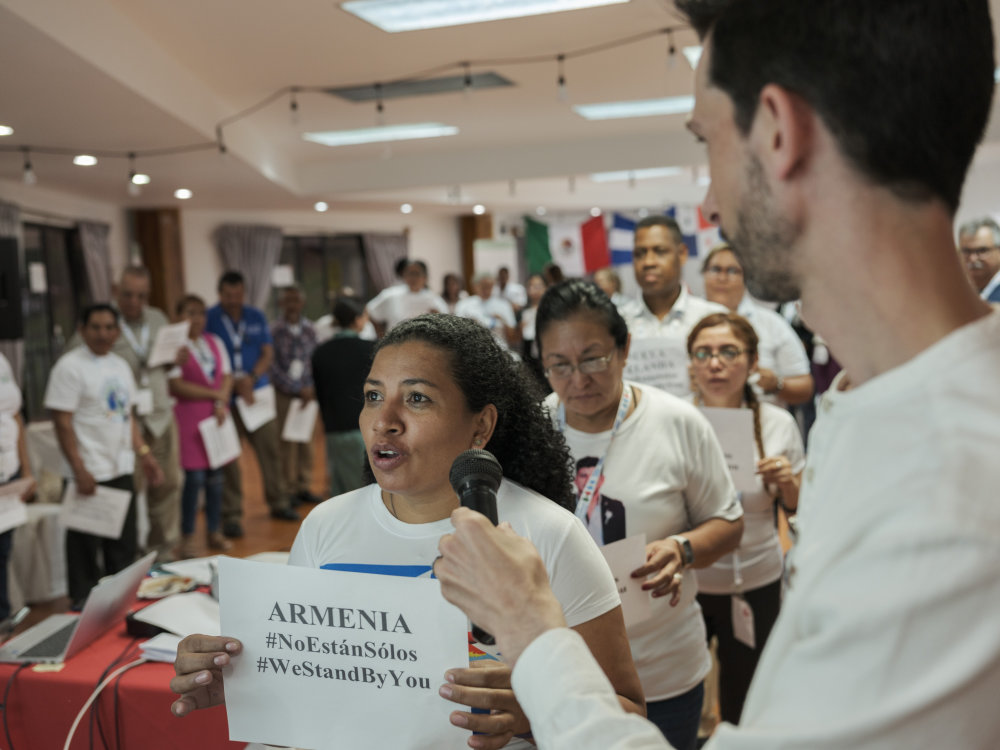
Families act as catalysts for broader attitudinal change. They become bridges among communities – symbols of the suffering caused by conflict and advocates for peace. Their lived experience and moral authority imbue their voice with unique legitimacy, allowing them to model new relationships and attitudes within society. This is clearly visible in the ICRC’s biennial International Conference for families of the Missing, which brings together over 900 families from more than 50 contexts worldwide to connect, share experiences and find strength in each other’s stories.
One concrete impact of this peer-to-peer conference has been to bring together families of those missing in armed conflict in contexts where it has not been possible to overcome the divisions of the conflict. For example, in Sri Lanka, families of the missing have long been divided by ethnicity – reflecting the long history of conflict in the country. However, following the international family conference, Tamil and Sinhalese families came together in a physical meeting in Colombo, forging the basis of a relationship that can potentially see the advocacy of families transcend these historic divisions.
Families are often on the “frontline” – not only of the search for their missing relatives, but also of dialogue, communication, and understanding. Because their need to know is urgent and personal, they overcome barriers, confront taboos, and set an example for the wider society. This role is too often overlooked. Yet their persistence – sometimes born of sheer desperation and pain – can lead to sustainable and meaningful peacebuilding within and between their broader communities. Their ability to forge connections outside formal peace processes makes them invaluable drivers of change.
Where family associations are visible and respected, they can engage directly with local and central authorities to address not only the cases of missing persons but also the underlying causes of conflict, such as exclusion, poverty, and discrimination. In Nepal in particular, these organizations have become powerful advocates, challenging the marginalization that fuelled conflict, mobilizing affected communities for development, and changing both social and political structures. Family associations have become agents of systemic change – connecting victims with economic opportunities, education, and governance, thus reducing vulnerability and consolidating peace.
Families as advocates with the state
The Central Tracing Agency (CTA) has also worked to support families and their associations as effective advocates who can make claims on states to both give them answers and advance peacebuilding. As a part of this, the CTA has been building the negotiation and advocacy skills of families, alongside the Centre of Competence on Humanitarian Negotiation. This helps families to design appropriate strategies to be heard by the authorities and to become more involved in decision-making processes, and to sharpen their soft skills and communication capacities.
Families as peacebuilders
The issue of missing persons in post-conflict settings not only perpetuates unresolved grief but also risks being used to foment further antagonism and hinder peace. However, families of the missing – through their search for answers, their outreach across the divide of conflict, and their efforts to transform suffering into advocacy – represent a unique and powerful resource for local peacebuilding efforts. Their capacity to reshape narratives, foster empathy, and model new societal attitudes can place them at the forefront of building lasting peace.
Ensuring families are central to all interventions and supporting their ability to engage across divides and in communities is not just a humanitarian imperative but one that unlocks immense potential for societal healing and conflict transformation. Their lived experience and willingness to connect are essential pillars of a process that seeks to address both the painful legacy of the past and the hope for a peaceful future.
Political authorities should be encouraged to see families of the missing not as victims whose victimhood justifies continued division, but as actors of change who find ways to overcome their suffering and show broader communities how reconciliation can begin. Recent work by the ICRC with families of the missing and their associations shows that peacebuilding requires more than ending violence; it demands confronting root causes, collective grievances, and the social structures that give rise to conflict, transforming relationships between people and the way society accounts for its past. Families of the missing – through their search for truth and their ability to transcend barriers – embody what becomes possible when those most affected by conflict are empowered to lead societal change.
See also:
- Terry Hackett and Audrey Purcell-O’Dwyer, Peace can start in a prison cell: how IHL and humane detention can build pathways to peace, November 6, 2025
- Pierre Krähenbühl, Sixty years on: why the Fundamental Principles must be lived, not just remembered, October 23, 2025
- Ariana Lopes Morey and Avigail Shai, Dialogue, dignity, and the humanitarian contribution to peace, October 2, 2025
- Grażyna Baranowska, Left behind: reparations and assistance for families of missing and disappeared persons, June 2, 2022
- Eva Svoboda and Filipa Schmitz Guinote, Where are they? Three things the families of missing persons teach us about war and peace, May 6, 2021