
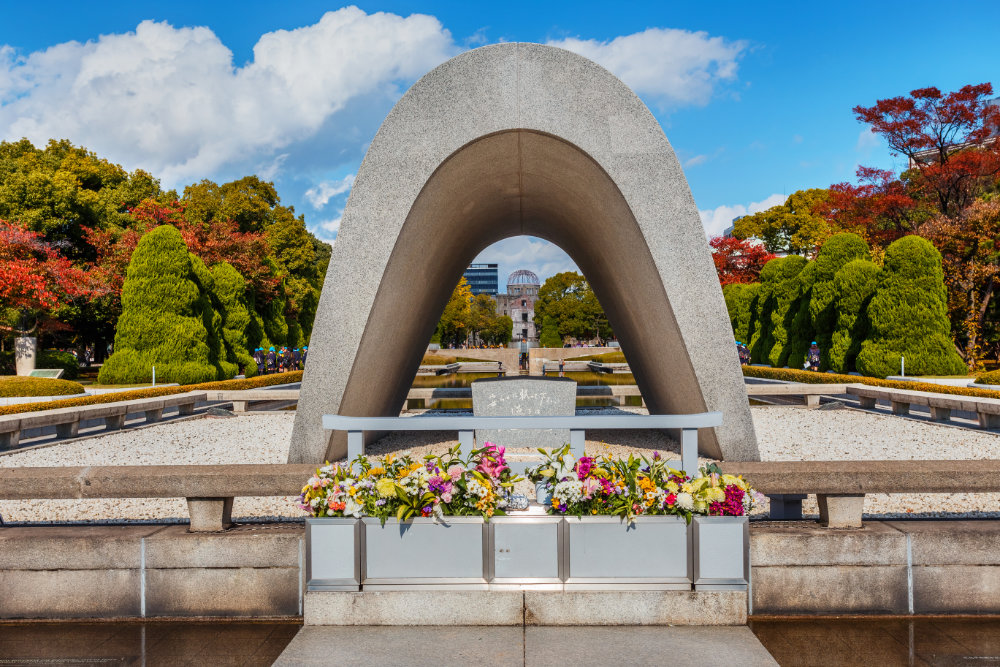
On August 6th and 9th 1945, Hiroshima and Nagasaki became the first – and so far only – targets of nuclear weapons in warfare, killing over 100,000 people instantly and devastating countless lives for decades to come. The humanitarian consequences of such weapons are unmatched in scale and severity. While legal and ethical arguments against the most horrendous weapons have existed since the 19th century, nuclear arsenals remain active and are even expanding, as global discourse shifts away from nuclear disarmament toward renewed reliance on deterrence.
In this post, ICRC Policy Adviser Dominique Loye traces the evolution of legal and humanitarian objections to nuclear weapons, from the 1868 Saint Petersburg Declaration to the Treaty on the Prohibition of Nuclear Weapons (TPNW). He argues that despite hopeful legal and diplomatic milestones, the world is once again drifting towards catastrophe. With the 2026 Treaty on the Non-Proliferation of Nuclear Weapons (NPT) Review Conference on the horizon, the time is now to reframe global security around humanity – not annihilation – and to take urgent, collective steps to reduce nuclear risks and prevent their use.
This week, the world – and in particular the people of Hiroshima and Nagasaki – commemorate one of the most horrendous moments in the history of warfare: on August 6th and 9th 1945, two nuclear bombs exploded over these two cities, killing over 100,000 people instantly. Tens of thousands more died in agony in the hours, days, and weeks that followed, due to burns, blast injuries, and acute radiation sickness. By 1950, the estimated death toll from both bombings had risen to 340,000, including many who succumbed to the long-term effects of radiation. To this day, survivors continue to suffer from cancer and other illnesses caused by radiation exposure.
International humanitarian law and the origins of restraint
More than 70 years earlier, in 1868, on the proposition of the Imperial Cabinet of Russia, an International Military Commission assembled in Saint Petersburg. Envoys from most European countries, as well as from Persia and the Ottoman Empire, attended three days of meetings and negotiation sessions chaired by the Tsar’s Minister of War. Russia had convened the conference to propose a ban on certain explosive projectiles that exploded on impact with the human body – projectiles that would cause especially horrible wounds and an agonizing death.
At the end of the three days, representatives of 17 states agreed to the Saint Petersburg Declaration, which prohibited the use of such weapons. Crucially, and beyond condemning the technical effects of these weapons, the Declaration’s preamble sets out principles that stand as a landmark in the history of international humanitarian law:
- There are technical limits to the necessities of war that ought to yield to the requirements of humanity;
- The progress of civilization should alleviate the calamities of war as much as possible;
- The only legitimate objective for states during war is to weaken the enemy’s military forces;
- This can be achieved by disabling the greatest possible number of combatants;
- Weapons that uselessly aggravate suffering or render death inevitable exceed this purpose;
- Such weapons are, therefore, contrary to the laws of humanity.
This was a bold line in the sand for the 19th century, establishing that not all means are acceptable in warfare, even if militarily effective.
In 1925, the Geneva Protocol banned the use of asphyxiating gases on the battlefield, reinforcing the same idea: some technologies, no matter their military value, are simply too horrible to use. States had responded to the horrors of World War I – fueled by a general outcry of young people returning ruined by poisonous substances – by recognizing yet again that military necessity must be constrained by humanity.
From mass destruction to mutually assured destruction
During World War II, the moral “line in the sand” was increasingly blurred – then finally washed away altogether – by the use of ever more destructive technologies, culminating in the cataclysmic use of atomic bombs on Hiroshima and Nagasaki. In the decades that followed, nuclear arsenals increased at an alarming rate, reaching levels of destructive capacities so great they gave rise to the logic of Mutually Assured Destruction (MAD), a doctrine in which the use of nuclear weapons by two or more opposing sides would result in the total annihilation of both the attacker and the defender.
Where was the humane wisdom and legal restraint seen in Saint Petersburg a century earlier? How did the survival of nations become predicated on the assured and complete destruction of others – and ultimately of humanity itself?
Gradually, amid experiences of armed conflict involving major powers and shifting geopolitical constellations, more and more voices started to call upon the international community to address the threat of using or accidentally using nuclear weapons. The world could not indefinitely live under the shadow of such a catastrophic threat.
In 1995, the Treaty on the Non-Proliferation of Nuclear Weapons (NPT) – originally adopted in 1968 – was extended indefinitely. This also reaffirmed the obligation for all States Parties, including nuclear-armed states, to pursue good-faith negotiations towards the cessation of the nuclear arms race and complete disarmament.
Reviving disarmament: from legal clarity to human security
A year later, in 1996, the International Court of Justice (ICJ) issued its Advisory Opinion on the Legality of the Threat or Use of Nuclear Weapons, unanimously concluding that “[a] threat or use of nuclear weapons should also be compatible with the requirements of the international law applicable in armed conflict, particularly those of the principles and rules of international humanitarian law […]”. With this conclusion, the world’s highest legal body clarified that the basic considerations of humanity which had inspired the negotiators of the 1868 Saint Petersburg Declaration were also applicable to nuclear weapons. It also concluded, by a vote, that “the threat or use of nuclear weapons would generally be contrary to … the principles and rules of humanitarian law”.
In parallel, with the end of the Cold War, the major nuclear weapons states started to significantly reduce their nuclear weapon stockpiles. The disarmament movement gained further momentum as campaigns around the use of conventional weapons such as anti-personnel mines or cluster munitions emphasized the humanitarian costs of certain weapons – not just their military utility.
These developments fostered hope that the international community would start framing the issue of nuclear weapons not only through the lens of national security and deterrence, but also through human security and the calamitous humanitarian consequences, which make it extremely doubtful that nuclear weapons could ever be used in accordance with the principles and rules of international humanitarian law.
The 2010 NPT Review Conference marked a turning point by expressing “its deep concern at the catastrophic humanitarian consequences of any use of nuclear weapons”. It reaffirmed the need for all states at all times to comply with applicable international law, including international humanitarian law. However, this rhetorical progress was not matched by concrete action: nuclear-armed states failed to take steps towards disarmament.
In response, a majority of states initiated negotiations under the auspices of the United Nations, leading to the 2017 adoption by 122 states of the Treaty on the Prohibition of Nuclear Weapons (TPNW). This treaty prohibits the development, testing, possession and use of nuclear weapons. As of August 2025, it has been ratified by 73 states, with an additional 25 signatories. The TPNW represents a vital effort towards the total elimination of nuclear weapons, recognizing that nuclear weapons are incompatible with international law and human dignity.
A dangerous regression
Sadly, these positive trends – inspired by the principles and spirit of the 1868 Saint Petersburg Declaration – have recently seen a sharp reversal. Nuclear weapons are once again prominent in military postures and doctrines, and stockpiles are being modernized and expanded. Instead of renewing nuclear disarmament agreements, states are allowing them to lapse. Meanwhile, some states continue to argue that nuclear deterrence is indispensable, even though non-nuclear states face the same security concerns. All states have the responsibility to protect their populations from threats to their security, and nuclear weapons represent an acute threat to the security of all states.
Over the past 12 months, many nuclear-armed states have been either directly engaged in or providing support to allies involved in armed conflicts. Paired with aggressive rhetoric, this may drive other countries to develop or acquire nuclear weapons, creating a dangerous cycle putting more nuclear weapons in a high state of alert, thereby increasing the risk of accidental use and potentially triggering a major nuclear war.
History has shown how close we’ve come to disaster – whether through technical errors, miscommunication or brinksmanship. The next time, we may not be so fortunate.
If the detonation of a single modern nuclear weapon in or near a populated area would overwhelm any national or international capacity to respond and address the needs of nuclear weapons survivors, what would happen in the event of multiple nuclear strikes? The consequences would be unimaginable.
Relying on nuclear weapons as a guarantee of human security is not only misguided – it is suicidal.
A call for a mind shift
This collective suicide is not inevitable. What is urgently needed is a mind shift: one that reestablishes dialogue among nuclear-armed states and revitalizes a sense of shared responsibility for humanity’s survival.
As a first step, all states must refrain from considering the use of nuclear weapons or from ignoring or minimizing their catastrophic humanitarian consequences. States should condemn any threat to use nuclear weapons, whether implicit or explicit, regardless of circumstances.
In addition, authorities, experts and civil society should educate the general public about the global, existential threat nuclear weapons pose; these weapons do not only concern top-level decision-makers or specialized international organizations but each individual living on any continent, as our very survival as a species is at stake.
Further initial measures to create the necessary conditions for disarmament include the adoption of risk-reduction measures to prevent the deliberate or accidental use of nuclear weapons. This includes removing nuclear weapons from high alert, committing to no-first-use policies, and deprioritizing nuclear weapons in military doctrines and security policies.
These practical steps would pave the way to fully implement the obligations under the NPT and the commitments made in the Action Plan of the 2010 Review Conference. The 2026 NPT Review Conference will be a crucial test: will nuclear-armed states – and those under their umbrellas – demonstrate that the future of humanity lies in cooperation, not annihilation?
In parallel, additional ratifications of the TPNW, which offers a pathway to their elimination, will also contribute to a vision without nuclear weapons.
More than 150 years ago in Saint Petersburg, states declared that the progress of civilization must alleviate the calamities of war, and that weapons rendering death inevitable are contrary to the main aim in war to weaken the military forces of the enemy.
Has humanity strayed so far that such an understanding is no longer possible? Are we truly destined for a catastrophe we know we can prevent?
We all have a shared responsibility – to ourselves, our children, and future generations – to prove otherwise. Let us act now and reverse the perilous drift towards nuclear destruction.
See also:
- Fatima Alkali, A world free from nuclear weapons: a call to action from Nigeria, October 1, 2020.
- Magnus Løvold, An unnecessary evil: the discursive battle over the meaning of nuclear weapons, August 6, 2020.
- Helen Durham, The Treaty on the Prohibition of Nuclear Weapons one year on: Reflections from Hiroshima, September 20, 2018.
- Elizabeth Minor, Towards a humanitarian ban on nuclear weapons, August 4, 2016.