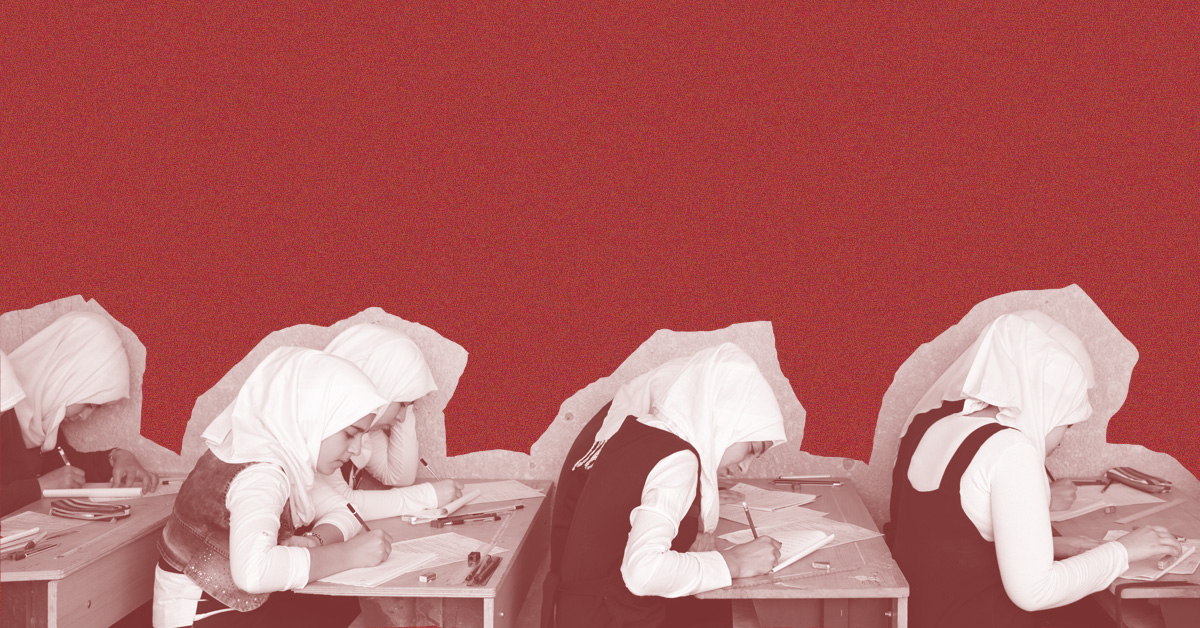
Refugee education is often framed in terms of access, infrastructure, and policy – but for children who grow up inside camps, meaningful learning begins long before they enter a classroom. It unfolds in everyday camp life: in caregiving roles, improvised survival strategies, and the small responsibilities that accelerate emotional maturity and practical skill. Imagination, resilience, and daily contribution form an “invisible curriculum” that shapes identity, agency, and social belonging, strengths that formal schooling in many crisis contexts can fail to acknowledge.
In this post, the first in our new series “Delivering for people in an evolving humanitarian landscape”, education specialist Sara Aleisseh draws on personal experience and years of professional work in humanitarian education to illustrate that the “invisible curriculum” carried by children in conflict settings is not a deficit to be corrected but a form of knowledge that demands recognition. She calls for education systems that listen to children’s realities, link learning content to those realities, protect their dignity, and build learning models rooted in healing, identity, and belonging.
For children raised in displacement, learning begins in narrow alleys where homes press against one another, in crowded rooms that share the same breath of uncertainty, and in households where parents sometimes never attended school. In these places, basic needs are not guaranteed. There are no parks, no public spaces, not even a library. So, we built our own worlds – imaginary ones big enough to hold our dreams.
We are not talking here about the “normal child” in international standards, measured against global developmental checklists. This child lives in stability; their needs – physical, emotional, and educational – are covered by a predictable system. Their main task is simply to grow.
In contrast, the “super child” of the camp is a child living an age older than the number on their birth certificate. They are not “super” by choice or because they are happier in their struggle; they are super because they have been forced to outrun their own childhood to support themselves, and often their environment, too. To ignore this is to ask them to leave behind the very strengths that kept them alive.
The two clocks of displacement
A child living in displacement carries two clocks. The first is the biological clock – the one that marks birthdays, grades, and height charts. The second is the lived clock – the one that counts responsibilities, losses, fears, and survival tasks.
Formal education systems typically read only the biological clock. Humanitarian programs often treat these children as “interrupted” learners who must be brought back to a standard starting point. But these children are not behind; they are differently prepared. They arrive at school with resilience, emotional intelligence, and lived knowledge that no curriculum could have taught them.
It is vital to understand that recognizing these hidden skills is not a glorification of poverty or conflict. We do not admire the hardship; we admire the human spirit that refused to be crushed by it. Their extraordinary abilities are the tools they forged to survive a reality no child should ever have to face.
The cardboard sanctuary
I grew up in a place where even the simplest needs of childhood were absent. I crafted my own Barbie from two crossed ice-lolly sticks, a bottle cap, and scraps of fabric, sewing her dresses with my own hands, and I built her a cardboard house with everything she needed – a reflection of the home I carried inside me, a million miles from my reality.
We made our footballs from packed socks and turned empty cans into cars. Looking back, I realized Barbie was not just a toy, she was my avatar, my way of imagining life beyond the walls around me.
But it was not just about playing; kindness was a way of living under those tough circumstances. We helped people with special needs, supported lonely elders, and helped shopkeepers with simple tasks. Those few earned coins gave us the dignity of choice, allowing us to buy juice and chips – luxuries our families simply could not afford. We were not just a community; we were like a big family, givers not because we had much, but because giving was how we survived together.
And without realizing it, as children, we were learning, practicing, and embodying deep life lessons. We did not read them in textbooks, we lived them in our daily acts of generosity, empathy, and resilience. Childhood itself became a hidden curriculum, full of wisdom that was not taught but was earned through living, sharing, and caring.
These were not just moments. They were lessons, the invisible curriculum of displacement – which shaped how we understood the world long before any classroom tried to teach us.
The living curriculum
The refugee camp is not merely a setting for living; it is the school itself, and the lived experiences, cultural practices, survival strategies, and emotional landscapes form a dynamic, teachable reality that becomes the curriculum. Education should not pull them away from this reality – it should recognize it, honor it, and learn from it.
The camp taught me more than any classroom ever could. It showed me that survival is a form of knowledge in a practical way, and that every person in the camp was a teacher we learned from.
Traditional schooling often creates artificial barriers between “learning” and “living,” turning students into passive recipients instead of active creators. But in the camp, learning and living were inseparable.
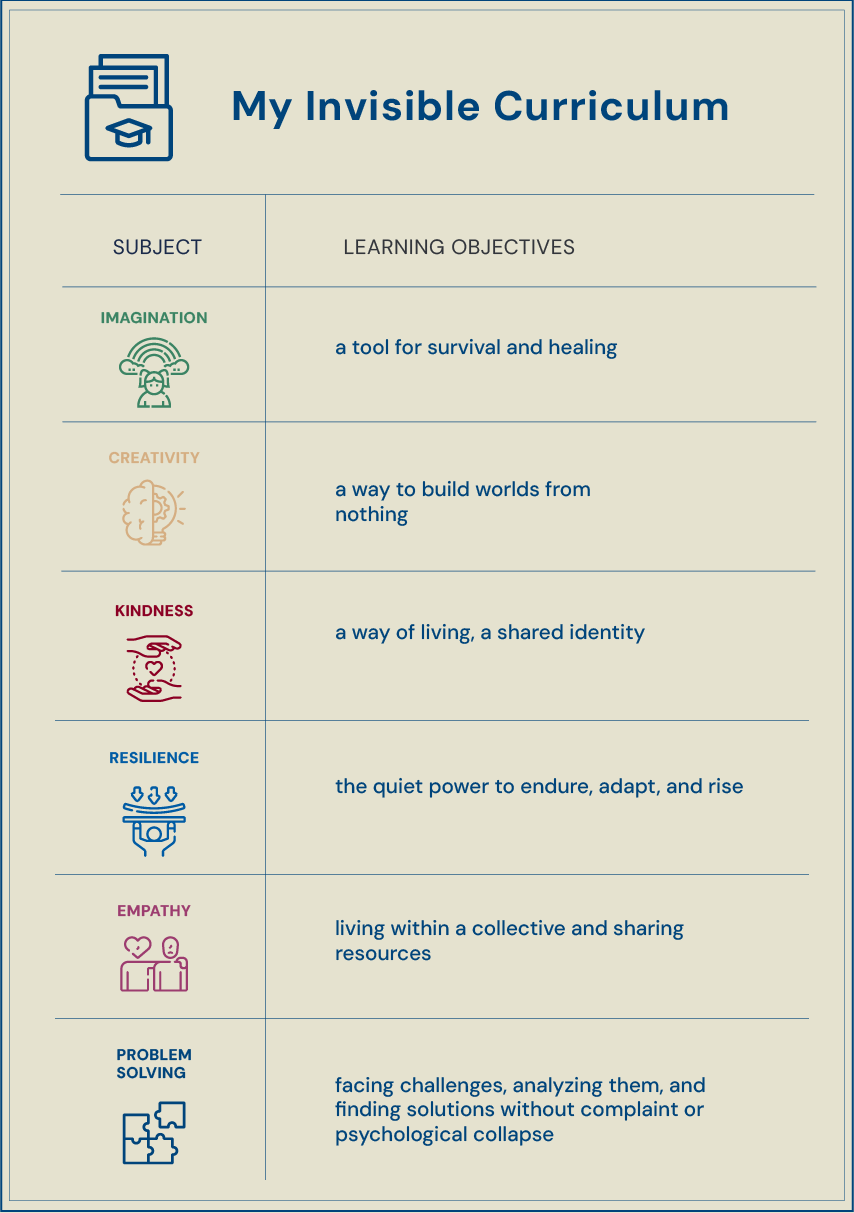
While school delivered its lessons, my invisible curriculum was blossoming beyond its walls – imagination born of necessity, creativity from nothing, kindness as a way of life, and resilience in every breath. And if analyze it now, I find we were practicing healing long before anyone called it “trauma informed”.
Protection through recognition: breaking the cycle of stigma
When we ignore what life tutors a child in the camp, we leave them vulnerable to a society that will only see what they lack. If we do not recognize the living curriculum they have already mastered, the label of “camp resident” becomes a shadow that follows them forever – a shorthand for being “less than”. When their resilience and the weight they carry are ignored by the systems around them, these children begin to feel that their true selves have no place in the “outside” world. The silence surrounding their hidden brilliance creates a wall, forcing them to choose between their truth and their survival.
So, to survive in society and be accepted in it, I became two people: the “persona girl” I showed the world, and the “camp girl shadow” I hid. When I attended secondary school, and later at university, I chose this path so I would not face classism and discrimination, because I knew how society would look at me and judge me.
This split was not my failure; it was the failure of a society that refuses to see the brilliance within the struggle. Most people look at the camp and see only passive creatures waiting for charity or beasts battling for their daily bread, pushing children to bury their true identity once they grow up and leave the camp just to be accepted and given a chance at life, never seeing the strength, intelligence, and leadership forged in its narrow alleys.
True protection begins with recognition. When we acknowledge the living curriculum within our classrooms and show the world that these children are unique, worthy, and capable, we break the cycle of shame that once forced me into silence. This is not an act of charity; it is an act of prevention. It ensures they grow into a future where their identity is a source of pride, not something to hide.
Conclusion
Of course, formal education should be better funded in crisis settings, and discriminatory attitudes towards refugee children need to be combatted at structural level (as UNICEF and UNHCR acknowledge in their Blueprint for Joint Action). Efforts to hold refugee education to inclusive and tailored standards – such as the INEE Minimum Standards – are sorely needed, alongside greater efforts to ensure that refugee, displaced, and migrant populations can access recognized and equitable formal and non-formal education through the national education system.
But above all, change must start with our recognition of these super children.
Refugee children are not empty vessels waiting to be filled. They arrive at school “full” – overflowing with stories, skills, burdens, and a brilliance that no standardized test can measure.
My call goes beyond the classroom and the humanitarian sector; it is a call to society at large and the global systems that govern our futures. Instead, we must read the “living curriculum” they carry.
Education then ceases to be a cage of conformity and becomes a bridge – one that connects lived experience to opportunity, survival to dignity, and childhood to hope.
And today, I ask myself:
What would I give little me if I could go back? Not just a desk or a textbook, but a space where my imagination was honored as true brilliance, where my caregiving was recognized as leadership, and where my survival was respected as the deepest form of scholarship. I would give myself the one thing I truly deserve: the right to be whole.
See also
- Geeta Mahapatra, Restoring education after armed conflict: an IHL-guided framework, March 26, 2026
- Michel Anglade, Mark Chapple, Elizabeth Rushing, Protecting education from attack during armed conflict, September 13, 2023
- Jerome Marston, Protecting education from non-state armed group attacks, September 12, 2023
- Laura K. Taylor, Alexandra Jacobs, Rebuilding peace in divided education systems, January 23, 2020
- Filipa Schmitz Guinote, Three reasons why education needs the support of humanitarian actors in conflict zones, December 12, 2019