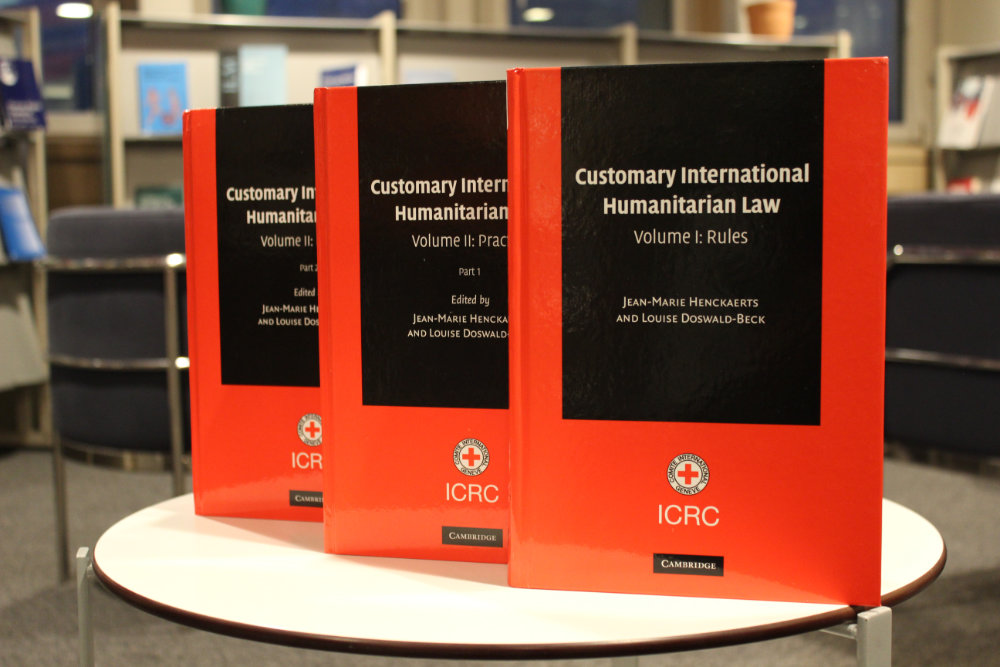
The ICRC’s 2005 study on customary international humanitarian law – along with the free, public database launched five years later – arrived at a moment when the legal landscape of armed conflict was rapidly shifting. Mandated by the 26th International Conference of the Red Cross and Red Crescent, the study set out to map the customary rules governing contemporary warfare by systematically analyzing global state practice and opinio juris. Twenty years on, with more than 130 armed conflicts active worldwide, reassessing the study’s methodological contributions, its evidence base, and its impact on the regulation of both international and non-international armed conflicts offers a timely lens on how customary IHL continues to underpin protections for people affected by war.
In this post, ICRC Legal Adviser Claudia Maritano and members of the British Red Cross-ICRC customary IHL research team reflect on how the study’s rigorous methodology, global scope, and identification of 161 customary rules helped clarify gaps left by treaties, especially in non-international armed conflicts, and strengthen the practical application of IHL.
In 2005, as the legal landscape of armed conflict was rapidly shifting, the ICRC released its study on customary international humanitarian law (the CIHL study or simply the study), the culmination of nearly a decade of painstaking research. The project had been set in motion almost ten years earlier, when the 26th International Conference of the Red Cross and Red Crescent[1] endorsed a recommendation to task the ICRC with identifying the customary rules of international humanitarian law applicable to international and non-international armed conflicts.
Twenty years on, and fifteen years after the study was made freely accessible through the online customary IHL database, where regular updates of state practice continue to be published, the moment feels right to take stock. What, exactly, have the study and the database contributed to the understanding, dissemination, and implementation of IHL? And how have they shaped the way practitioners, policymakers, and scholars engage with the law of armed conflict today?
Methodology matters: approaching the identification of customary IHL
The Statute of the International Court of Justice describes customary international law as “a general practice accepted as law.” When work on the study began, both elements –general practice and the accompanying sense of legal obligation, or opinio juris – had already generated extensive scholarly debate. The study’s authors had to confront these methodological questions head-on, developing criteria for selecting and including practice and determining when a customary rule could be said to exist.
They adopted the classic approach reflected in the Court’s jurisprudence, based on an inductive method that starts with the collection of state practice and opinio juris and then assesses both to see whether a customary rule has crystallized. This had two implications. First, any serious assessment of customary law required a painstaking global survey of practice and opinio juris – a task as demanding as it was essential (as discussed below). And second, customary rules could emerge in areas not covered by treaty law, or could regulate issues in ways that diverged slightly from their treaty-based counterparts.
The research team also had to grapple with a series of additional methodological questions. What, for instance, actually constitutes state practice – only what states do, or also what they say? And should certain states be considered as “specially affected,” and, if so, how should their practice be weighed? These and other issues, along with the broader methodological choices underpinning the study, are examined in detail in the study’s introduction and in subsequent publications by its authors (for instance, see here).
Discussions over how to identify customary law have continued in the years since. Although the study’s answers to the various methodological questions have been, and still are, subject to scrutiny and occasional criticism, its systematic engagement with those questions remains a significant contribution to the broader conversation on how customary law should be discerned.
Building a global record of practice and opinio juris
The study’s inductive approach required an extensive, meticulous effort to collect and assess state practice and opinio juris from countries around the world. This breadth was not optional: the ICJ Statute’s requirement that practice be “general” meant that only a truly global survey could provide a reliable basis for identifying customary IHL.
To give a sense of scale, nearly fifty countries (nine in Africa, fifteen in Asia, eleven in Europe, eleven in the Americas and one in Australasia) were selected for in-depth research by national researchers, who submitted detailed reports to the authors in Geneva. For countries not covered by these reports, military manuals and national legislation were gathered with the help of ICRC delegations worldwide. State practice that could be gleaned from international sources was further collected, and the team conducted further research in the ICRC archives on nearly forty armed conflicts – about twenty in Africa, eight in Asia, eight in Europe and two in the Americas – to fill remaining gaps.
The result was a study grounded in practice from every region, reflecting diverse legal traditions and systems. This expansive evidence base, published alongside the study itself, enabled the authors to draw their conclusions from a comprehensive body of material. Representing states from across the world – and managing the sheer scope of this undertaking – was a significant achievement in its own right.
The effort to ensure this broad and representative geographical reach continues today through the work of the British Red Cross/ICRC Customary IHL project, which updates state practice section of the CIHL database (see below for more details). Working with ICRC delegations, National Red Cross and Red Crescent Societies, and state bodies, the project gathers practice from around the world and makes it regularly available on the online database.
Ongoing relevance: the study’s impact on the regulation of contemporary armed conflicts
The study’s most significant contribution lies in clarifying existing rules of customary IHL governing contemporary armed conflicts.
This was the project’s central purpose from the outset, and its importance is no less urgent today than it was thirty years ago, when the International Conference endorsed the recommendation to task the ICRC to undertake the work. Despite the existence of numerous treaties regulating the conduct of hostilities and protecting individuals in wartime, customary IHL remains indispensable – for the same two main reasons that prompted the study in the first place.
First, treaties bind only those states that have ratified them. While the 1949 Geneva Conventions enjoy universal ratification, other IHL instruments, such as the 1977 Additional Protocols and several humanitarian disarmament treaties, do not and thus apply far more unevenly. Second, although treaty law is extensive in regulating international armed conflicts (IACs), non-international armed conflicts (NIACs) continue to be governed by a comparatively sparser, albeit essential, set of treaty rules.
The study ultimately identified 161 rules of customary IHL. Of these, 135 were found to apply in both international and non-international armed conflicts. Thirteen applied only to IACs, and two only to NIACs. Three rules addressed the same matter but their content differed depending on the type of conflict. Finally, eight rules were deemed applicable in IACs and “arguably” in NIACs, where practice generally pointed in that direction but was less extensive. This last category underscores the study’s transparency and its commitment to presenting an accurate snapshot of customary IHL as it stood.
The study’s most unequivocal achievement was to demonstrate that, on the basis of state practice and opinio juris, customary law fills several of the gaps left by treaty law. The significance of this is hard to overstate. Customary IHL, for example, governs the conduct of hostilities, providing a set of rules applicable even to states engaged in IACs that have not ratified Additional Protocol I. The study also showed that customary norms play a particularly important role in NIACs: state practice and opinio juris have generated a substantial body of customary rules that go beyond existing treaty provisions, thereby addressing some of the most consequential gaps in NIAC regulation.
From study to living resource: the ongoing project to update the practice section of the customary IHL database
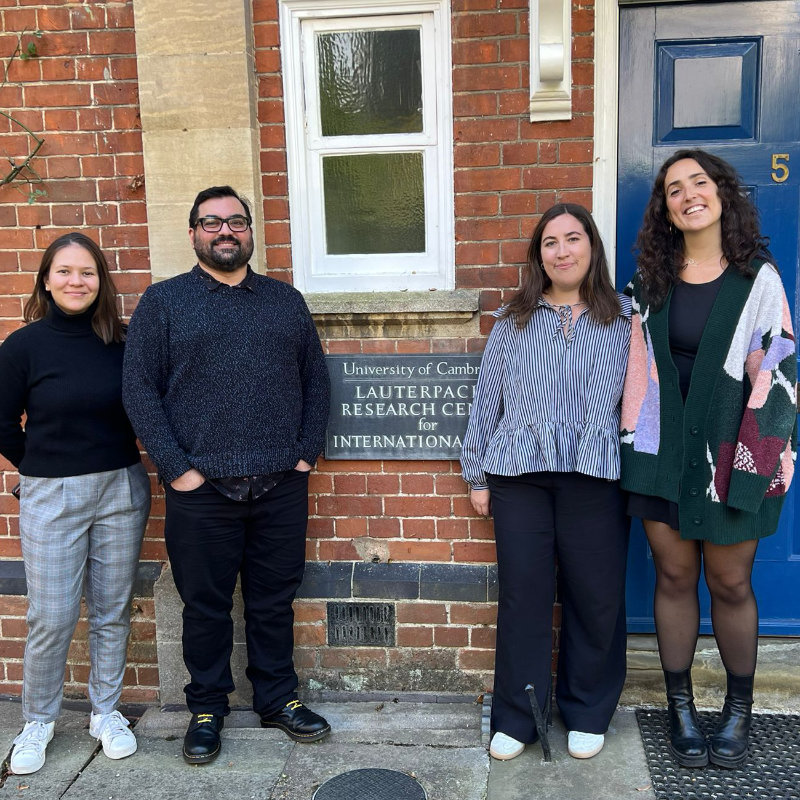
The publication of the study in 2005 was a major milestone for the ICRC. But it quickly became clear that state practice would continue to evolve, offering fresh insight into how they understand and implement their IHL obligations. In response, the ICRC joined forces with the British Red Cross in 2007 to create the Customary IHL Project, based at the Lauterpacht Centre for International Law of the University of Cambridge. This project updates the practice section of the CIHL database, ensuring that it remains up-to-date, accurate, extensive and geographically diverse, and freely accessible online.
To this end, the research team reviews military manuals, national legislation, case law and other types of state practice from around the world. Today, the customary IHL database is regularly updated with new state practice relating to the existence, scope and interpretation of the 161 rules of customary IHL identified by the study.
The ongoing updates to the state practice section already offer valuable insight into how states interpret and implement their IHL obligations. As the database grows, it will also help users see how the rules identified in 2005 apply and regulate new questions – particularly those emerging from rapidly evolving technologies of warfare. This underscores the enduring relevance of the 2005 rules: in a world where technological change outpaces legal development, and where new binding norms are needed for certain domains, customary IHL remains an essential source of guidance.
Customary IHL at 20: a living framework for protection
With more than 130 armed conflicts tearing through communities in 2025, international humanitarian law remains indispensable for preserving a minimum of humanity in war. Respect for IHL depends on many factors – above all, political will – but none of these can function without a clear understanding of what the law requires. By clarifying the customary rules that apply across armed conflicts, the CIHL study helped reduce uncertainty and equipped all those responsible for applying, disseminating, and enforcing IHL with a more solid foundation.
That, twenty years after its publication and fifteen years after its online release, the study and the CIHL database have become routine points of reference for practitioners, academics, students, and international bodies speaks to their lasting influence. Both the rules and the accompanying practice are cited widely (see for example here and here respectively), a testament to the study’s central role in strengthening knowledge of IHL, and, ultimately, in supporting better respect for the protections it enshrines.
References
[1] The International Conference of the Red Cross and Red Crescent is the highest deliberative body of the International Red Cross and Red Crescent Movement, bringing together the Movement’s main components (the International Committee of the Red Cross, the International Federation of Red Cross and Red Crescent Societies, and all recognized National Societies) alongside all states party to the 1949 Geneva Conventions.
See also:
- Ellen Policinski, Complying with IHL in large-scale conflicts: How should states prepare to allow and facilitate delivery of humanitarian relief?, December 4, 2025
- Cordula Droege, War and what we make of the law, July 18, 2024
- Olivier Ray, Principles under pressure: have humanitarian principles really stood the test of time?, July 11, 2024
- 2020 British Red Cross-ICRC customary IHL research team, August 12th: hopes and wishes?, August 12, 2020