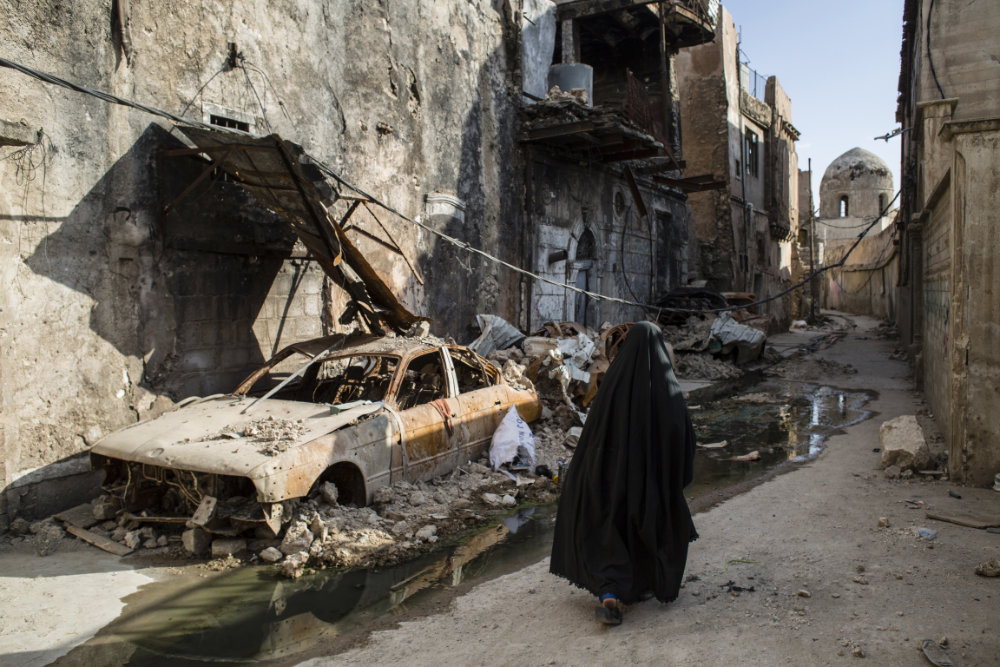
More than 200 million people live today in contested territories – places where the authority of the state is challenged outright and armed groups exercise full or fluid control. This number has risen by 30 million since 2021. These are not distant statistics; each figure represents a person living in the shadow of competing powers, making difficult choices in an almost impossible environment.
How do people navigate the presence of multiple, often competing, armed actors? Is dignity found in defiance, or safety in uneasy compliance? How do families secure food, water or medical care when neither the state nor armed groups are able or willing to provide basic services? And, crucially, what can humanitarian actors do to better protect and assist those caught in these fractured landscapes?
In this post, and drawing on recently published research in Cameroon, Iraq and the Philippines, Arjun Claire, Senior Policy Adviser at the ICRC, and Matthew Bamber-Zryd, the ICRC’s Adviser on Armed Groups, offer five insights to help strengthen humanitarian responses in contested territories – insights rooted in the lived realities of the people who navigate them every day.
“Running away from fire, running into water”.
That is how a village chief in Cameroon’s north-west region described life in areas contested by armed groups. In such places, even as people take steps to evade immediate danger, they must weigh the new threats those very steps might unleash. Every decision requires caution; every movement is a negotiation to avoid falling afoul of one side or the other.
These are molten spaces, seething and settling by turns, where safety and stability is found – if at all – in the constant search for firmer ground.
In our conversations with communities living in these areas, one word surfaced again and again: fear. Fear of being caught in clashes; fear of going back home; fear of being branded a collaborator. People described a landscape of threats that ranged from targeted attacks and kidnapping for ransom to extortion, sexual violence, and the forced expropriation of their land.
When we began this research, we set out to understand how people negotiate everyday life with armed groups, as a basis for strengthening humanitarian responses. What emerged was far more complex. Armed groups are only one among a constellation of threats. Safety is not a matter of navigating a single relationship, but of moving carefully among multiple armed actors – including state armed forces – alongside a dizzying number of armed groups.
For this reason, we have chosen to describe these areas as “contested territories”, to underscore the competing nature of control, authority and influence that armed actors exercise.
The service collapse
In these contested areas, neither the state nor armed groups reliably provide essential services. Less than 20 percent of armed groups provide healthcare or education. More critically, almost no one provides civil documentation. When neither the state nor armed groups register births and deaths, people lose the ability to prove who they are. They cannot move freely. They cannot access schools or clinics. They cannot later claim inheritance or prove kinship.
One woman we met in Iraq spent years unable to obtain a birth certificate for her children – children born during the Islamic State group’s rule – because documentation had to be registered in her husband’s name, and he was missing.
Service collapse is not incidental. Schools are shut down by armed groups seeking to undermine state authority or abandoned because teachers have fled. Health facilities are attacked. Water systems deteriorate without maintenance. People resort to expensive private vendors or contaminated sources. Trade blockages and sanctions restrictions push economies underground. What emerges is a landscape where survival depends on personal resources, social networks, and luck.
Humanitarian responses, too, have fallen short of the scale of needs in contested territories. Evaluation after evaluation shows that responses tend to cluster in government-held areas, precisely where needs are often less acute. Why? Because policy and operational discussions tend to be dominated by access and security challenges, steering the conversation toward what is possible rather than what is necessary. We need to reverse that logic. The determination to meet people’s actual needs must be our starting point.
Five insights for humanitarian response
Let us be clear: states are responsible for protecting civilians living in their territory, including those in contested areas where possible. Non-state armed groups also have obligations under international humanitarian law to protect and facilitate people’s access to essential services. To enable this, states and non-state armed groups must allow impartial humanitarian actors to sustain rapid and unimpeded operations and must facilitate such operations, including by ensuring respect for and protection of humanitarian personnel.
But beyond these calls to states and non-state armed groups, our focus is on how to strengthen the humanitarian response in contested areas. We need a clearer understanding of how people cope and adapt as essential services steadily erode, even as violence presses ever closer into the routines of their everyday lives.
Our research offers five insights that can reshape how humanitarian actors approach contested territories.
1. Shifting community dynamics
Humanitarian actors know that communities matter. What we often miss is how the onset of armed contestation scrambles community leadership. As territorial control fluctuates – sometimes daily – power relations among communities constantly shift. Traditional hierarchies are upended. New leaders emerge from unexpected places.
As both armed groups and state armed forces seek to mobilize communities on their side, identity often becomes a lightning rod around which conflict plays out, heightening inter-community tensions.
In anglophone Cameroon, we found that some village chiefs and elders had lost influence, seen as too aligned with the state or pursuing self-interest. Meanwhile, other people quietly accumulated influence: a woman who ran a savings group for displaced families; a former schoolteacher who had taught members of armed groups years earlier and maintained their respect; a religious leader trusted by both communities. These informal leaders sometimes wield more influence than official ones.
Yet we often conduct conflict analysis once, at the start of engagement, then treat it as fixed. We identify key informants and community leaders, then maintain those relationships unchanged for years. We focus mostly on examining armed groups and the wider political context, but often struggle to grasp changing social dynamics at the level of communities.
We need to account for these shifts. Conflict analysis should be a continuous process and must incorporate a deeper understanding of inter- and intra-community relations. This is vital to unlocking access, managing security risks, and providing impartial responses.
2. Political economy of contested territories
Armed actors – from the state to armed groups – do not simply wage war. They structure economic life. They control markets, tax traders, regulate agricultural production, manage utilities. Understanding who benefits economically from the current arrangements – and who loses – is essential to understanding conflict dynamics and where humanitarians might engage.
The political economy – the interaction of power, society and markets – shapes the interests and motivations of all armed actors, which in turn deeply impact people’s daily lives.
How do armed groups relate to different communities and identity groups? Do they favour one community over another? How do they generate revenue? Who controls economic activity in contested territories and what is their relationship with armed actors? How is land ownership and use affected? These are but a few questions that can shed light on how power is exercised and where resources flow.
This is all the more critical in contested territories, where armed actors meticulously exploit identity-based grievances and weak regulations, distorting both social harmony and markets.
When humanitarian actors ignore political economy, they inadvertently cause harm. Livelihood programs may reinforce the economic coercion faced by farmers already controlled by armed groups, or programmes may benefit one community while excluding another, exacerbating tensions.
3. Armed groups as governance actors
If we view armed groups solely through the lens of violence, we fail to see the many ways in which armed groups and communities influence each other. We see armed groups as purely violent actors. This misses something crucial: most armed groups exercise some form of governance – whether bureaucratic and stable, chaotic and extractive, or deliberately disruptive.
This awareness helps identify which individuals or groups might be most at risk. When the Islamic State group held parts of northern Iraq, it ran a complex administrative apparatus, controlling various economic aspects including agricultural production in the region, but restricted food supplies for minority groups. Women reported difficulties in accessing health care, as they could not travel to health centres without a male companion; and access to sexual and reproductive health was badly affected.
Understanding governance types reveals which communities are most vulnerable, which individuals hold real influence, and what negotiating points humanitarians possess. This shapes engagement strategy fundamentally.
4. Overcoming mistrust
Where fear is ubiquitous, mistrust is contagious. Trust, as a result, is a major casualty of contested territories. In our research, people often spoke of how surveillance works its way within communities.
“There are trust issues in the community,” said one woman in north-west Cameroon. “If people are jealous of you, they can report you. This is happening now in the community. There are many informants.”
When people start to be wary of neighbours, it is unlikely they will trust humanitarian actors, especially if they are new to their communities. Yet developing trust – or at the least, gaining acceptance – with communities and warring parties is the foundation of strong and impartial humanitarian responses. The only way to do so is to engage. Such barriers to direct engagement as overly cautious security rules, which prevent direct contact with communities and armed groups, are likely to reinforce mistrust of humanitarian actors.
Sometimes these barriers are a function of external constraints. This includes domestic and international counter-terrorism legislation, as well as other state-imposed restrictions. Overcoming them requires concerted efforts, such as in the Philippines, where the ICRC and the Philippines Red Cross successfully negotiated exemptions in the domestic counter-terrorism law.
5. Supporting community initiatives
Communities do not wait for humanitarians. They create savings groups to pool resources. They form early warning networks to detect approaching violence. They establish dialogue committees to negotiate with armed actors. They create self-defense groups to protect vulnerable members.
We found that communities that were able to maintain or create collective action consistently achieved better safety outcomes. Communities, however, often need help in sustaining these initiatives. Where such initiatives exist, humanitarian actors must strive to support them. This implies understanding the various ways in which communities are coping and adapting.
Humanitarian actors tend to approach communities mostly through formal community structures, for example village elders or community leaders. These community structures, however, do not always reflect the diversity of their communities, resulting sometimes in the marginalization of minority and women voices. Engaging only with customary and traditional leaders, therefore, means humanitarian actors can miss other important ways of supporting communities.
In Bamenda, north-west Cameroon, women living in a violence-prone locality, many of them the sole breadwinner in their family, had come together to form a savings group. They said they received food from a humanitarian organization for three months, but it stopped after volunteers from the organization were harassed by armed groups while registering people. In this case, supporting the already existing savings group might have been more sustainable and less demanding logistically, while addressing the needs of a particularly vulnerable group.
These are the capacities humanitarian actors must recognize, support and amplify.
By strengthening community-based protection and service mechanisms, humanitarians create resilience that outlasts their presence.
Renewed commitment to support people in contested territories
Supporting people in contested territories is an urgent policy and operational priority.
Across all three contexts where we conducted our research, few people were able – or willing – to leave contested areas altogether. Even those who moved away because of violence preferred staying close to their homes and land, hoping to return when the situation calmed. Others simply lacked the resources or connections to move further away.
To address the needs of those unable to leave – and who are often most affected by violence – humanitarian actors must find ways to sustain their presence in contested territories. We must move away from transactional approaches that rely on periodic deliveries of assistance, to a committed and deliberate approach, that seeks to improve the protective environment for people in these places.
The humanitarian system, already grappling with crises of trust and legitimacy, must reaffirm its commitment to those at the farthest edge of violence and precarity.
People navigating contested territories have long shown remarkable resolve and ingenuity. It is time for humanitarian actors to demonstrate the same.
See also:
- Matthew Bamber-Zyrd, ICRC engagement with armed groups in 2025, October 30, 2025
- Ruben Stewart, The shifting battlefield: technology, tactics, and the risk of blurring lines in warfare, May 22, 2025