
Restrictions on movement and access to medical supplies have become an often-unseen threat to health care in today’s armed conflicts. Even where hospitals are not attacked, the quiet tightening of supply routes can deprive them of the medicines, equipment, and basic services they need to function.
In this post, ICRC Legal Advisers Supriya Rao and Alexander Breitegger outline what the obligation to protect medical facilities means in practice, from allowing the passage of medical consignments to enabling essential services like power and water. They also describe how concerns about dual-use risks must be balanced against humanitarian needs, and highlight ongoing work under the Global IHL Initiative to identify good practices that help keep hospitals operating even in the most difficult conditions.
The fighting intensifies. Roads that once carried families, traders, humanitarian personnel, and ambulances fall silent, blocked off except for a handful of main arteries now fractured by successive military checkpoints. At each stop, soldiers scrutinize vehicles and cargo; medical supplies are slowed to a crawl or turned back entirely. An x-ray machine, officials say, could be repurposed for military use. The pillars needed to erect a temporary field clinic might be diverted to fortify a position. One by one, items essential to health are recast as potential security threats.
Weeks pass, then months. Inside hospitals and vaccination centers, stockrooms grow emptier. Vials disappear first, then syringes, then the medicines needed for diagnosis, treatment, and surgery. Vaccination campaigns sputter out. Entire wards shut down – not because they were hit, but because they have simply run out of what they need to function.
This is a scenario that recurs with unsettling regularity in contemporary conflicts. Unlike direct attacks on health care that leave shattered buildings and vivid images, the quiet throttling of medical supply chains often unfolds out of sight. Yet its impact can be just as devastating: a slow, suffocating pressure that compromises medical services, weakens entire health systems, and places civilian lives at risk all the same.
The central legal and operational questions are these: Do IHL rules that grant specific protection to medical facilities also imply a broader obligation to ensure they receive adequate supplies? And if they do, what practical measures are parties to the conflict required to take to comply with this obligation? Closely linked with this is the question of how IHL and related legal frameworks regulate access to the various resources that are important for a properly functioning health care system during conflict: medical supplies and equipment, vital resources such as electricity, fuel and water, and other materials needed to set up or repair medical units.
The obligation to protect medical facilities
Under IHL, hospitals and other medical facilities – whether military or civilian – are granted one of the highest levels of protection, known as specific protection. This elevated protection benefits a wide range of medical facilities, such as units organized for the collection, transport, diagnosis, and treatment of wounded and sick, whether military or civilian, or the prevention of disease. They can include hospitals, blood transfusion centres and preventive medicine centres – whether they are fixed or mobile, permanent or temporary in nature.[1]
Under the specific protection regime, parties to armed conflict are obligated “to respect and protect hospitals and other medical facilities at all times.” To respect requires belligerents not only to avoid attacking medical facilities, but also to refrain from other military interferences with their medical functions and misusing them for military purposes. To protect requires belligerents to take positive measures, including all feasible measures depending on the circumstances to facilitate the functioning of medical establishments and protect them from harm, such as looting by third parties.[2]
The obligation to protect means that a party must actively help to ensure the delivery of medical supplies and vital resources such as electricity, fuel or water, and must not impede medical personnel from accessing hospitals.[3] The ICRC updated Commentaries explain that the practical implementation of this obligation depends on a party’s capacity to implement and the prevailing security situation.[4] In situations of occupation, the obligation to facilitate the flow of medical supplies finds specific expression in the obligation of the occupying power to ensure food and medical supplies essential to the survival of the civilian population as well as ensure and maintain hospitals and medical services in occupied territory.[5] This has been interpreted to mean that the occupying power is under a positive obligation to ensure essential supplies to the local population and it is also under a negative obligation not to impede the provision of supplies or public health services.[6]
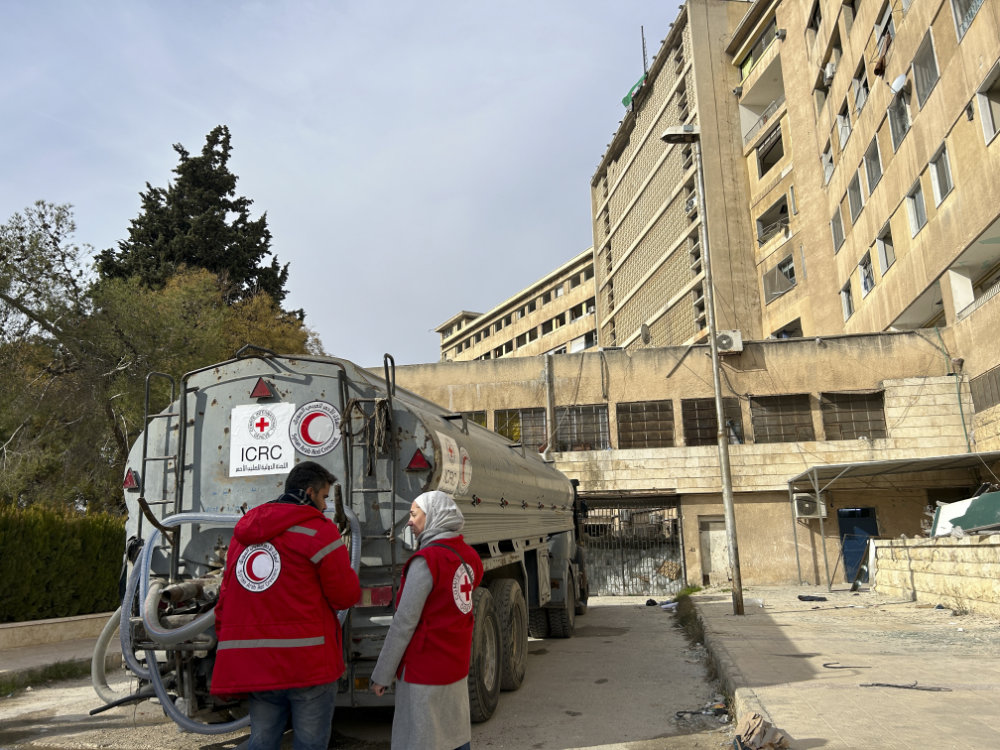
Based on this, belligerents are required to take all feasible measures to support the functioning of medical facilities and to actively assist in ensuring they receive medical supplies and vital resources to deliver on their humanitarian function. In practice, this means parties must take all feasible measures to allow the passage of medical consignments, fuel to power hospital generators and all other materials necessary for the functioning of medical facilities.
Conversely, measures that have the purpose or effect of depriving a medical facility of vital resources would be inconsistent with the obligation to protect medical facilities. Depending on the circumstances, measures taken pursuant to the obligation to protect medical facilities in areas under the party’s control could involve repairing water or power lines serving a medical facility when these services are disrupted during a conflict. Of course, the extent of efforts made will inevitably be influenced by battlefield conditions, including the capacity of the party and the prevailing security situation. While this can result in reasonable delays, it should not be transformed into a justification that rules out implementation. Such a result would be inconsistent with the humanitarian object and purpose of the rules, which is to collect and care for the wounded and sick by enabling hospitals to function.
Access to medical supplies, vital resources and other materials
With regard to IHL rules on access to medical supplies, vital resources and other materials, it is worth recalling that proper functioning of a hospital depends on a number of resources which, for the sake of simplicity, can be grouped into three main categories:
First, medical supplies, which is broadly interpreted to cover any equipment or supplies necessary for medical care, including pharmaceutical products for preventative or therapeutic purposes, including vaccines, materials for blood transfusion and treatment for survivors of sexual violence; medical devices including medical, dental or surgical instruments; but also heavier equipment for an operating theatre, including spare parts. [7]
Second, vital resources that make possible the supply of essential services for the functioning of medical facilities, for example fuel for generators as well as for the functioning of intensive care units and incubators for newborn babies.[8]
And third, other materials that are necessary to establish or repair fixed or mobile medical facilities, for example pillars for setting up a field hospital.
Under IHL, providing access to medical supplies directly used for the prevention, diagnosis or treatment of diseases and injuries is uncontroversial. IHL requires that medical care must be made available to all wounded and sick persons, whether they are civilian or military. Therefore, no restrictions can be placed on access to such medical supplies with the justification that they could also benefit enemy wounded and sick. This is consistent with the overarching obligation to collect and care for the wounded and sick no matter to which side of the conflict they belong.[9] Limiting access to medical supplies also raises questions about compliance with the specific protection obligation to respect medical facilities. This is because obstructing supplies may amount to an interference with a medical facility’s function of treating the wounded and the sick.
Turning to vital resources and other materials necessary to establish or repair medical facilities, allowing access can also be read into the obligation to protect medical facilities.[10] Lastly, since health services are a basic need of the population, access to medical supplies and vital resources is implied in the obligation of each party to the conflict to meet the basic needs of a population under its control.[11] If the basic needs of civilians are unmet then impartial humanitarian organizations can undertake relief activities to deliver essential supplies including medical supplies subject to the consent of the parties concerned.[12] For the purpose of such relief schemes, “essential supplies” has been interpreted to include medical supplies.[13]
It is widely accepted that states’ obligations under international human rights law (IHRL) continue to apply in times of armed conflict. Thus, both IHL and IHRL complement each other in protecting access to and delivery of health care in times of armed conflict. Under IHRL, Article 12 of the International Covenant on Economic Social and Cultural Rights (ICESCR) recognizes the right of everyone to the highest attainable standard of health without discrimination. The right to health, as explained in the General Comment 14 (2000) of the UN Committee of Economic, Social and Cultural Rights, imposes three levels of obligations on States Parties to the International Covenant on Economic, Social and Cultural Rights: to respect, protect and fulfill. [14] In this regard, respecting the right to health has been interpreted as requiring states to refrain from interfering directly or indirectly with the enjoyment of this right.[15] Respecting the right to health has also been interpreted to include an obligation to refrain from arbitrarily denying or limiting access to health services as a punitive measure against political opponents.[16]
The obligation to fulfill the right to health has been interpreted to include an obligation to ensure the provision of a sufficient number of hospitals, clinics and other health-related facilities and to take positive measures that enable and assist individuals and communities to enjoy the right to health.[17] While the ICESCR obliges each state to take necessary steps to the maximum of its available resources to comply with its obligations, the right to health is interpreted to contain minimum core obligations that are considered non-derogable.[18] These include the right of access to health facilities, goods and services on a non-discriminatory basis and to provide essential drugs as defined under the WHO Action Programme on Essential Drugs, and to ensure equitable distribution of all health facilities, goods and services.[19] Under IHRL, preventing access to medical supplies, vital resources or other materials necessary for medical facilities would be considered an interference incompatible with the obligation to respect and fulfill the right to health and would be at odds with the non-derogable nature of minimum core obligations under the right to health, which is closely interrelated with the right to life.
While the law is clear in favouring access for all materials necessary for the functioning of hospitals, in practice, concerns that such materials may also be diverted to military purposes outside of humanitarian functions – sometimes referred to as “dual use” – present complex challenges to the application of these rules. As for medical supplies, purporting to justify a denial of access to such supplies based on the risk of their simultaneous use for military purposes would be inconsistent with the IHL obligation to care for the wounded and sick, whether civilian or military and whether friend or foe. Thus, essential medical supplies to treat the priority health needs of the wounded and sick must be identified and free passage of such supplies must be permitted, subject to a party’s control, as they are indispensable to the proper functioning of health facilities.
At the same time, a blanket prohibition on medical supplies, vital resources and other items necessary to establish or repair medical facilities based on concerns that they could be used for military purposes must be avoided, given the obligation to protect medical facilities and the humanitarian consequences at stake. The risk of diversion for military use may be effectively addressed or at least mitigated by adopting due diligence measures. For example, the distinctive emblem, which is designed to facilitate identification of specifically protected medical objects, including medical supplies and equipment, may be used to visually identify that these items are intended for exclusively medical purposes, thereby distinguishing them from other objects which could also be used for military purposes.[20]
The Global IHL Initiative’s work on the protection of medical facilities
The second round of the Global IHL Initiative’s state and expert meetings on achieving meaningful protection for hospitals in armed conflict will address, among other issues, the issue of facilitating the functioning of medical facilities. The overall aim of this workstream is to engage states and experts to ensure that existing IHL rules granting specific protection to medical facilities are better known and understood, and are applied in a way that upholds their humanitarian purpose and protective intent. The objective of the state consultation is to collect good practices on improving respect for IHL rules protecting medical facilities, which will feed into the development of practical recommendations that will form the key outcome of this process.
Good practices collected from the first round of state consultation related to facilitating the functioning of medical facilities include: establishing a coordination platform with health-care authorities to understand supply routes for medical supplies; identifying available alternative resupply routes; and mapping out essential services such as water and electricity systems so that military operations do not undermine the public health system and thereby compromise protections owed to the wounded and sick.
We hope to further engage on these and other issues with states during the second state consultation, which will be held in December 2025, and arrive at solutions that respond to the complex operational challenges presented. It is hoped that these collective efforts will bring us a step closer to preserving the functioning of hospitals, even in the darkest moments of armed conflict, so they continue to serve as lifelines for the wounded and sick in accordance with the letter and spirit of the Geneva Conventions.
References
[1] Additional Protocol I (1977) (“AP I”), Art. 8(e); ICRC Customary IHL Database, Rule 28 (2005).
[2] ICRC Updated Commentary (2016) to Geneva Convention I (“GC I”), Art. 19 paras. 1792-1808; ICRC Updated Commentary (2025) to Geneva Convention IV (“GC IV”), Art. 18 paras 1792-1803; AP I, Art. 12; Additional Protocol II (1977) (“AP II”) Art. 11; ICRC Customary IHL Database, Rule 28.
[3] ICRC Updated Commentary (2016) to GC I, Art. 19 para. 1807; ICRC Updated Commentary (2025) to GC IV, Art. 18 para. 1802.
[4] ICRC Updated Commentary (2016) to GC I, Art. 19 para. 1805; ICRC Updated Commentary (2025) to GC IV, Art. 18 para. 1800.
[5] GC IV, Arts. 55 and 56; AP I, Arts. 14(1) and 69.
[6] Obligations of Israel in relation to the presence and activities of the UN, other int’l orgs. and third states in and in relation to the occupied Palestinian Territory, Advisory Opinion, ¶ 132 (ICJ Oct. 2025).
[7] See ICRC Updated Commentary (2025) to GC IV, Art. 23 para. 22 and Art. 55 para. 3452; ICRC Commentary (1987) to AP I, Art. 8 para. 382 and Art. 14(2) para. 587; Also see, WHO, Methodology paper: Surveillance System for Attacks on Health Care defines health care supplies as any material or equipment that is used for curative or preventive health care. This includes medicines, vaccines, diagnostic equipment, administration documents and equipment, health care facility equipment. This list is not exhaustive (WHO/WHE/EMO/2019.2/BRO December 2018).
[8] Obligations of Israel, ICJ ¶ 96.
[9] Common Art. 3(1)(1); GC I, Arts. 12, and 15(1); GC II, Arts. 12 and 18; GC IV, Art. 16; AP I, Art. 10; AP II, Arts. 7 and 8; ICRC CIHL Database Rules 109 – 111.
[10] ICRC Updated commentary (2025) to GC IV, Art. 18 para. 1802.
[11] Derived from general international law, a number of IHL rules in particular the humane treatment obligation under Common Art. 3, and human rights obligations of states.
[12] AP I, Art. 70, ICRC CIHL Database, Rule 55.
[13] Obligations of Israel, ICJ ¶ 93.
[14] General Comment 14 (2000) on the highest attainable standards of health issued by the Committee of Economic, Social and Cultural Rights; Maastricht Guidelines on Violations of Economic Social and Cultural Rights (1997) issued as UN Doc. E/C.12/2000/13), para. 6.
[15] General Comment No. 14(2000) paras. 33-34, 48 and 50.
[19] Id. at 43 (a), (d) and (e).
[20] For the use of the protective emblem on military medical supplies see ICRC Updated commentary (2016) to GC I, Art. 39, paras. 2576 and 2577; for emblem use on civilian medical supplies see ICRC, Study on the use of the emblems: Operational and Commercial and other non-operational issues pp. 80-81 (2011) which notes the broad definition of medical supplies and equipment and recommends that civilian medical supplies and equipment are entitled to bear the emblem as a protective device.
See also:
- Supriya Rao and Alex Breitegger, Reaffirming IHL’s specific protection of hospitals, May 27, 2025
- Khang Phan and Thao Nguyen, Hospitals under fire: legal and practical challenges to strengthened protection, March 6, 2025
- Marnie Lloydd, Caroline Baudot, Peter Herby, and Tobias Ehret, Protecting essential service personnel is a vital part of humanitarian action, October 10, 2024