More than seven decades after their adoption, the four Geneva Conventions of 1949 remain foundational to contemporary international humanitarian law (IHL). Efforts to update their Commentaries testify to both the resilience of the Geneva Conventions and their enduring relevance in modern armed conflicts. Yet the story of their making is inseparable from the longer history of the law of armed conflict, which developed in the late nineteenth century within a deeply hierarchical international legal order. From the perspective of colonized states and territories, that history reveals a persistent divide between European and non-European worlds, a divide that shaped not only general international law but also key features of the Geneva Conventions themselves.
In this post, part of a joint symposium on the updated Commentary on the Fourth Geneva Convention with EJIL:Talk! and Just Security, Associate Professor Srinivas Burra revisits the adoption of the 1949 Geneva Conventions against the backdrop of the Second World War, the creation of the United Nations, and the onset of decolonization. Focusing on the Fourth Convention’s regime of occupation and on Common Article 3, he examines these developments from a Third World Approaches to International Law (TWAIL) perspective, accounting for the structural legacies of empire in international law. He argues that while these provisions marked important advances, they also carried forward earlier exclusions embedded in colonial conceptions of sovereignty. Read in this light, the Conventions represent both a decisive break in humanitarian protection and a continuation of hierarchies inherited from the nineteenth century.
The historical evolution of the laws of armed conflict has not differed from that of international law more generally, reinforcing the binary of civilized and uncivilized and the hierarchical relationship between the European powers and colonial territories. This manifested at two different levels. At substantive level, laws of armed conflict reflected general international law’s denial of equal status to non-European colonial territories. At another level, the development of the laws of armed conflict was primarily a response to the needs and experiences of European states, ignoring the concerns of others.
Law of occupation, colonial exclusion, and the limits of humanitarian protection
The law of occupation emerged in the mid-19th century within a broader European political and legal context. Its central premise was that military defeat in an armed conflict did not automatically result in the annexation of a state’s territory and the consequent alteration of its sovereignty. Until that time, annexation through conquest had been an acceptable practice in Europe. Gradually, however, political and ideological developments shifted toward preserving the geopolitical status quo despite armed conflict. Territory would therefore be occupied rather than annexed at the end of hostilities and any change in the status of the occupied territory would be subject to further processes. This shift reflected a broader consensus among European powers to maintain the stability of sovereignty and territorial borders.
This consensus, however, was clearly intended to govern intra-European interstate relations. It cannot be understood in isolation from developments beyond Europe, particularly in the territories connected to European powers. Although these legal developments arose within a specifically European framework of international law, they were articulated in universal terms and claimed applicability far beyond Europe.
This tension is particularly evident in the relationship between European powers and their colonies. While the emerging law of occupation applied between European states, colonial territories were effectively excluded from its scope. When the Hague Peace Conferences turned to the legal regulation of armed conflicts, these dynamics of inclusion and exclusion were formalized in law. The Regulations annexed to the 1907 Hague Convention (IV) respecting the Laws and Customs of War on Land (the “Hague Regulations”) themselves did not explicitly exclude colonial territories; they were framed in neutral language applicable to all occupied territories. Nor can this situation be explained as mere non-application of the specific law of occupation to the specific context of colonies. Rather, it stemmed from a particular formulation and application of the idea of sovereignty.
The idea of humanitarianism – and the concomitant development of the laws of armed conflict – evolved within a framework of international law in which sovereignty occupied a central place. As the predominant purpose of the law of occupation was to protect sovereignty, the scheme of inclusion and exclusion surrounding it became a determining factor in the application of the former.
Because sovereignty was defined as applicable only to the “civilized” European world, it was not applied to colonial territories. This was the result of, as Antony Anghie argued in his seminal work, “the endless process of creating a gap between two cultures, demarcating one as ‘universal’ and civilized and the other as ‘particular’ and uncivilized, and seeking to bridge the gap by developing techniques to normalize the aberrant society.” Anghie further argues that this process led to the development of many central doctrines of international law, including sovereignty, and observes that colonial confrontation “particularly since the nineteenth century when colonialism reached its apogee, was not a confrontation between two sovereign states, but rather between a sovereign European state and a non-European society that was deemed by jurists to be lacking in sovereignty – or else, at best only partially sovereign.” Anghie’s reference to the 19th century here is critical, as the legal regulation of occupation was evolving during this period.
Because sovereignty was central to the law of occupation, denial of its application to colonial territories was a logical consequence, as the conceptualization of sovereignty denial was central to colonial administration. As there was no sovereignty for colonies, there was no protection under occupation law. Thus, neither the Brussels Declaration nor the Hague Convention IV explicitly deny the extension of rules applicable to occupation to colonies; rather, it was considered a natural consequence, as colonies did not possess sovereignty. The humanitarianism of laws of armed conflicts and the occupation law’s protectionist ideal were therefore embedded in the European colonial conceptualization of international law in general. This understanding largely prevailed, as there was no attempt to revise these laws till the adoption of the four Geneva Conventions.
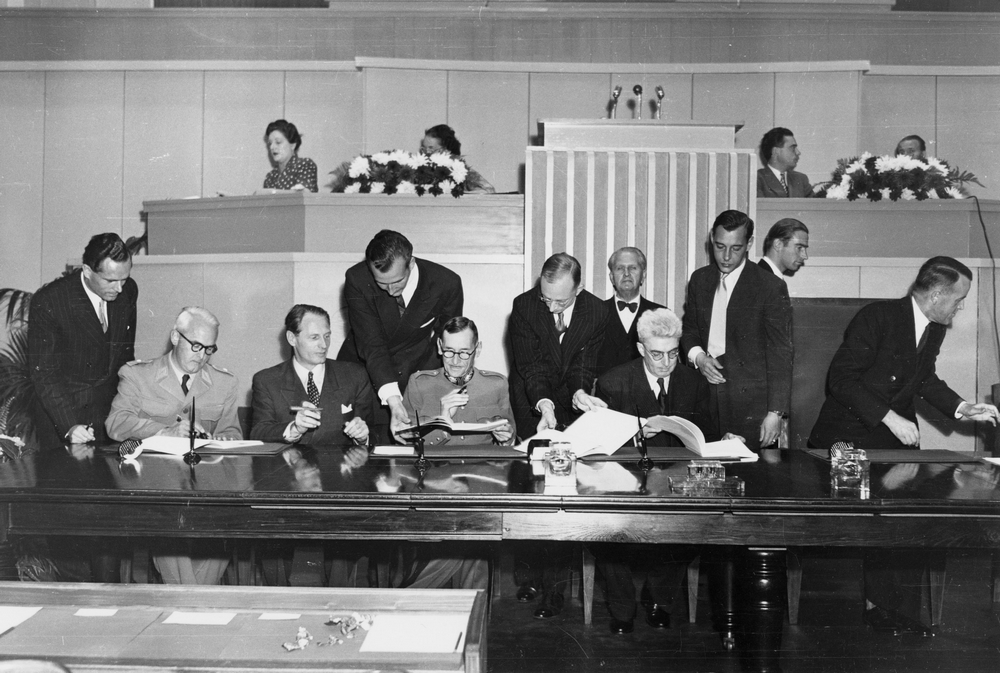
It is well known that the experiences of the Second World War significantly influenced the making of the four Geneva Conventions. Notably, a substantial part of the Fourth Convention addresses situations of occupation and, understandably, the legal gaps encountered during the Second World War. Thus, the Fourth Convention enhances the protection of individuals in occupied territories, as the Hague Regulations focused on property.
Most importantly, the Fourth Convention does not include the definition of occupation; as a result, it effectively relies on the definition provided in the Hague Regulations. This factual position is noteworthy because, as the Fourth Convention does not have its own definition of occupation, the Hague Regulations definition has served as a reference point for the application of the Fourth Convention as well. At least two observations can be made here. Firstly, though the Fourth Convention is a new addition, it has not significantly changed the scope of application of occupation law, effectively maintaining the position of the Hague Regulations. Secondly, while the gravity of European experiences during the Second World War rightly influenced the making of the Convention, the experience of the colonial peoples did not draw similar attention. Although African, Asian and Latin American states constituted nearly half of the participating states at the Diplomatic Conference, their experiences with colonial wars were not adequately recognized in the resulting Conventions. This highlights the bias of international law towards European and North American experiences, which the Third World international law scholars continue to challenge.
Common Article 3 was not so “radical” for the Third World
The inclusion of Common Article 3 (CA3) in the four Geneva Conventions is considered a radical development in international law, in general, and in international humanitarian law, in particular. For the first time, and long before the comprehensive development of the human rights treaty law, matters relating to internal aspects of a state were sought to be regulated by international law.
In that respect, it is a pathbreaking development in international law. Certain developments on the content and substance of the provision preceded CA3’s inclusion. Conferences before 1949 addressed the application of the laws of armed conflict to civil wars. The preliminary conference of the National Red Cross Societies, held in 1946, explicitly proposed the revision of the 1929 Geneva Convention for the Relief of the Wounded and Sick in Armies in the Field that it should be applied to civil wars within any particular state. The same Conference similarly suggested the application of the 1929 Convention Relative to the Treatment of Prisoners of War to civil war situations. Later on, the conference of Government Experts for the Study of the Conventions for the Protection of War Victims of 1947 recommended a provision which stated that “[in] case of civil war, in any part of the home or colonial territory of a Contracting Party, the principles of the Convention shall be equally applied by the said Party, subject to the adverse Party also conforming thereto.”
It is to be noted that this provision included civil wars in colonial territory as well. In continuation to this, the draft convention submitted to the XVIIth International Red Cross Conference of 1948 in Stockholm included a draft provision which extended the principles of the conventions to “all cases of armed conflict which are not of an international character, especially cases of civil war, colonial conflicts, or wars of religion, which may occur in the territory of one or more of the High Contracting Parties,…” This draft explicitly extends the conventions to anti-colonial conflicts occurring on the territory of a state, thereby treating them as non-international armed conflicts.
However, the texts approved and amended by the XVIIth conference did not make reference to colonial conflicts. Some Western states had difficulty with the inclusion of colonial conflicts. (Geoffrey Best, Law and War Since 1945 (New York: Clarendon Press, 1994), p. 170). The CA3 text finally included in the four Geneva Conventions does not explicitly refer to colonial conflicts. Despite the absence of express reference to colonial conflicts, some newly independent states, such as India, considered the CA3 to cover such conflicts as non-international armed conflicts. As mentioned above, the Geneva Conventions, particularly the Fourth Convention, did not recognize colonial conflicts in their treatment of occupation. However, while dealing with civil wars, an attempt was made to include such conflicts, though unsuccessfully.
It is essential to evaluate CA3 from the perspective of colonial conflicts. As discussed above, the colonial occupation was not considered a belligerent occupation. This denial was premised on the denial of sovereignty to colonial peoples and territories. The drafting history of CA3 and its final inclusion reinforced the logic of denial inherent in international law during the colonial period. When the draft of CA3 sought to explicitly cover colonial conflicts, it clearly continued the denial of sovereignty to colonial territories. As the final version of CA3 was intended to be applicable to non-international armed conflicts, the colonial conflicts, though explicit reference to them was omitted, were understood as civil wars between non-state actors, i.e., anti-colonial armed movements and the colonial powers. This understanding implicitly denies sovereignty to colonial peoples and recognizes the colonial powers as possessing it. While CA3 is celebrated as breaking the veil of sovereignty, it is equally important to underscore that it also excluded some territories from sovereignty.
Interestingly, some Western states opposed any reference to colonial conflicts in CA3, which may have contributed to their exclusion from the final text. This position of Western states goes beyond denying sovereignty and refuses to accord any status to colonial conflicts other than treating them as law-and-order matters falling under domestic criminal law. To avoid being regarded as involved in criminal activity, Third World states like India understood that CA3 would cover anti-colonial conflicts.
This is where the importance of the Additional Protocol I (API) lies, as it recognized the national liberation movements as international armed conflicts. Despite the limited practical relevance, the newly independent states sought the inclusion of “armed conflicts in which peoples are fighting against colonial domination” in API as a way of correcting the historical wrong of the denial of sovereignty to them. They were also rewriting the laws of armed conflict by correcting the latter’s complicity in the colonial project.
While historical binaries like the civilized and uncivilized are done away with formally through the processes of decolonization and other developments, similar structures continue to operate in diverse manifestations. As the purpose of updating the commentaries is to bring “together more than 75 years of State practice, legal developments, judicial decisions, scholarly debate and operational experience”, an evaluation of the complex historical processes that led to the making of these conventions helps us better understand the complex political and social realities within which the Conventions are applied. It also allows us to avoid subjecting humanitarian considerations to global hierarchies, as it happened in the past at several historical junctures. This evaluation is also necessary because the relevance of these conventions to the victims of armed conflicts today is pressing as ever.
See also
- Katharine Fortin, “If it ain’t broke, don’t fix it”: the ICRC’s approach to Common Article 3 in its updated Commentary, February 19, 2026
- Jean-Marie Henckaerts, Protecting civilians in good faith: a joint symposium on the updated ICRC Commentary on the Fourth Geneva Convention, February 17, 2026
- Jacob Coffelt, Codifying IHL before Lieber and Dunant: the 1820 treaty for the regularization of war, April 4, 2024
- Cordula Droege, Eirini Giorgou, Elizabeth Rushing, How does international humanitarian law develop?, April 13, 2023