
The international humanitarian system has built a sophisticated architecture for the protection of civilians, namely political resolutions, cluster coordination mechanisms, reporting frameworks, and accountability tools. Yet when conflict-affected people are asked directly whether they feel protected, or whether they trust the actors claiming to protect them, the answer is frequently at odds with the system’s own assessments. Despite commitments under the Grand Bargain to center local actors and affected communities, research consistently reveals a persistent gap between how humanitarian actors evaluate their own performance and how affected communities experience it.
In this post[1],part of our ongoing series “Delivering for people in an evolving humanitarian landscape,” Imane Karimou argues that humanitarian protection faces a trust and legitimacy crisis that cannot be resolved through better coordination or increased funding alone. Drawing on community perception research and the experience of community-centered protection frameworks, she makes the case for reorienting how the system evaluates success, measuring protection through community-reported experiences of safety, trust, and dignity, rather than through system-generated indicators and outputs.
Some months ago, I came across the work of Peter Kidi, a poet, writer, and refugee activist living in Kakuma Refugee Camp in Kenya. One poem in particular, Metrics, commissioned by the international NGO Ground Truth Solutions, struck me. In it, Kidi describes a man who learns to perform recovery for the humanitarian system, “standing straight when his bones whisper collapse, speaking in numbers when his truth comes in tears” until he becomes, in the system’s own language, improved, resilient and self-reliant. It is a poem about something civilians across many conflict settings know well: the system is often better at documenting their suffering than alleviating it.
The gap between what the system records as protection and what communities actually experience as safety is the problem this article sets out to examine. It is a gap that runs through the humanitarian system broadly, but it is sharpest in the domain of civilian protection, where the quality of human presence matters as much as any output (if not more), and where the gap between what the system measures and what people actually experience can often be interpreted as a protection failure in and of itself.
The gap between system performance and community experience
For years, and across various conflict contexts, research on community perceptions has returned the same finding: humanitarian actors consistently rate their own performance far more positively than the people they serve do. A gap this consistent, documented across many contexts and crises, is not the result of poor implementation but rather reflects how the system is fundamentally designed.
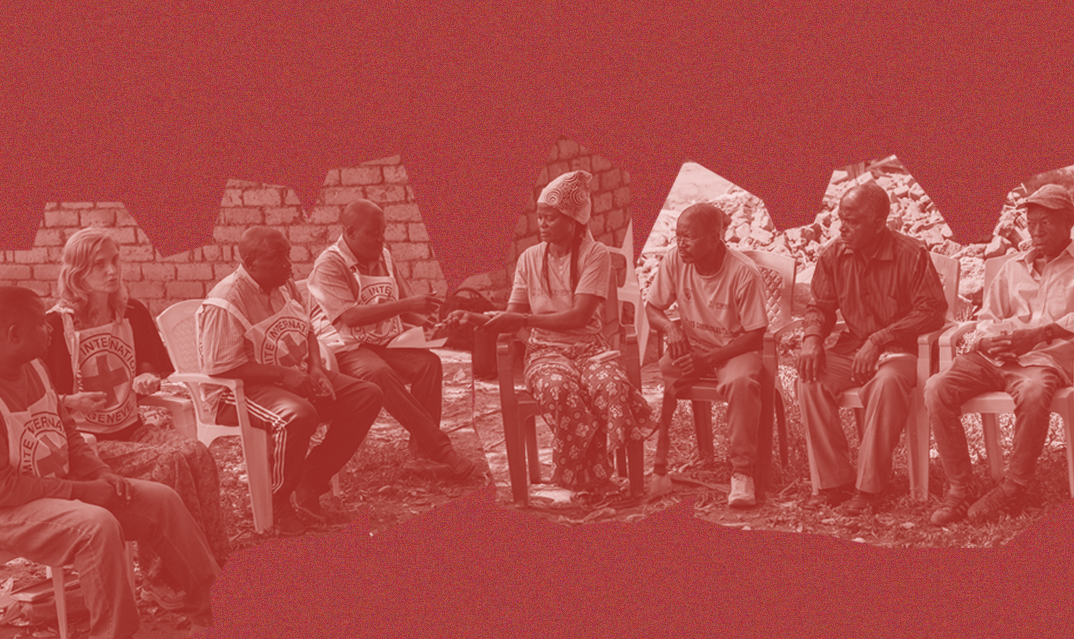
In 2022, Ground Truth Solutions launched their global analysis “Listening Is Not Enough”, which synthesizes perception data from thousands of crisis-affected people across ten contexts (Afghanistan, Burkina Faso, Chad, Central African Republic, Democratic Republic of Congo, Haiti, Nigeria, Somalia, Syria, and Ukraine). The study unambiguously concludes that despite the proliferation of feedback mechanisms, community engagement strategies, and accountability frameworks, decision-making power in the global humanitarian system has not shifted. Rather, affected people consistently report feeling excluded from decisions about the assistance they receive.
Where, in Haiti, 98% of people were expected to be informed about available aid, the data showed how only 14% felt informed. In the DRC, around half of aid recipients believed assistance was distributed unfairly. Community members reported seeing vehicles and logos but rarely meeting staff in any meaningful way. While these perceptions are not infallible, they point to the core idea that in protection work, the experience of being treated fairly is inseparable from whether protection has actually occurred. In other words, how people experience an interaction is part of what protection actually is.
Protection is relational and needs to be measured as such
Protection is different from other forms of humanitarian assistance. Delivering food or shelter is, at its core, a logistical challenge: one can count what was distributed and to whom. Protection does not work that way. Whether someone feels protected depends not just on what was done, but on how they were treated in the process. Protection depends on whether the beneficiaries were listened to, whether they felt their situation was genuinely understood, whether the people claiming to act on their behalf actually showed up and stayed.
In other words, the experience of safety and the experience of dignity are not separable. A community that has been surveyed, logged, and referred through the right channels, but never meaningfully heard, can subjectively feel to never have been fully protected, even if every indicator says otherwise. This points to a fundamental premise of this post, which is that protection is relational. Protection scholars like Cathrine Brun and Cindy Horst or Felicity Gray have explored how humanitarianism, in particular protective practice, is built (or destroyed) in the quality of contact between people.
In fact, this is not a novel observation. The ICRC’s own professional standards for protection work recognize that protection outcomes are shaped by the quality of engagement with affected communities, not only by the delivery of tangible outputs. The Inter-Agency Standing Committee’s 2016 Policy on Protection in Humanitarian Action similarly emphasizes that protection must be people-centred and that affected populations should participate meaningfully in protection responses. In some ways, that is a recognition of the relational dimension of protection.
However, while these commitments exist on paper, the measurement systems that would make them enforceable do not necessarily. Instead, protection is evaluated through outputs, whether numbers of people reached, referrals completed, cases closed etc., which can cause the relational dimension to disappear entirely. A system optimized for outputs can, in principle, deliver protection perfectly by its own metrics while failing completely by those of the community. The data presented by Ground Truth Solutions suggests that this is what is happening now, at scale.
The structural roots of the measurement problem
The measurement gap in protection work exists because of who the system is actually accountable to. Humanitarian organizations are accountable upward (to donors, to headquarters, to the coordination structures that govern funding) far more than they are accountable downward, i.e. to the communities they serve. This distinction, identified by Michael Edwards and David Hulme in 1995 in their work on NGO accountability, remains one of the most cited frameworks for understanding why humanitarian organizations struggle to be genuinely accountable to the people they serve. Edwards and Hulme lay out how the incentive structures that govern how organizations report and demonstrate effectiveness all run toward powerful funders, not toward affected populations.
It is worth being clear about one of the reasons this dynamic persists. Upward accountability is not always an institutional preference but most often than not, a survival strategy for protection organizations for whom outcomes are difficult to quantify and results take time to materialize. Hence, reporting in the system’s own language is frequently how programs justify their existence to funders who might otherwise redirect resources toward sectors where results are easier to show. The 2024 Core Humanitarian Standard on Quality and Accountability, for example, acknowledges the tension between accountability to donors and accountability to affected people without necessarily resolving it. As a result, even organizations genuinely committed to community-centered protection find themselves operating within incentive structures that primarily reward significance to donors over responsiveness to communities.
Another deeper problem is that the system evaluates its own success against standards it sets for itself. There is no widely accepted, independent, community-based measure of whether a protection response has worked, for example. Organizations report against targets they designed which themselves are verified through frameworks they control. This is why the measurement problem cannot be resolved by simply adding more feedback mechanisms to existing structures, because it doesn’t change the fundamental logic but rather adds another layer to a system that was never designed to be held accountable by the people it serves.
The same Ground Truth Solutions 2022 study documents very clearly that even where feedback mechanisms exist, local staff report that they lack the authority to actually change programming based on what communities tell them. Hence the situation is that, on the one hand, community members provide input that does not change decisions or generate action. On the other, organizations report results that do not reflect community experience. In other words, the feedback loop remains open at both ends.
For protection specifically, this dynamic is corrosive. Because protection work depends on trust, communities must trust that disclosing threats or vulnerabilities will result in action rather than exposure. When accountability runs upward rather than downward, however, individuals have every rational reason to withhold that trust. And when they do, the protection response is weakened at its foundation, regardless of how well it performs against its own indicators.
Toward a locally-owned standard of success
The argument across this article points in one direction: the humanitarian protection system’s legitimacy problem is not primarily one of resources or coordination, but rather a problem of what gets measured, and whose judgment counts as evidence.
Alternatives exist. Search for Common Ground’s Peace Impact Framework, developed with over 180 organizations across 45 countries, offers one. Rather than measuring what organizations deliver, it measures what communities experience via ten indicators built around perceptions of safety, trust, and dignity. Crucially, those indicators are defined by communities themselves, locally and context specific. What the framework has demonstrated, across highly varied conflict settings, is that when you ask communities whether they feel protected rather than asking organizations whether they delivered protection, you get a fundamentally different, if not to say perhaps more honest, picture of what is working and what is not.
That picture has practical value beyond evaluation itself. Humanitarian actors are not the primary duty-bearers of protection. Under international humanitarian law and human rights law, that responsibility rests with state authorities and parties to a conflict. Humanitarian protection operates in the space created when those authorities are unable or unwilling to fulfil that obligation. This means that when communities report feeling unsafe, the failures they are describing are not always, or even primarily, failures of humanitarian delivery. They are often failures of political will that humanitarian actors can document and name but cannot remedy alone. This shows the value of community-led metrics as more than an accountability tool. Output-based indicators tell you what humanitarian actors did. Community-reported safety data, on the other hand, give an account of what people are actually experiencing which is precisely the kind of evidence that can inform advocacy directed at the authorities who bear primary responsibility for protection. It can also surface patterns of fear or distrust, and flag deteriorating protection environments before they reach a crisis point.
Reorienting around community-defined protection would nonetheless also require confronting the incentive structures that currently make upward accountability more rewarding than downward accountability. It would require donors to accept community assessments as legitimate evidence of performance. It would also require protection actors to cede some control over how success is defined.
While none of this is straightforward, the alternative is a system that continues to produce evidence of its own effectiveness while conflict-affected people learn, as Peter Kidi describes, to perform recovery for the camera. In Metrics, the man is no longer a person in the system’s records. He is a number “that learned how not to scream”. Because once he is “no longer vulnerable” he is no longer seen.
Conflict-affected people are not, and have never been, data points. Hence, the question humanitarian protection system must ask should shift from “what did we deliver?” to “do the people we claim to protect feel safer, more dignified, and more in control of decisions that affect their lives?” Until community experience becomes the primary standard of evidence, the gap between protection on paper and protection as people live it will persist.
References
[1] This title is inspired by a powerful line in Peter Kidi’s poem “Metrics”: “He is a number that learned how not to scream”.
See also
- Mamuch Bey, The shelter that shone in the distance, June 18, 2026
- Eberechukwu Owuamanam SJ, We helped individuals while harming persons: what conflict-affected communities deserve beyond beneficiary status, June 11, 2026
- Sundus Tehreem Shahzad Khattak, Climate resilience is not optional: what people in fragile, urban settings should expect from WASH, June 9, 2026
- Sara Aleisseh, Life teaches before school does: the invisible curriculum of the super child, June 4, 2026