
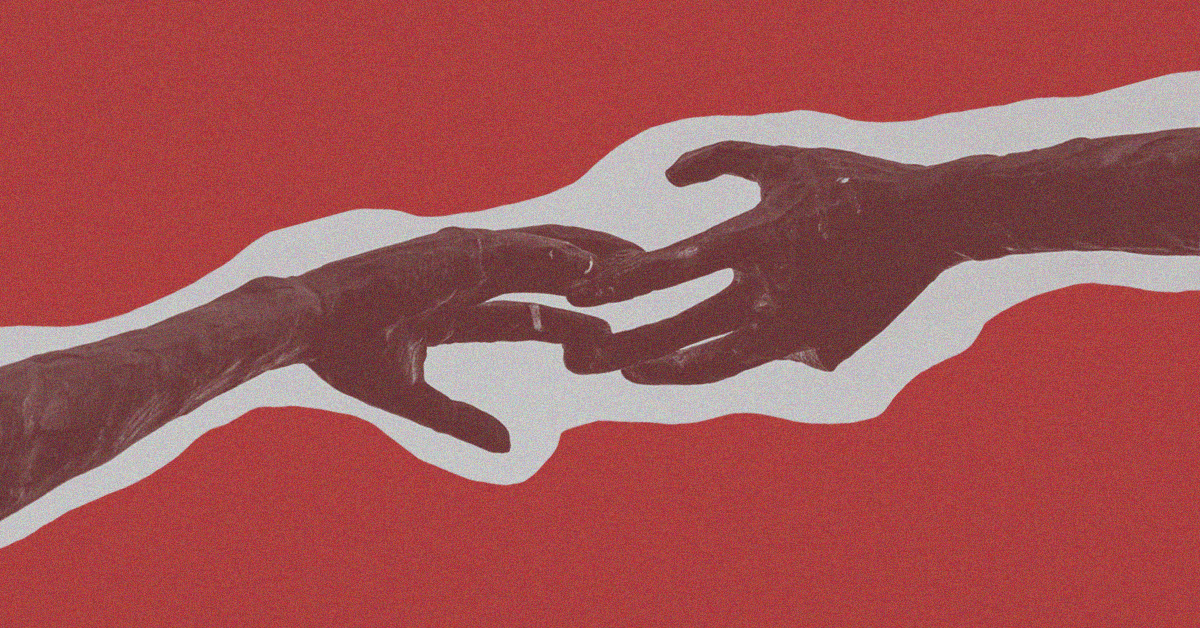
Conflict and displacement do more than destroy homes, livelihoods, and infrastructure. They also fracture the social relationships through which people sustain dignity, identity, and collective life. Yet humanitarian responses often focus primarily on individuals as beneficiaries, measured through categories of vulnerability, targeting, and service delivery. In many conflict settings, this approach can actively erode the communal bonds, local agency, and relational structures that communities themselves rely on to survive and recover.
In this post, part of our new series “Delivering for people in an evolving humanitarian landscape”, Eberechukwu Owuamanam, Jesuit scholastic and humanitarian practitioner, draws on experiences from conflict-affected and disaster-affected communities in Nigeria, as well as African relational ontology, to argue that humanitarian action should move beyond models centered primarily on intervention and delivery. Drawing on concepts including Ubuntu, Igwebuike, and the Ijeluwa framework, he argues for approaches grounded in accompaniment, practice that strengthens, rather than replaces, the relational networks through which dignity and recovery become possible.
In 2019, I walked into a camp for internally displaced persons (IDPs) in Mubi, Adamawa State, northern Nigeria, carrying food, blankets, and medical supplies. The camp housed families from multiple communities displaced by the Boko Haram conflict, and our organization had mobilized significant resources for their assistance. We distributed, documented, and left satisfied. Months later, I returned. Dependency had deepened. Vulnerability had multiplied. Most troubling, the dignity that had survived displacement seemed halved by our assistance. People who had once introduced themselves by their trades and families now introduced themselves as beneficiaries.
That same year, I visited a flooded village in Yenagoa, Bayelsa State. The community had lost homes, crops, and livestock; material destruction comparable, in proportion, to what families in Mubi had endured. Yet there was no queue of waiting beneficiaries. The community had organized fishing expeditions, redistributed shelter among extended family networks, and was rebuilding with minimal external support. When I asked an elder how they managed, he looked at me as though the question made no sense. “We are one,” he said. “How can one part of the body abandon another?”
Both communities faced crisis. We gave far more resources to the IDP camp. Yet the outcomes diverged radically, and the reasons cannot be reduced to resources, or even to the obvious structural asymmetries between conflict and flood. Yenagoa retained what Mubi had lost before any aid agency arrived: an intact relational architecture. Kinship networks, decision-making structures, and territorial bonds remained functional. The Mubi camp aggregated individuals severed from those bonds; the camp’s organizational framework of individual registration, household rations, external governance then compounded the rupture rather than repairing it. These suggested distinct understandings of individual identity and community connection.
The beneficiary trap and the agency it obscures
The humanitarian system, for all its achievements, operates on a philosophical anthropology it has never fully examined. It inherits from the Western intellectual tradition a conception of personhood as an individual, the person as an autonomous unit, the recipient as a discrete beneficiary, the community as an aggregate of separate selves. This is a philosophical commitment with consequences that play out daily in conflict settings.
Yet this framing obscures what affected communities do. Even within the Mubi camp, people exercised agency: women organized informal childcare cooperatives; elders from the same village of origin mediated disputes using customary norms; youth groups negotiated with camp authorities over water distribution. The problem was not that agency was absent, but that the system’s architecture, individual beneficiary numbers, household-level targeting, external coordination rendered relational agency invisible and unsupported. As recent ICRC research on civilian experiences in contested territories documents, communities in areas controlled or contested by armed groups consistently demonstrate collective strategies – pooling resources, creating early warning systems, negotiating with armed actors – that humanitarian systems often fail to recognize or strengthen.
Conflict doesn’t impact everyone in a community the same way. UN Women reports that women in conflict settings experience an increased risk of gender-based violence, reduced access to decision-making, and heightened food insecurity; they make up sixty per cent of the chronically food insecure. Girls in conflict zones are 2.5 times more likely than boys to be out of school. These differential impacts mean that conflict itself reshapes communal values and structures before any humanitarian actor arrives: gender roles shift as women become sole providers; generational authority is disrupted when elders are displaced and youth are recruited; communal trust fractures along lines that displacement and violence create. A relational approach must therefore attend not only to the existence of community bonds but to their internal inequities and transformations.
The ontological blind spot
What the humanitarian system misses is what African philosophical traditions articulated: personhood is not a property possessed by isolated individuals but is constituted through relationships. The Ubuntu tradition of Southern Africa captures this through the principle umuntu ngumuntu ngabantu: a person is a person through other persons. In the Igbo philosophical concept of Igwebuike, community is strength; the individual finds meaning through participation in relational life.
What I have developed elsewhere, building on Tempels, Menkiti, Ramose, and the broader African philosophical tradition, is what I call the Ijeluwa Framework. It proposes that personhood unfolds along three dimensions simultaneously: the horizontal-relational (community, kinship, land), the interior-vertical (character, interiority, discernment), and the ultimate-vertical (orientation toward transcendent meaning). These are not separate simulations but dimensions of a single relational being, which is why an intervention that touches one without regard to the others does damage the intervener rarely sees.
This philosophically rigorous claim has direct implications for humanitarian practice. If persons are constituted through relationships, then an intervention that delivers resources while severing relational bonds does not help people; it harms them. The refugee assisted as an isolated beneficiary but cut off from relational ties may survive, but their personhood diminishes.
This was precisely the difference between my two villages. In the IDP camp, we helped individuals while harming persons. In Yenagoa, relational integrity was maintained because support flowed through existing networks rather than replacing them.
What conflict-affected communities should expect
If the humanitarian system is serious about asking what conflict-affected people should reasonably expect, the answer begins here: they should expect to be treated as persons, not as beneficiaries. This distinction asks for a fundamental reorientation of practice.
First, humanitarian delivery must shift from intervention to accompaniment. The aid coordinator does not arrive with predetermined solutions to impose on passive recipients. They accompany persons and communities in discerning and walking their own paths. Both parties contribute, receive, and learn. In practice, this means joint needs assessment where communities define priorities, shared governance of distribution processes, and sustained presence rather than episodic delivery.
Some humanitarian actors are already moving in this direction. The 34th International Conference of the Red Cross and Red Crescent (2024) adopted a resolution on enabling local leadership and strengthening resilience, recognizing that locally led action, particularly through National Societies and community-based volunteers, is central to sustainable humanitarian response.
Second, accountability must be measured by relational outcomes alongside individual metrics. Does this intervention strengthen or weaken community bonds? Does it flow through existing relational networks or replace them? Does it preserve the communal identity through which people make sense of their lives? Concretely, this means supplementing beneficiary counts with indicators of social cohesion: whether kinship networks remain functional after intervention, whether communal decision-making structures survive the aid process, and whether people continue to identify themselves by their roles in the community rather than by their beneficiary status. Research on social cohesion and forced displacement confirms that inclusive, community-driven approaches can offset the negative social impacts of displacement, but only when they are designed to strengthen rather than supplant local relational networks.
Third, localization must be understood not as an efficiency measure but as a philosophical necessity. Local actors are embedded in the relational fabric that constitutes community life. Their effectiveness flows from relational knowledge that no external assessment can replicate. Yet the Grand Bargain’s 2016 commitment to channel twenty-five per cent of humanitarian funding to local actors as directly as possible remains largely unmet nearly a decade later. Funding continues to flow overwhelmingly through multilateral institutions and international NGOs, while local organizations that sustain relational networks during and after crises receive a fraction. This structural gap reflects a philosophical assumption that expertise resides outside the affected community, an assumption that a relational ontology directly challenges.
Fourth, a relational approach must refuse to romanticize the very communities it centers. Conflict transforms relational structures, deepening solidarity in some quarters while fracturing trust in others, empowering women as community leaders while exposing them to new forms of violence. Studies on displacement and social cohesion demonstrate that the social effects of conflict persist long after violence ends. To honor relational personhood is not to defer to community as it presents itself, but to engage it as it actually is: unequal, contested, transformed by conflict, and yet still the medium through which recovery becomes possible. Humanitarian actors who claim a relational frame without this honesty produce a softer version of the same harm; a romanticized community used to justify external choices.
The courage to reimagine
At the 14th Annual Global Humanitarian Policy Forum convened by OCHA in December 2025, the conversations I participated in confirmed what I had witnessed on the ground: the old models are straining. But the conversations also revealed a persistent reluctance to interrogate the philosophical foundations on which those models rest. We discuss funding gaps, coordination failures, and access constraints. We rarely ask whether the conception of personhood underlying our operational logic might itself be the problem.
The Yenagoa elder’s words remain: “We are one. How can one part of the body abandon another?” It is not folk wise sayings but a philosophical proposition about what a person is, and a verdict on what we have been doing. The stakes are ontological. The choice is ours.
See also
- Arjun Claire, Matthew Bamber-Zryd, Navigating violence: five insights to strengthen humanitarian action in contested territories, November 24, 2025
- Indu Nepal, Natalie Klein-Kelly, Navigating dilemmas in people-centric humanitarian action, August 31, 2023
- David Loquercio, Martin Schüepp, People, principles, processes: accountability in humanitarian action, August 29, 2023
- Colin Walch, Supporting social protection: five considerations for a principled humanitarian approach, June 8, 2023
- Hugo Slim, People power in humanitarian action, February 20, 2020