
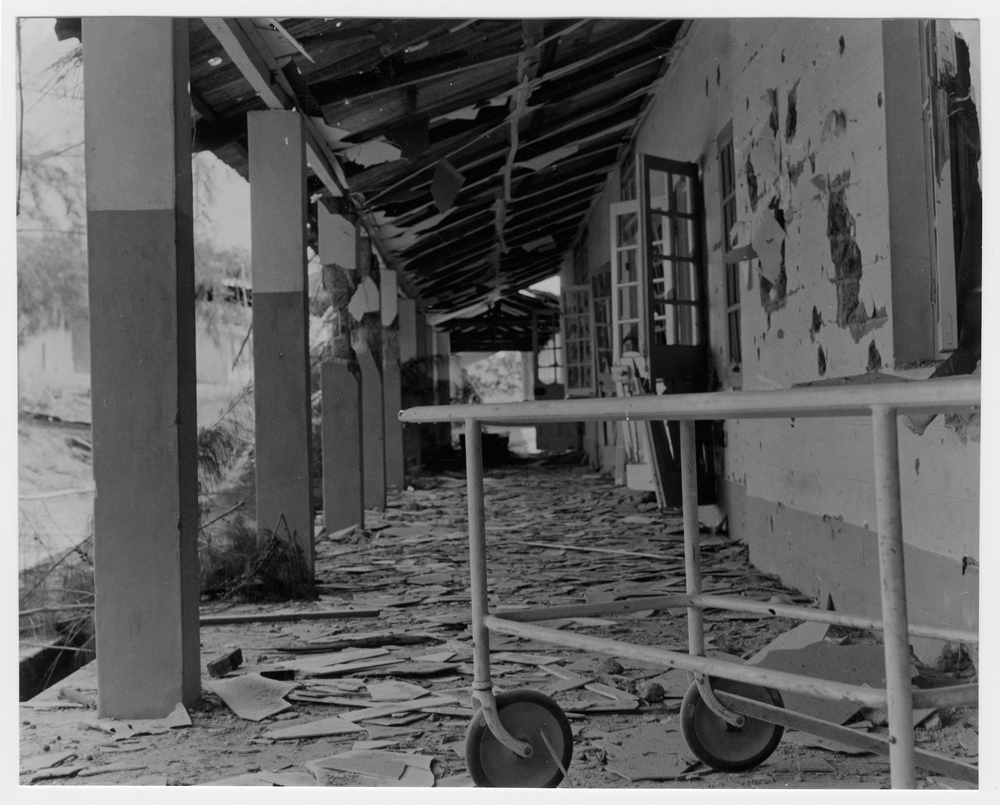
During the last decade, attacks against hospitals have been a hallmark of almost every conflict. What humanitarian medical practitioners have witnessed and denounced for years has become alarmingly routine. International humanitarian law (IHL) is sometimes criticized for failing to protect the very purpose that justified its own existence, particularly when the states responsible for its enforcement remain incapable or unwilling to stand up for the protection of medical facilities in armed conflicts.
In this post, Claude Maon, Legal Director for Médecins Sans Frontières (MSF), highlights the need to build consensus around the specific protection of the medical mission under IHL. She calls for good faith interpretation in applying these rules to ensure the effective protection of hospitals by all actors in real situations of attack. In doing so, she underscores that attacks on hospitals are not inevitable and argues that this persistent trend of violations can only be reversed if states respect the law by adopting good operational practices to protect the medical mission, alongside ensuring accountability for attacks affecting medical facilities in armed conflict.
The numerous attacks on hospitals over the past decade, and the debates they have generated, have brought renewed attention to the legally permissible limited exceptions of international humanitarian law. They underscore the need to resist opportunistic or “permissive interpretations” of these highly limited exceptions so that they do not replace the rules granting specific protection to medical facilities, as well as to address the military practices that provoke, facilitate or seek to legitimatize such attacks.
Discussions on the protection of medical facilities currently taking place under the auspices of the Global Initiative to Galvanize Political Commitment to IHL still lead to an obvious and largely uncontested observation: hospitals benefit from specific protection and therefore must be respected and protected in armed conflict.
The fundamental problem, however, is that states and institutions are often very good at writing laws and very poor at enforcing them. The real question, therefore, is not what the rules say, but how to make them real.
By the time you finish reading this humble contribution, medical personnel, facilities or patients will have suffered violations of their protected status somewhere in the world – this is almost a certainty in 2026. Despite benefiting from one of the most protective legal frameworks under modern IHL, developed in the aftermath of WWII and the promise of “never again”, hospitals are nonetheless under attack every single day, in various forms and under a range of pretexts.
Ten years ago, United Nations Security Council Resolution 2286 – adopted unanimously by Member States on 3 May 2016 and strongly condemning attacks against medical facilities, personnel and transport in conflict zones – called on the Secretary-General to propose practical measures to operationalize the rules governing the protection of hospitals. To date, Member States have mostly ignored that call to address this concrete issue, opting instead for theoretical debates on rules and sanctions. This is, sadly, where we still stand today – marking a miserable 10th anniversary with nothing to celebrate.
Attacks against hospitals have been a hallmark of almost every conflict of the past decade – Afghanistan, Gaza, Lebanon, Myanmar, Nigeria, Pakistan, South Sudan, Sudan, Syria, Ukraine, Yemen: the list seems endless. As humanitarian medical practitioners, what we have witnessed and denounced seems to have become a very alarming pattern – one that we cannot accept becoming the rule.
What truly matters at this urgent stage is giving effect to good practices and good faith interpretations of the law in line with its humanitarian object and purpose. This applies in particular to issues such as the loss of specific protection, including warning requirements, the rules of proportionality and precautions, as well as accountability mechanisms.
Loss of specific protection
When hospitals are misused for military purposes to commit acts harmful to the enemy outside their humanitarian function, they may lose their specific protection, provided certain conditions are fulfilled. This includes the requirement to issue a warning to the opposing party to cease the harmful acts, which must go unheeded. However, this limited exception often leads to unilateral and opportunistic interpretation and implementation by each party to the conflict. While some parties to the conflict may misuse hospitals to hide their military activities, others often claim loss of specific protection as a justification to attack hospitals, thereby depriving their enemies, the wounded and civilians of medical care.
Unilateral and discretionary decisions by parties to the conflict regarding the potential loss of protection for medical facilities and personnel are leading to the current failure.
The loss of specific protection of medical facilities and personnel therefore requires stronger definitional guidance and a more transparent assessment system. It can no longer be left to one-sided and secret military intelligence. In various real situations, depriving the enemy and the affiliated population of health care is not a side effect of conflict, but a deliberate component of deterrent and punitive military strategy. This political choice is never openly acknowledged as such by the parties to the conflict, because it is illegal under the laws of war. Yet it remains a reality in many conflicts, often masked by the claims that hospitals and medical personnel have forfeited their specific protection.
States’ political guidance and good practices should dispel this clear ambiguity and reaffirm that the eventual loss of a hospital’s specific protection status does not, in itself, make it a lawful target that is liable to attack.
Due warning
States’ political guidance and military doctrine shall promote good practices and dispel ambiguity regarding the obligation to issue a warning in case of alleged misuse of a hospital outside of its humanitarian function for military purposes. The primary purpose of the warning is not to trigger the evacuation of the hospital, but to inform the enemy and, where feasible, the health authorities, about the potential misuse of the hospital and to call for such acts to cease.
Good practice, therefore, requires that warnings be precise and specific as to the nature of the acts in question, and that they be directed to the medical authorities in charge of the hospital, not only to the party to the conflict involved. Providing detailed information about the alleged misuse takes precedence over other concerns of protecting intelligence sources or the pursuit of tactical surprise.
Specific protection is lost only if cumulative legal conditions are met: the acts harmful to the enemy have not ceased following a warning; the part of the hospital being misused meets the definition of a military objective; and any attack can meet the proportionality test and respects the rule of precaution, in taking all feasible precautions to limit incidental civilian harm, which always bind the attacking party.
Proportionality and precautions
The rules of proportionality and precautions represent the protections IHL provides to civilians, including the wounded and sick and civilian objects. This assessment is usually undertaken by military commanders, forming a central part of their legal duties and one of the cornerstones of IHL.
This assessment of proportionality and related precautions is based on what a reasonable commander knew, or should have known, at the time of launching the attack. It must consider not only the direct harm expected to result from the attack – which is easily considered as a direct consequence – but also the foreseeable indirect harm which would follow: the so-called “reverberating impact” on the civilian population which, taken together, should be considered as the consequences of the attack.
However, beyond broad agreement on the importance of both of these IHL rules, there remains a lack of shared understanding between military and humanitarian actors as to how they should be interpreted and applied in practice. When it comes to their practical implementation on the battlefield, it is often extremely difficult to challenge the military rationale. There is no consolidated body of jurisprudence from international tribunals on the application of these rules that could provide an effective framework for accountability in the protection of medical facilities. This is particularly true when it comes to accountability for the long-term consequences of the destruction of vital civilian infrastructures.
International tribunals know that they cannot meet the high threshold of proof required by criminal law to establish responsibility beyond a reasonable doubt without access to restricted military information.
For these reasons, it is both ineffective and disingenuous to rely exclusively on criminal justice, or on the responsibility of commanders alone, to define and apply the proportionality test in relation to the protection of medical facilities. It is, first and foremost, the responsibility of states to define, share and adopt dedicated policies and military doctrine, supported by practical measures to effectively limit civilian harm and damage to medical facilities in armed conflict.
Policy guidance and best practices from states are essential to address the accountability gap regarding the individual responsibility of commanders during attacks on medical facilities.
Good practices – such as requiring highest-level command authorization before any military action affecting a medical facility is taken, implementing zero tolerance for attacks on hospitals throughout the military hierarchy, ensuring that commanders have no alternative but to comply with IHL, and integrating hospital protection as a criterion of mission success and not a footnote – represent a reachable benchmark that demonstrates respect for IHL.
Accountability
Calls for accountability on attacks on hospitals can regularly become an alibi. Parties to the conflict, or states, may conduct investigations that go nowhere, establish mechanisms with no teeth, and cite process as a substitute for an outcome. Relying only on criminal justice will, for the reasons described above, likely prove insufficient.
On good practices in this domain, supporting the establishment of systems for investigating allegations is crucial, but with the important caveat that military actors investigating their own military conduct cannot be considered as an independent system. Any credible accountability mechanism must include elements of independence, whether through national judicial oversight, independent commissions, or international mechanisms.
Financially and logistically supported fact-finding exercises, conducted in the aftermath of an attack, might prove useful. A key challenge after an attack is to avoid being overwhelmed by competing narratives put forward by parties to the conflict and/or the medical management of the targeted hospital.
While allegations of loss of protection will be quickly and easily made, the information supporting such allegations will probably never be shared, quickly and conveniently stamped as “defense secret” by the very actors who hold it, making the fight for transparency an uphill battle. Supporting affected medical facilities to shed light on all the elements and sequencing of an attack is a way to preserve facts and evidence for potential future justice and accountability claims.
Investigations conducted in opacity do not deter future attacks. Evidence and information should be declassified through all means available. Victims, including medical institutions or organizations, should have access to this information. Command responsibility must be addressed explicitly in domestic legislation: individual commanders who fail to prevent or punish attacks on hospitals must face consequences.
The almost forgotten mandate of the International Humanitarian Fact Finding Commission (IHFFC) should also be emphasized. This mechanism, created by Additional Protocol I – and which is the only IHL treaty-based mechanism available today for accountability – could play such a bigger role than it does today, including through its good offices mandate.
Conclusion
In the nineteenth century, the imperative to protect the medical mission led to the adoption of the First Geneva Convention, granting humanity an immense and unparalleled gift. In the twenty-first century, real patients and real medical personnel, who are literally risking their lives trying to save others, are still dying from preventable causes.
The knowledge of what works already exists, and it is not rocket science: fewer words and more action, fewer non-binding commitments and more concrete political responsibility. Good faith interpretations and sound practices to implement the law.
MSF has been able to maintain hospitals in war zones when simple rules and procedures, including hotlines, were set up with parties to the conflict.
But these good practices, standards, and the recommendations emerging from this process will only matter if states implement them with urgency, enforce them with consequence, and measure them against outcomes – not against the quality of their discourse and documentation.
See also
- Supriya Rao and Alexander Breitegger, Reaffirming the obligation to protect medical facilities and support their functioning, November 20, 2025
- Supriya Rao and Alexander Breitegger, Reaffirming IHL’s specific protection of hospitals, May 27, 2025
- Khang Phan and Thao Nguyen, Hospitals under fire: legal and practical challenges to strengthened protection, March 6, 2025
- ICRC, Call by global leaders: work together now to stop cyberattacks on the healthcare sector, May 26, 2020
- ICRC, e-Learning: Health care in danger, the legal framework, April 8, 2016