Climate change and armed conflict increasingly intersect in humanitarian settings. While the sector is now alert to climate-related risks – particularly in disaster response, resilience programming, and displacement governance – the ways these risks are interpreted and operationalized vary across institutional mandates and operational contexts. In protection practice within conflict-affected settings, climate impacts are still often framed primarily as “conflict multipliers” rather than direct drivers of civilian harm. This narrow lens risks overlooking the very insecurities communities experience most acutely: displacement, restricted movement, isolation, and livelihood collapse.
In this post, researcher and former ICRC delegate Lina Aburas argues that our current conflict-centered analysis has a dangerous blind spot. Drawing on her experience in northeast Nigeria, she explores how communities define their own insecurity amid climate and conflict pressures. Practitioner and community perspectives reveal how climate-related hazards reshape mobility, access to livelihoods and assistance, and exposure to protection risks in ways not fully captured by prevailing conflict-centered analyses. Centering these lived experiences reveals that adapting humanitarian action isn’t about mission creep or expanding mandates; it’s about fundamentally shifting how we interpret and prioritize the risks already in front of us.
When I landed in northeast Nigeria in 2019 as a Protection of the Civilian Population delegate with the ICRC, I welcomed the hot gust of air that filled my lungs as I stepped out of the ICRC plane. I had anticipated that my work would revolve around the non-international armed conflict that was tearing through Nigeria’s northeastern states. But what do we do when the perpetrator of so much pain and displacement is not a human who can be reasoned with, but the climate?
Attention to climate-related risks is no longer new within the humanitarian sector, particularly in disaster risk reduction, resilience programing, and displacement governance. However, how these risks are interpreted and prioritized varies across institutional mandates and operational contexts. Within protection approaches in conflict-affected settings, climate impacts are still often treated as “background stressors” rather than direct drivers of civilian harm. One of the challenges I faced as a humanitarian was integrating climate impacts into our protection analysis – not as a secondary stressor, but as a direct driver of displacement, restricted movement, and heightened vulnerability. My work with the ICRC inspired me to go back to Nigeria as a PhD candidate to ask the affected communities directly how this climate-conflict relationship impacts them. Here is what I learned.
A flood that displaced a city: when harm is not armed
Extreme weather events have long existed throughout human history, but their frequency, intensity, and violence have changed. Droughts are becoming more severe and lasting longer, affecting areas that were already dry. Similarly, floods have intensified in volume and frequency, causing greater damage than experienced before.
But what happens when these extreme weather events occur in areas already destabilized by conflict? In September 2024, the banks of the Alau dam in Konduga local government in Borno state burst following heavy rainfall. A wave of water surged towards Maiduguri, the Borno state capital, submerging more than half of the city. More than one million people were affected, and even more were displaced. While floods are not uncommon in northeastern Nigeria, experts and the communities stated they had not seen a disaster this severe in thirty years. One community member I interviewed noted that: “If you look at the level of displacement, insecurity itself did not displace four million individuals at a go. It has been from one community to the other. Not like hitting it hard at one time.”
The city of Maiduguri that I fondly remember was almost 70 per cent underwater. Food stock from the harvest were carried away, houses and communities were destroyed, and animals were killed. This disaster illustrates how climate-related harm can produce protection risks that fall outside traditional conflict categories. These extreme weather events tell us humanitarian workers that we must be prepared to respond to all perpetrators of harm. What used to be an exceptional event is now a persistent force of destruction.
What communities told me: three shifts for humanitarian practice
Shift 1: Protection analysis should start from where harm is experienced, not from who or what causes it
When speaking with communities for my research, I found that insecurity was not limited to physical harm, fear of kidnapping, gender-based violence, or loss of life. Displacement and movement restrictions rank highly on the list of what defines insecurity. As one participant noted, insecurity was when “people are not able to do their life activities […] if they want to go to farm, they cannot go, if they want to go to school, they cannot go”.
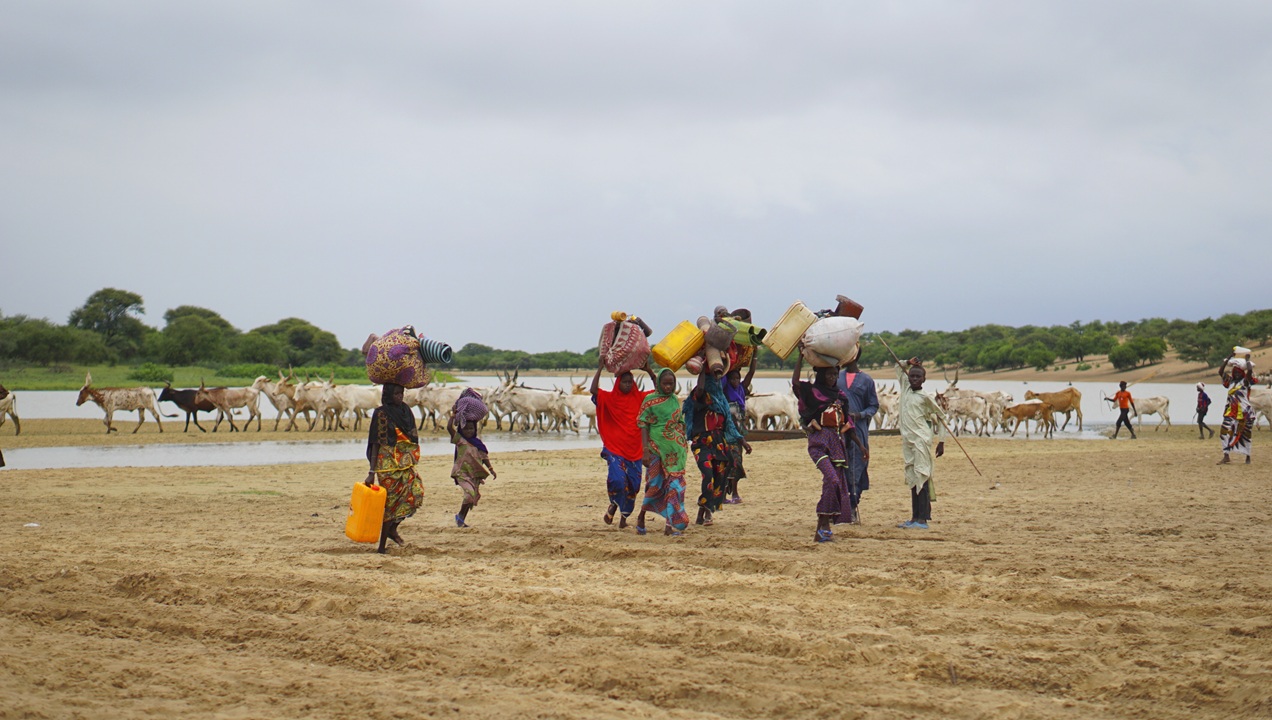
The inability to move has pervasive impacts. Fishermen cannot reach the river, and farmers cannot reach their crops. People in remote villages cannot access the schools, hospitals, or markets. These restrictions create livelihood insecurity and, above all, isolation. Without that contact, survival becomes difficult or even impossible. Furthermore, movement restrictions often mean being unable to reach areas where humanitarian assistance is distributed, which represents a lifeline for many households in hard-to-reach areas.
While displacement and mobility restrictions are frequently associated with armed conflict, communities also experience them as a direct result of extreme weather events. In Nigeria, flooding regularly isolates communities along riverbeds in southern states such as Cross River and Bayelsa. In Borno state, local government areas near the Lake Chad Basin, particularly Rann and Damasak, are repeatedly cut off following seasonal floods. As these events become more frequent, unpredictable, and destructive, their effects on mobility, access, and survival increasingly mirror, and at times surpass, those associated with conflict-related violence. One community member emphasized this by sharing that “the insecurity that we have, half of it is due to climate change”.
Viewing these dynamics through a protection lens reveals risks that extend beyond environmental loss or economic hardship. It highlights how mobility can become unsafe, how access to assistance becomes uneven, and how displacement and recovery periods can increase exposure to exploitation and gender-based violence. These dimensions of harm often remain peripheral in climate adaptation or conflict analyses but are central to civilian protection.
Starting protection analysis from how harm is experienced, rather than from predefined conflict categories, allows humanitarian actors to better identify priority risks and align responses with what communities’ experience as most urgent. When protection analysis remains anchored primarily to armed actors and violence typologies, climate-driven harms risk being misdiagnosed, leading to responses that overlook immobility, isolation, and livelihood collapse as central protection concerns. Many humanitarian actors – including the United Nations High Commissioner for Refugees, World Food Programme, Norwegian Refugee Council, Care International, and Oxfam International – increasingly recognize climate hazards as drivers of displacement, food insecurity, and protection risk. At the same time, the ICRC remains anchored in international humanitarian law and conflict-related harm. Recognizing these institutional differences helps situate climate-related protection risks within existing mandates rather than outside them.
Shift 2: Now more than ever, participatory approaches are necessary not only when designing the response to a crisis, but in defining and understanding it.
Community based protection (CBP) and other similar approaches used by humanitarian workers show a community-driven identification of problems and solutions. During my time in Nigeria, we carried out CBP workshops with community members, asking them to identify their biggest issues, rank them by priority, and share how they would like these issues fixed. As a result, alternative sources of fuel, tailored water and sanitation projects in internally displaced persons (IDP) camps, and structured protection dialogue with arms carriers emerged as solutions to the problems communities identified as the direst.
These approaches should capture climate-related concerns. Community definitions of insecurity should be integrated not only during protection and assistance assessments, but in overall context and security assessments too. Tools such as CBP are critical in context analysis and prioritization, particularly in places where climate change reshapes patterns of insecurity. In regions like northeastern Nigeria, shaped by armed conflict, farmer-herder tensions, banditry, kidnapping, and climate variability, participatory approaches enable responses that address overlapping crises simultaneously, regardless of who the perpetrator of harm is.
Shift 3: Operating in a mandate-adjacent space can be done by adjusting interpretation, not expanding mandates
Adapting to the new reality of overlapping crises does not mean humanitarian actors must become climate experts or expand their mandate into climate governance. It means adjusting how we interpret needs, risks, and protection concerns when environmental harm is no longer exceptional, but recurring and disruptive at scale. Climate shocks generate mandate-relevant protection concerns. They displace families, sever access to markets and services, increase exposure to exploitation and gender-based violence during unsafe movement, and isolate communities from humanitarian assistance that may be their primary lifeline.
When climate impacts are treated only as background conditions or as indirect “stressors” on conflict dynamics, the result can be an operational blind spot. Needs assessments might overlook mobility constraints, livelihood loss is framed as secondary, and response planning remains calibrated to conflict patterns alone. A more adaptive approach would integrate community definitions of insecurity, such as restricted movement, loss of access to farmland and fishing areas, and isolation after floods or drought, all of which are a part of humanitarian analysis and program design. This is not a mission breach; it is a refinement of humanitarian practice, rooted in the core purpose of reducing harm, protecting dignity, and enabling survival in rapidly changing environments. Integrating these realities into existing humanitarian tools strengthen, rather than dilute, humanitarian responses and identity.
Conclusion: refining the response
Climate change is not simply a background event in conflict-affected settings. It is an increasingly central source of harm that reshapes how insecurity is lived and experienced. When climate impacts are framed primarily through the lens of conflict, humanitarian analysis risks overlooking the protection risks that communities themselves identify as most urgent.
My research in Nigeria suggests that starting from lived experiences of harm, integrating community definitions of insecurity into risk analysis, and adapting existing humanitarian tools to account for climate-related consequences can strengthen humanitarian response without blurring mandates. As overlapping crises become the norm rather than the exception, the challenge for humanitarian actors is not whether to respond to climate change, but how to interpret evolving risks in ways that remain firmly grounded in protection and dignity of the affected population.
See also
- Catherine-Lune and Amir Khouzam, Climate action in conflict and fragile settings: closing the implementation gap, November 12, 2024
- Catherine-Lune and Amir Khouzam, Responding to climate risks in conflict settings: in search of solutions, November 23, 2023
- Alistair D. B. Cook, Climate change, environment and humanitarian action in Southeast Asia, March 28, 2023
- Namita Khatri, Who gets what: how to get climate finance working for the people who need it most, November 10, 2022