
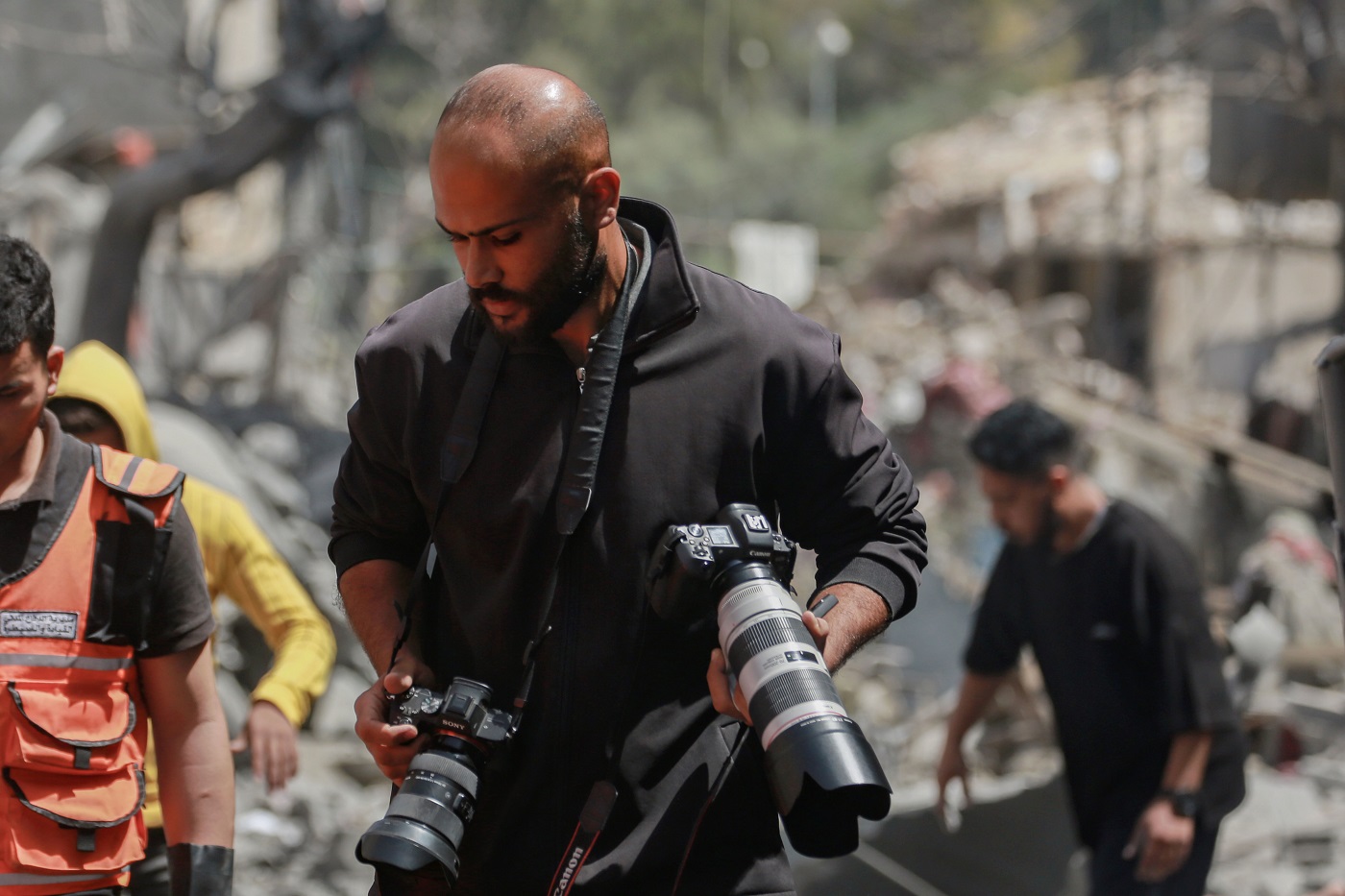
Photo credit (header): Basher Taleb
In June 2025, 28-year-old Palestinian photojournalist Saher Alghorra was awarded the ICRC’s Humanitarian Visa d’Or for his series of powerful, intimate images entitled We Have No Escape. Through his images, he shows us the realities of the conflict in Gaza. He captures the resilience of the civilians in spite of the devastation, while paying tribute to the lives that will never be the same.
Saher has not left Gaza since the hostilities began. Day after day, amidst the bombings, his exceptionally intense photographs document the suffering, fear and resilience of the civilians that are caught in the crossfire. As the war wages on, he tirelessly continues his work. The ICRC is proud to present Saher with this award, which recognizes his commitment to truth, dignity and humanity.
In this interview, which was conducted by Ahmed Ghanam for Al-Insani, the ICRC’s Arabic blog, Saher reflects on his career, the images he has captured and those moments when he needed to step back from the camera.
Please note that this article contains photos that some may find disturbing. The statements and captions contained in this article are those of the photojournalist and do not necessarily reflect the views of the ICRC.
The ICRC reiterates that parties to a conflict have an obligation to respect international humanitarian law. Only a lasting agreement between the parties can end the suffering endured by the millions of civilians in Gaza who are fighting to survive every day, and by hostages and their families.
First of all, how did you discover photography and when did you take your first photograph as a photojournalist?
My interest in photography began in 2017 while I was studying public relations and media at the University of Palestine. That year, my father gave me my very first camera, and so I had what I needed to get started. I began by taking photos of everyday life, and I took some for my university projects. After I graduated, I volunteered for the Palestine Red Crescent Society, which gave me an opportunity to experience the realities of the situation in the field, and that was how I first got into humanitarian photography.
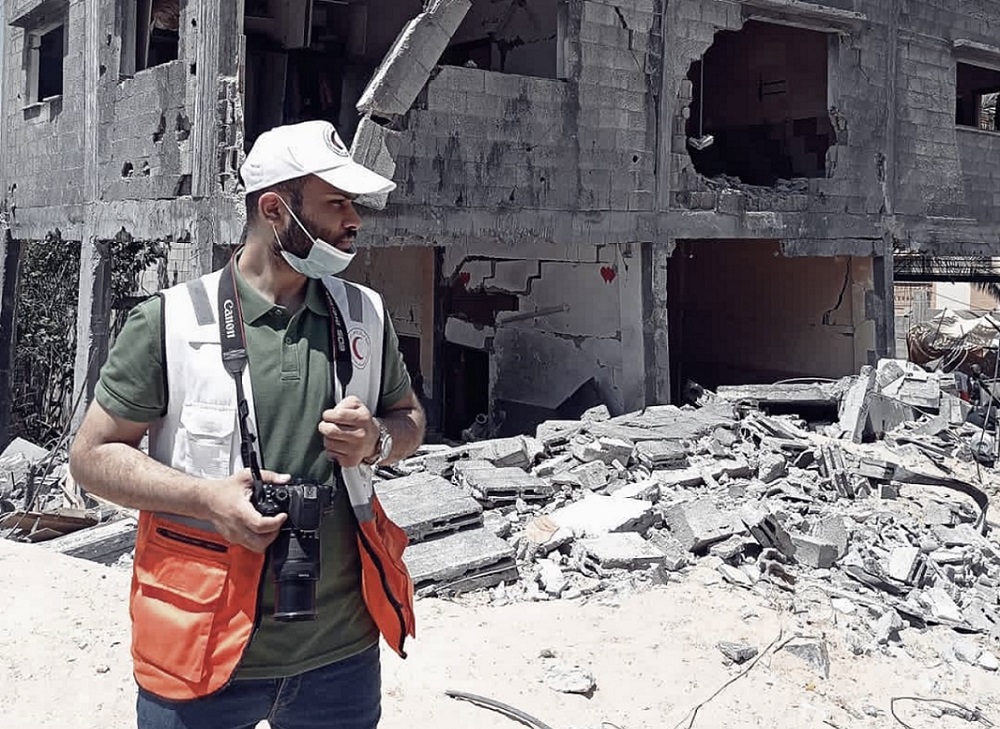 Gaza, 25 May 2021. Following ten days of raids, Saher Alghorra accompanies the Palestine Red Crescent rescue team to assess the damage caused to homes in the Al-Ghoul area of the Al-Nasr neighbourhood, which is in the north west of Gaza City.
It was in 2018, while documenting the Great March of Return, that I really got my start in photojournalism. I began to build up my own archives and refine my perspective. Since 2021, I have been working as a freelance photojournalist, which involves collaborating with international and humanitarian organizations. And since the start of the conflict in 2023, I have worked in the field non-stop in order to document what is happening.
In a previous interview, you said that you started out wanting to capture beauty, for example, the sea, everyday life and joyful moments. But very quickly, war, protests and disasters became your focus. What’s this shift been like for you?
In times of peace, photographers seek out beauty in the places where they live almost instinctively, whether it’s capturing the sea, people fishing, children playing, joyful moments or any other ordinary sights that warm the heart and give us that feeling of belonging. But we don’t have that luxury in Gaza.
Here, the war is long, the siege severe and everyday life brutal – even for the dreamers among us. Like many other people living here, I am in an oppressed area where it is impossible to remain neutral and to stand back and watch what is happening. As the suffering intensified, I attached greater meaning to my photographs. I was no longer concerned with art and aesthetics. It became a moral and personal responsibility for me.
In my work, I decided to focus on two inseparable aspects of life in Gaza. On the one hand, I wanted to document the injustices and daily struggles for survival, including the destruction, the hunger and the relentless bombing. On the other hand, I wanted to show that despite everything, the people here cling onto life – they refuse to simply survive but instead are determined to live.
And so alongside the images of war and civilians fleeing, I also look for glimmers of hope, even in the most fragile situations. It might be a child playing among the ruins, a family celebrating a birthday in a camp for displaced people or a small shaft of light piercing the darkness of a tent.
Yes, my perspective has changed. I’ve gone from trying to capture beauty to needing to document the suffering that I witness. However, my purpose hasn’t changed. I aim to convey the truth, whether it is joyful or unbearable.

At Al-Aqsa Martyrs Hospital, a Palestinian woman receives news of her child’s death after the bombing of a neighbouring house, in Deir al-Balah, in the Gaza Strip on April 22, 2024. © Saher Alghorra / Zuma Press
When you are in a country that is being bombed, how do you fulfil your professional duty to document the suffering while also taking care of your family and giving space to your emotions?
Without a doubt, finding this balance is one of the hardest things I have ever had to do. We are not journalists passing through Gaza. We do not come to report on the conflict and then go home. We were born and raised here. We can feel the war in our bodies, and we record it even as it feeds on us.
When we were ordered to evacuate northern Gaza in October 2023, I took my family to the south to find a safer place to shelter. I left them there and immediately returned to the field. I was away from them for weeks and exposed to danger every day. Like many of my colleagues, I set up my tent near a hospital, and we transformed our makeshift camp into an operational base. We slept next to the emergency services, amid the sirens and the ambulances, working under a bomb-filled sky, bodies arriving by the dozen.
And all the while, we never stopped worrying about our loved ones. We had not seen them for days, and we did not know whether they were still alive.
In Gaza, fear is unavoidable. And yet, you continue to go out every day with your camera, even during the bombings. How do you overcome the fear? And how do you know when it is time to pull back and protect yourself?
In this job, fear never leaves you. Danger is an integral part of our daily lives. From the outset, we knew that this job involved risks at every turn and we are under no illusions about how dangerous it is. What keeps me going despite everything is my belief in the message I am conveying, my faith in God and the strong sense of responsibility I feel towards my family, my people and the truth, which must be shared. This gives me courage, and even though the fear is still there, this helps me deal with it.
We are not reckless adventurers. Everything we do is carefully planned. We evaluate the risks involved, wear protective equipment, study the routes we will take and set our own boundaries, which we must not cross, otherwise we risk dying in vain. However, there are times when we have no other choice than to take calculated risks.
I remember a particular moment that happened in Rafah before we were forced to flee to the south. At that time, journalists were being targeted more than ever before, and for the first time, I felt that my camera could cost me my life. We stopped carrying our cameras in public for a while, out of fear of being targeted. In moments like that, it is not about giving up but about knowing when to take a step back.
If you let fear win, all you’re left with is silence. And silence is not an option in times of war. Sometimes I take risks. And sometimes I am more cautious. But in any case, I make sure that no stories are lost. Because here, persistence is not heroic – it’s essential.
Can you recall a moment when you put your camera down, not because you weren’t able to take photographs but because you couldn’t bear to watch what was happening any longer?
Yes. I’ll never forget it.
It was in late 2024 at the Shuhada al-Aqsa Hospital in Deir el-Balah in the centre of the Gaza Strip. That morning, a terrible massacre took place in the west of the city. All of a sudden, the hospital was overflowing with wounded people and dead bodies. It was as if death had suddenly decided to invade the place.
I started taking photographs of the wounded as soon as they arrived at the emergency room. There were people suffering all around me – pain and endless screaming. It was chaos. I didn’t have time to think. I just had to document what I was witnessing. Then I went to the morgue. I knew what I was going to find there, but I still wasn’t prepared for what I saw.
The scene in front of the morgue door stopped me in my tracks. There were women collapsed on the ground, wailing, hitting themselves in the face, clutching onto shrouded bodies, kissing foreheads that were already cold. There were men crying silently or crumpled on the ground. The bodies of children and young people, covered in blood, were laid out in mortuary cabinets, their faces still wearing an expression of sleep, not death.
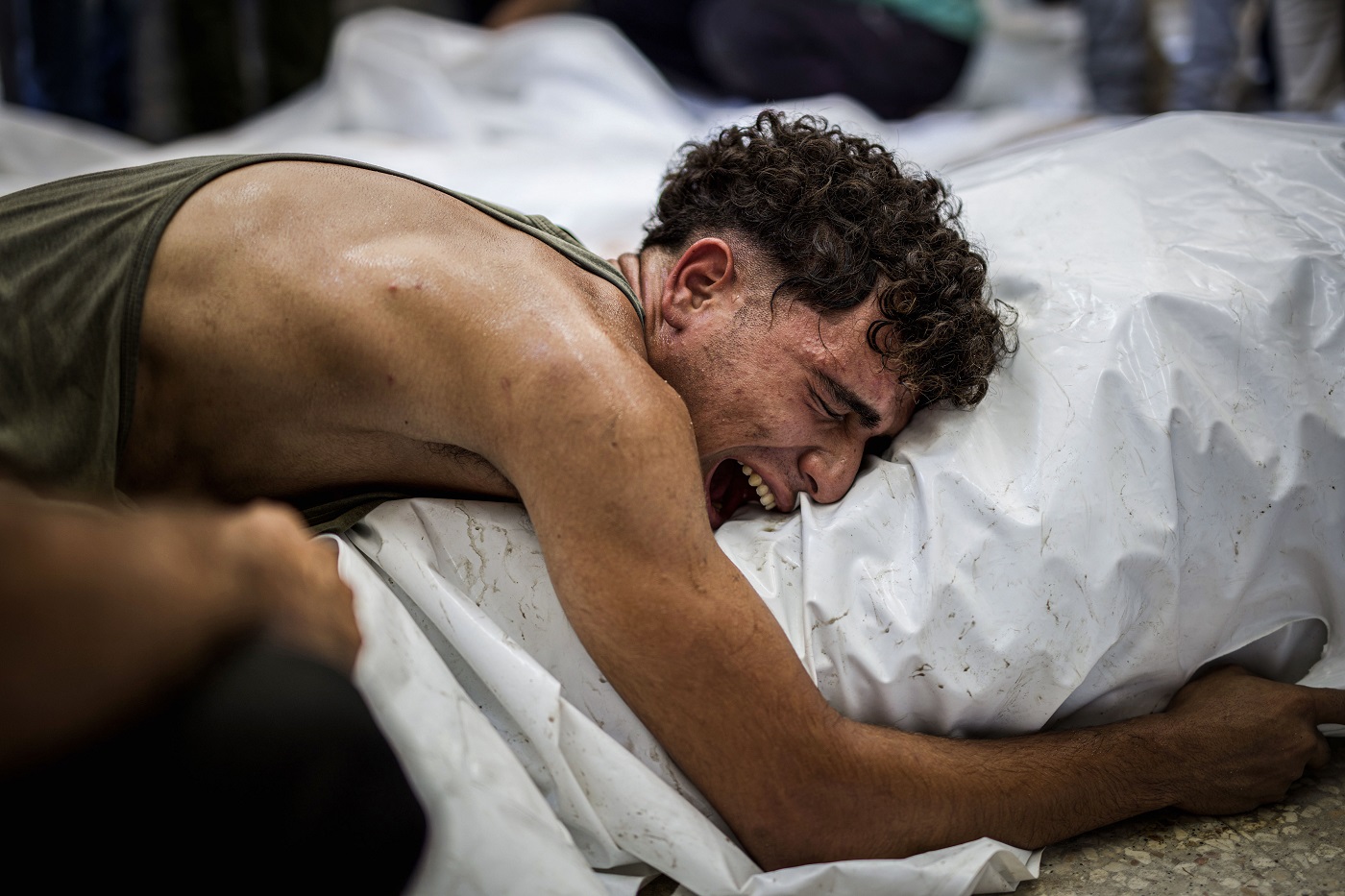
A man cries and embraces the wrapped body of a loved one at the morgue of Al-Aqsa Martyrs Hospital in Deir al-Balah in Gaza on August 13, 2024. A number of injured and deceased Palestinians arrived at Al-Aqsa Martyrs Hospital after Israeli bombings on various areas in the central Gaza Strip. © Saher Alghorra / Zuma Press
I froze. I couldn’t raise my camera. I stood there listening to the cries, the screams and the mothers sobbing. I was pinned to the wall, helpless, paralysed. For the first time, I felt like I couldn’t take another photo.
It wasn’t fear that was stopping me. It was something else. I was simply a human being watching the most heartbreaking scene I had ever witnessed. All I could do was cry in silence.
I said to myself, “Enough. That’s enough for today.” And I quietly left.
Looking back at all of the pictures you have taken, is there one that stands out for you as a point of no return – one that you took and felt like nothing would be the same again?
I’m not sure whether a single photograph can fundamentally change a person. I think it’s the accumulation of experiences, the recurring injuries, the scars that build up that ultimately change us. But there is one image that I’ll never forget, one that continues to haunt me. It’s a photograph I took at the Shuhada al-Aqsa Hospital of Ziad Saydam, an only child who was killed during an attack on the Nuseirat refugee camp.
I can still see the scene in vivid detail. Ziad’s father was sitting on the floor, tightly holding onto his son’s body, crying his eyes out, talking to him as if he could bring him back to life. He kept saying, “Forgive me, Baba. I couldn’t protect you.” His mother kept switching between sorrow and denial. There were moments when she would scream, “Not my son! He’s not dead!” Then suddenly she would stare at him in silence, as if her mind was frozen. I watched, feeling broken and stunned. I couldn’t press the shutter button. But then, in an almost unnatural silence, I raised my camera and took this photograph. The mother is sitting in stunned silence with her hand delicately placed over her son’s heart. Off to the side, the father is in pieces, covering his face, as if he is refusing to look or to believe the extent of his loss.
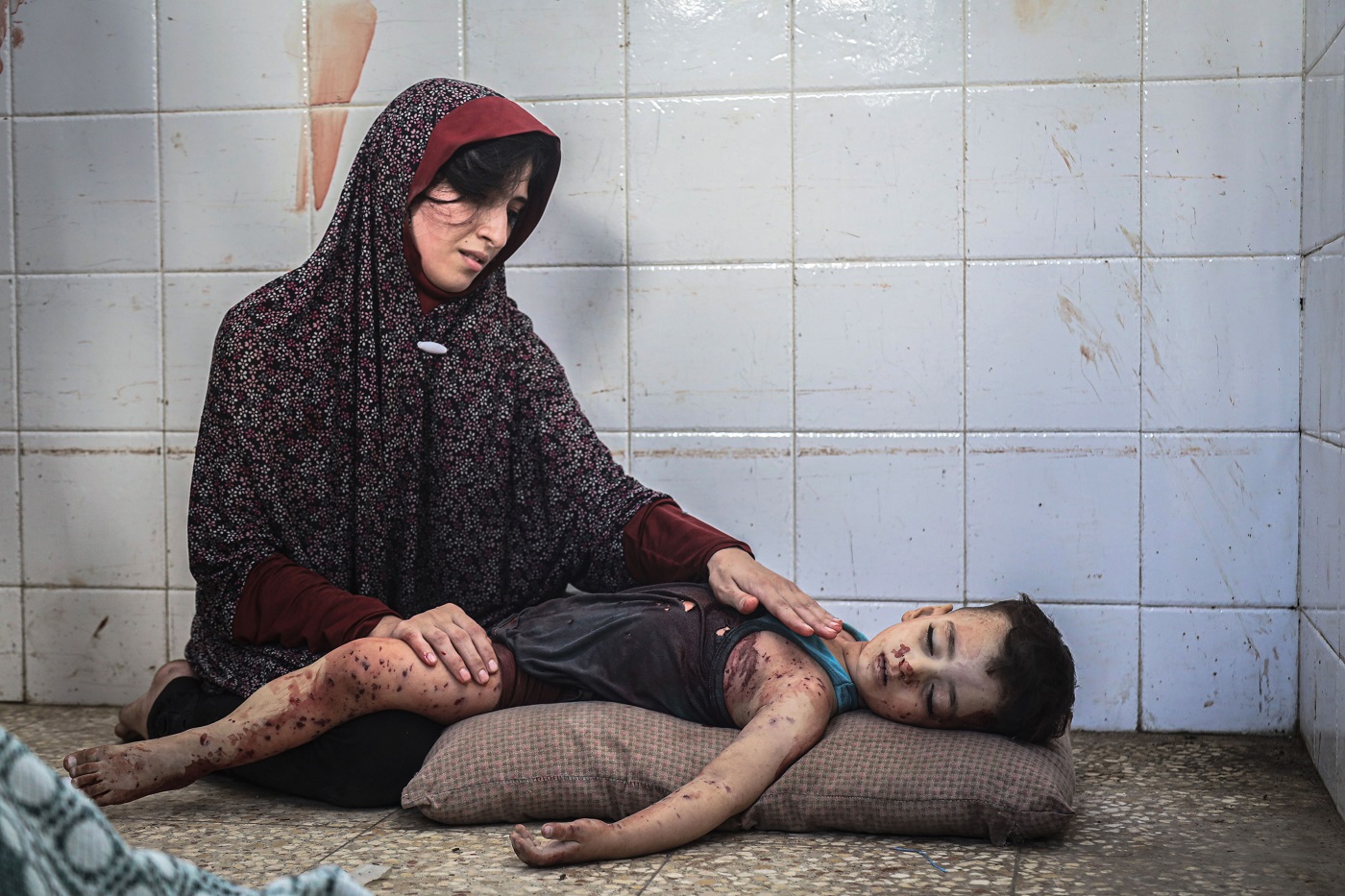
A mother mourns her son, Ziad Mahmoud Ziad Saydam at the morgue of Al-Aqsa Martyrs Hospital in Deir al-Balah in the Gaza Strip on July 24, 2024. The boy was killed on June 24, 2024 during an Israeli raid on a house in Nuseirat Camp, central Gaza after the family had fled to Rafah where they spent two months moving from one place to another for safety and then fled Rafah to find refuge in Deir al-Balah, only for Ziad to lose his life in the attack. © Saher Alghorra / Zuma Press
This was the first image in my series We Have No Escape. In my opinion, it is also the most powerful. I sent it to several international exhibitions, not with the intention of shocking people, but rather to reveal the truth. It portrays everything: loss, turmoil, abandonment and the true cost of war.
But this photo continued to have an impact on me, even after I’d published it and received awards for it. For days, Ziad’s face remained etched in my memory. Every time I closed my eyes, I would see his mother gently stroking his forehead, as if she was still hoping for a miracle. I wouldn’t say that this image changed me from one day to the next. But it’s broken something in me, and I have never been the same.
Since that day, my camera is no longer simply a tool for documenting things. It has become a witness for people whose stories go untold and whose suffering goes unheard.
Why did you decide to put yourself forward for the Humanitarian Visa d’Or? What were you hoping to achieve by doing so?
My decision to put myself forward was driven by my professional ambitions and my commitment to humanitarian work. Organized by the ICRC, this award is one of the most prestigious in the world for humanitarian photojournalism. It stands out for its focus on civilian suffering in conflict zones, which goes far beyond mere facts and events.
When I heard about it, I immediately thought that this was exactly what I’d been looking for. I wanted an opportunity to showcase my photographs, which document the suffering experienced by the people of Gaza, on a respectful platform, where there was no risk of exploitation and where the victims’ stories about truth, dignity and suffering would really be heard.
One of the main reasons I put myself forward was because I knew that this award would give my photographs visibility at the most prestigious photojournalism event in the world, the Visa pour l’image international festival, which is held every year in Perpignan in France. I imagined these photographs of Gaza on display there, in a space where journalists, decision makers and humanitarian workers come together, and I felt that through those people, the voices of the people of Gaza, which are so often absent from the daily news, could finally be heard more clearly around the world.
From a professional point of view, I was also fully aware that winning an award of this calibre would have a huge impact on my career as a photographer. Being honoured by an organization such as the ICRC, whose humanitarian work in conflict zones is recognized worldwide, also gives this award particular significance.
Finally, I would like to take this opportunity to thank Aruallan, a French photographer. She has been such an important part of my journey. From the very start of the war, she has supported me on both a psychological and a professional level.
Can you tell us about your series of photos entitled We Have No Escape? How did the idea come about, and what is the story behind the title?
The title We Have No Escape did not come out of nowhere. It came from a feeling that is felt intensely by everyone living in Gaza: an oppressive feeling of being locked up or trapped with no way out. I was inspired by this verse from a poem by Mahmoud Darwish:
“You are besieged by madness…
The people you love are gone…
There is no escape. There is no escape.”
Every time I hear these words, I feel that they accurately sum up our situation – there is nowhere to go. There is nowhere to shelter from the siege, the bombings, the hunger or the death. Even if we stay at home, death finds us.
Having reflected on what we have experienced during the war, I am sure that this title encapsulates it perfectly. It represents the feeling of being confined in both a physical and a psychological sense. I wanted everyone who looked at these images to feel this weight, to get a sense of what it is like to wake up every morning not asking, “Are we safe?” but rather “Where can we go to stay alive?”
Every photo in this series documents this – lives on hold, trapped bodies, people imprisoned in a reality that is out of their control.
With these images, I wanted to send a message to the world, “If we have no escape from this war, at least I can publish these images to show you what it is really like.”
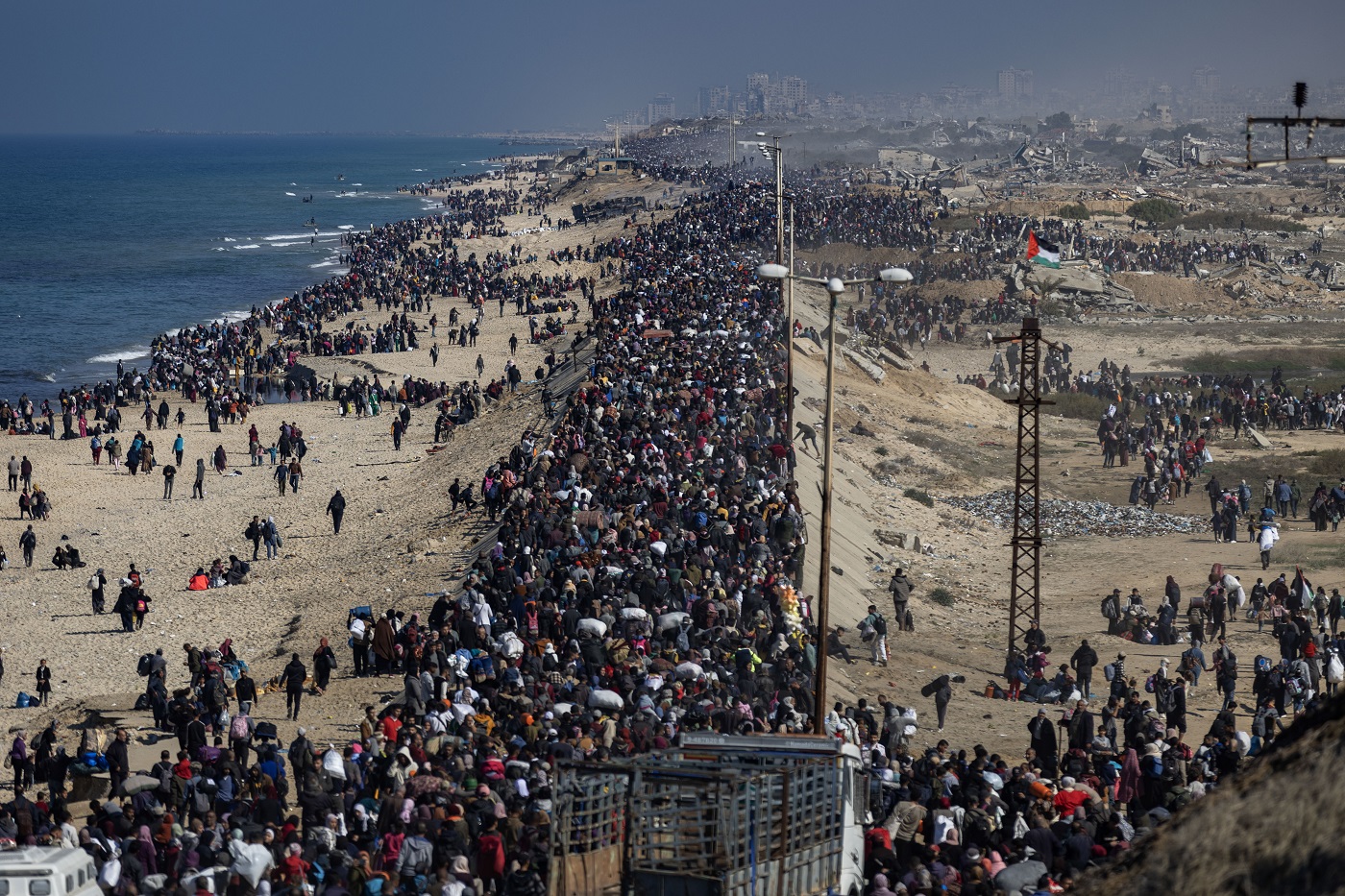
Massive crowds of Palestinians who had been displaced to the southern Gaza Strip, are going back to the northern Gaza Strip, following Israel’s decision to allow their return to their city for the first time since the early weeks of war against Hamas, in the area of Wadi Gaza Bridge in Gaza City on January 27, 2025. © Saher Alghorra / Zuma Press
By recognizing your photographs, this award also honours the people that appear in your images. Did anyone’s expression, story or suffering make a particular impression on you?
Every image in the We Have No Escape series contains a face that haunts me. But one of the most memorable images – one that has never left me – is not related to the bombings but to hunger.
I took it while I was documenting the distribution of free meals at a takaya [soup kitchen] in Khan Younis. Owing to the siege and the complete collapse of the economy, more and more people have become dependent on these simple meals – often rice or soup – which are barely enough to satisfy their hunger. That day, hundreds of people came to get food, particularly women and children. Suddenly, I noticed a little boy who was trapped between the bodies that were squashed up against the iron railings. He was screaming and clearly terrified. His face was red and swollen with distress as he struggled to breathe. With help from the volunteers, I rushed to pull him out of the crowd. We took him away from the commotion and gave him a plate of food.
When I looked around me, I saw mothers and children, their eyes filled with hunger and the fear of leaving empty-handed. It was horrifying. Some of them were crying with their hands in the air in search of some food. Among them were people who, only yesterday, would never have imagined having to queue for a ladle of soup.
I took out my camera and photographed a woman in the middle of the crowd who was screaming with her hands raised up to the sky, a child crying at her feet. I included this photo in my series because it depicts a different kind of suffering. It’s suffering that we cannot see – the pain of a war that destroys dignity through hunger and that kills people slowly, without weapons.
Every time I look at this photo, I feel a newfound sense of duty. I believe I have a duty to tell the stories that are hidden behind the fog of war – the stories of those who may not scream but who are suffering every day.
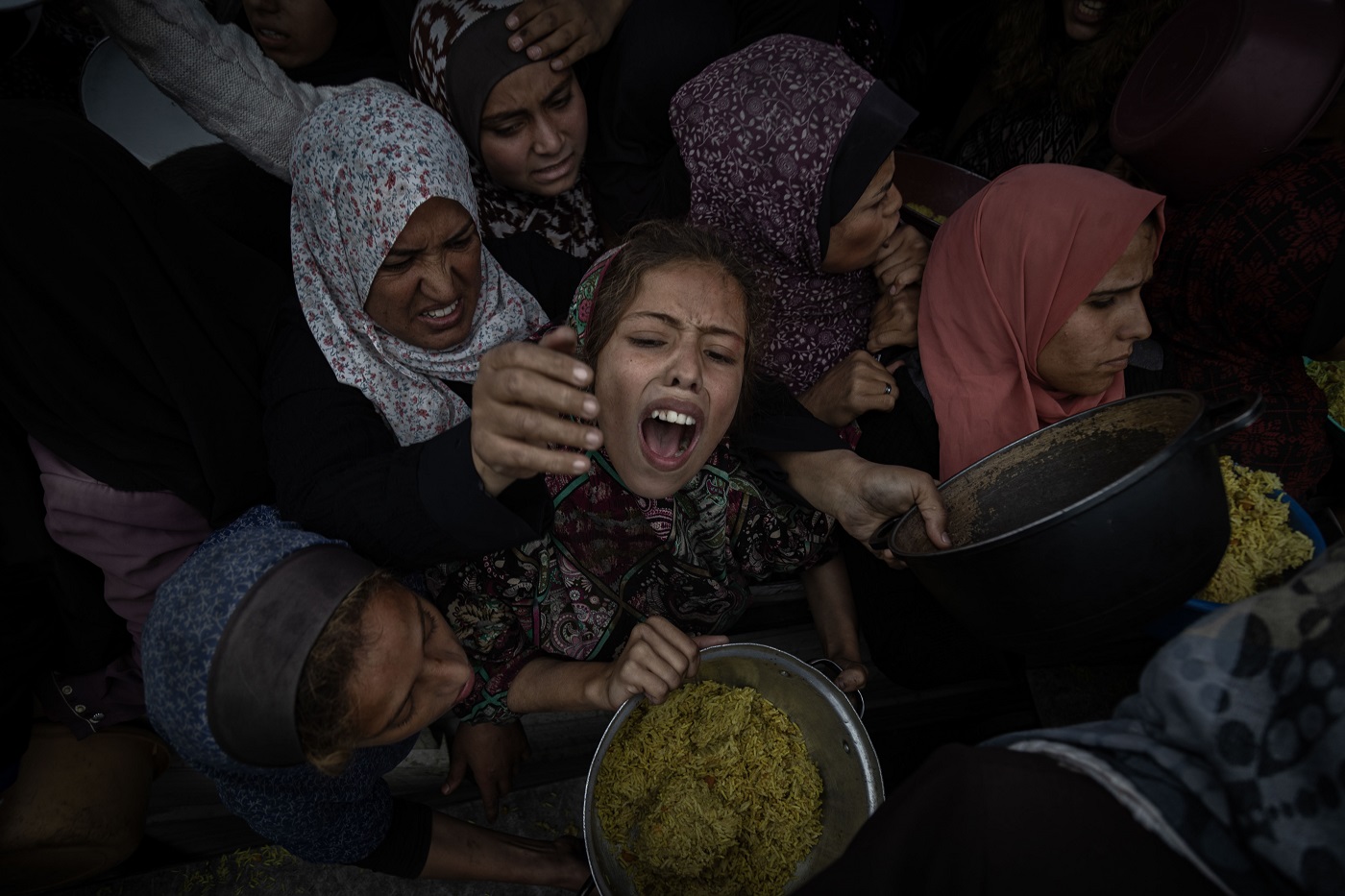
Palestinians women squeezed in a crowd struggle to get food at a charity kitchen, amid a hunger crisis, as the conflict between Israel and Hamas continues, in Khan Yunis, southern Gaza Strip on November 29, 2024. © Saher Alghorra / Zuma Press
What has the war taught you about human nature when it is pushed to its limits?
What I have seen the most is that a lot of people become deeply apathetic. When people suffer so much repeatedly, it ends up suppressing their natural reactions to abhorrent situations, and this is without a doubt one of the most dangerous effects of war on the human spirit. In Gaza, I have come across people whose emotions seem to be numbed by the horror of what they have lived through.
I remember an image that went viral of a man who was sitting in the middle of the street in tears holding the body of a loved one. Meanwhile, people rushed past him, carrying on as usual, almost stepping on the dead person’s limbs. The image was unbearable but it depicted a new normal. Death was now such a big part of everyday life that it only elicited brief glances before life carried on.
It is as if it has become normal to see death on our streets, attracting attention for only a few seconds before everyone goes back to their business. This image affected me deeply, but it has become part of our everyday lives.
People often say that they have nothing left to lose. When death becomes an everyday occurrence and people lose the instinct to protect themselves, it is a sign of collective trauma and the bitter fruit of years of war.
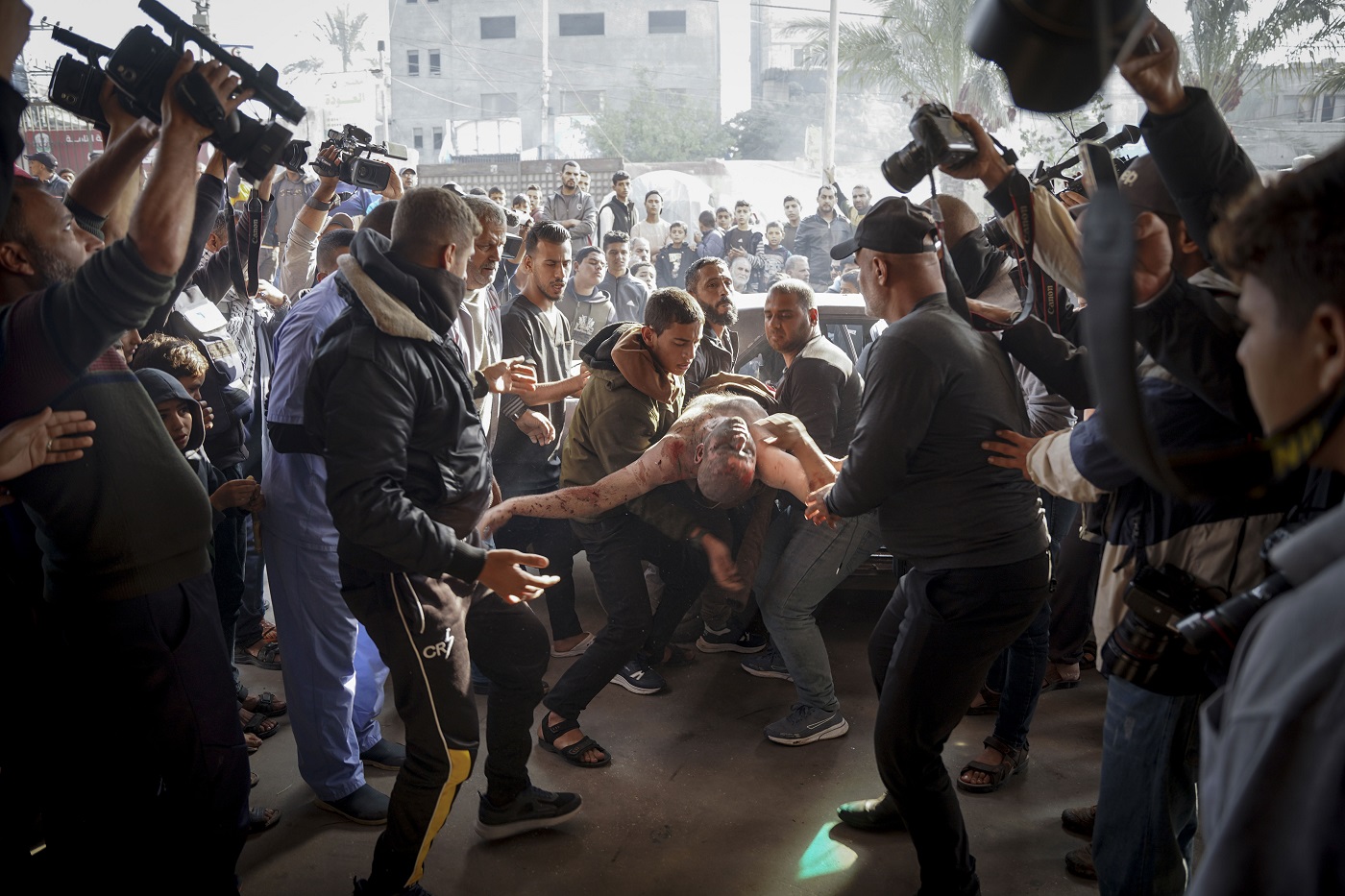
Numerous wounded and killed arrive at Nasser Medical Hospital on the day of the resumption of the war after a truce that lasted 7 days, in Khan Yunis in the Gaza strip on December 1st, 2023. © Saher Alghorra / Zuma Press
About the Humanitarian Visa d’or Award
Created in 2011, the ICRC’s Humanitarian Visa d’or is a photojournalism award that is presented once a year to a professional photojournalist who has covered a humanitarian issue related to an armed conflict. This award is part of the international photojournalism festival Visa pour l’image, and the winner receives a prize of €8,000.
This award aims to highlight the work that photojournalists do every day in the field, but also and above all, to promote international humanitarian law through photography.
Over the course of its 15-year history, the Humanitarian Visa d’or has explored a range of themes related to the humanitarian consequences of armed conflict:
- 2011–2014: Respect for health care services in armed conflict
- 2015–2017: Women in war
- 2018–2019: Urban warfare
- 2022–2023: Forced displacement
- 2024–2025: The fate of civilians in armed conflict.
Click here to read about the previous winners of the ICRC’s Humanitarian Visa d’or award.
Commentaires