

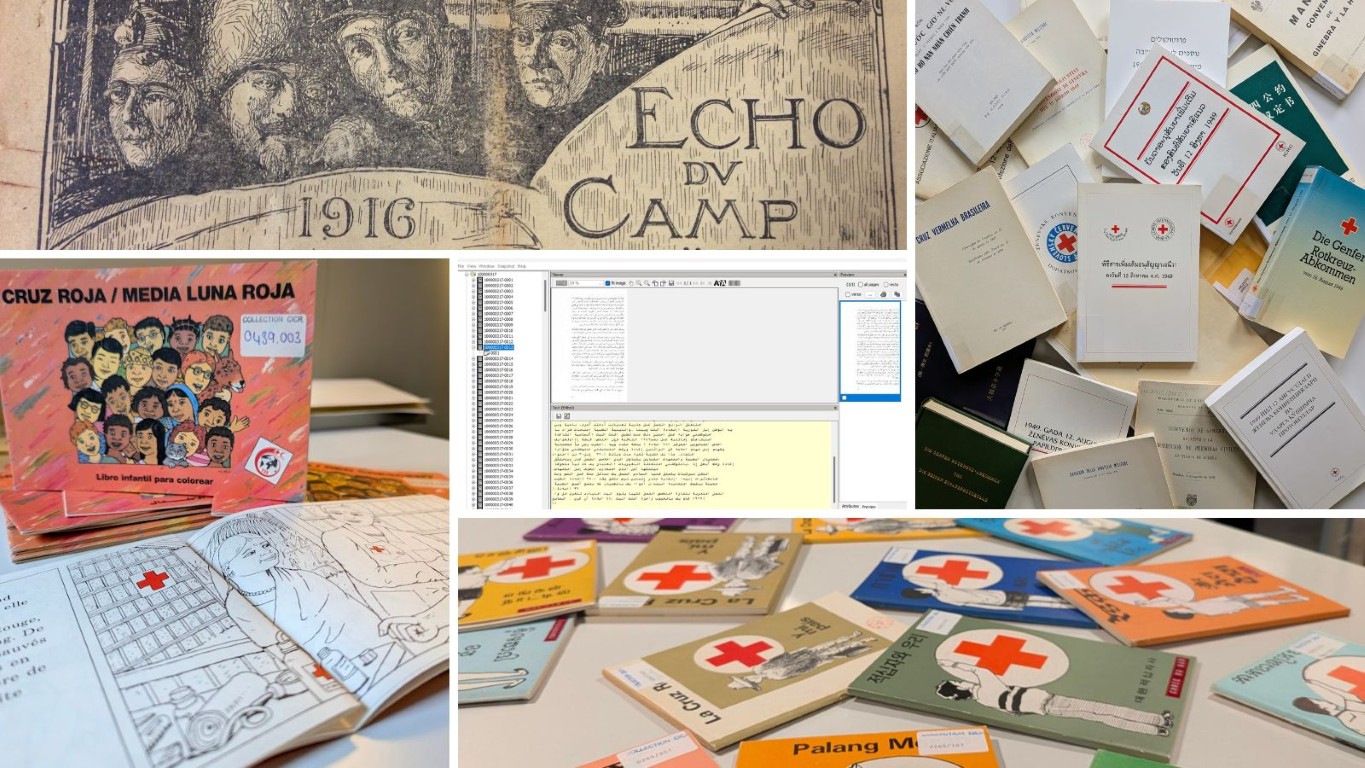
You may have already come across the news on Cross-files: the ICRC archives recently launched their largest digitization project to date. The library is glad to take part in the project and continue making more of its unique collections accessible to all online.
This blogpost takes you behind the scenes of the library team’s work to select and prepare collections for digitization. Plus, a first look at the close to 9’000 publications that will become available online in our catalogue in 2026–2027.
Why and what do we digitize ?
Digitizing our library collections has two clear aims. First, improving access: publications currently only available for consultation in Geneva will become accessible online. Our collections document part of the global history of humanitarian law and action in armed conflict since the mid-19th century. Digitized, they will be open to researchers worldwide and to new technologies for analysis.
Second, preserving them for the long term: when a digital surrogate is available, we can reduce the number of manipulations of the original print copy, helping to minimize damage over time. It remains a balancing act: a few particularly fragile or damaged publications are excluded, deemed too fragile to withstand transport and scanning. Note that, for digitized materials, consultation of the print copy will remain an option when preferred by the researcher, as long as the physical condition of the material allows.
These two aims have always guided our selection of collections to digitize. This time, we’ve selected four : our collection of translations of the Geneva Conventions and their Additional Protocols, our institutional repository of ICRC publications, our “Ancien Fonds” heritage collection and our “Prisoners of War” heritage collection.
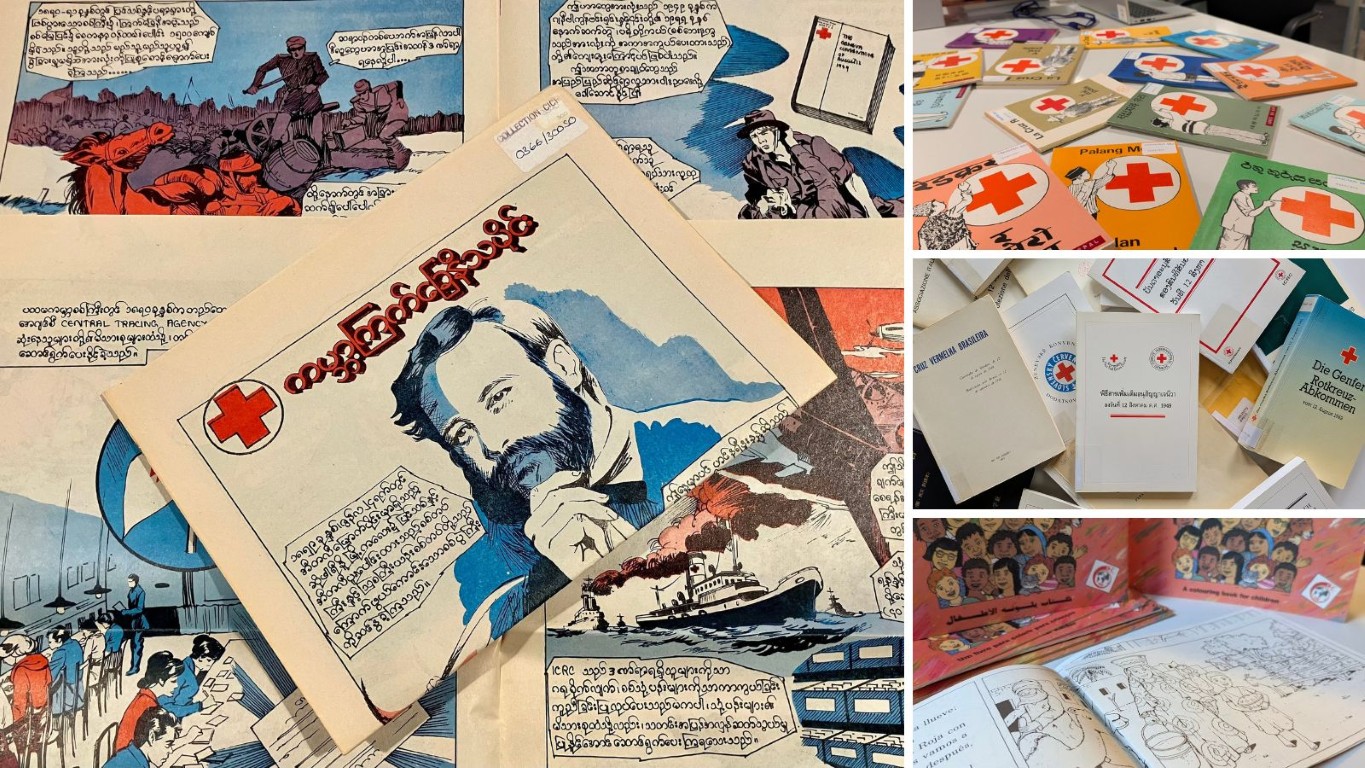
Comic books, brochures and treaties, in 135 different language combinations
Starting with a smaller but strategic collection, we will first digitize translations of the cornerstone international humanitarian law (IHL) treaties, the Geneva Conventions and their Additional Protocols. The digitized translations, from Albanian to Vietnamese, will enrich the ICRC’s IHL databases. Official translations, in particular, will be carefully mapped.
Next, we will digitize our institutional repository of ICRC publications: a collection of everything the ICRC headquarters has ever published in print, plus translations produced in field delegations around the globe.[1] In total, it brings together a little over 4’000 publications, spanning from 1863 up to today (with all publications up to the shift to digital production in the early 2000s to be digitized).
This collection is a unique record of how the ICRC has communicated about its humanitarian mission and action over time. The wide variety of languages – 135 different combinations – and publication types – from comic books to legal treatises – reflect our institution’s longevity, its global footprint, and the diversity of its activities and audiences. The collection also includes some of the ICRC’s most notable intellectual output, from commentaries on IHL treaties to war surgery manuals.
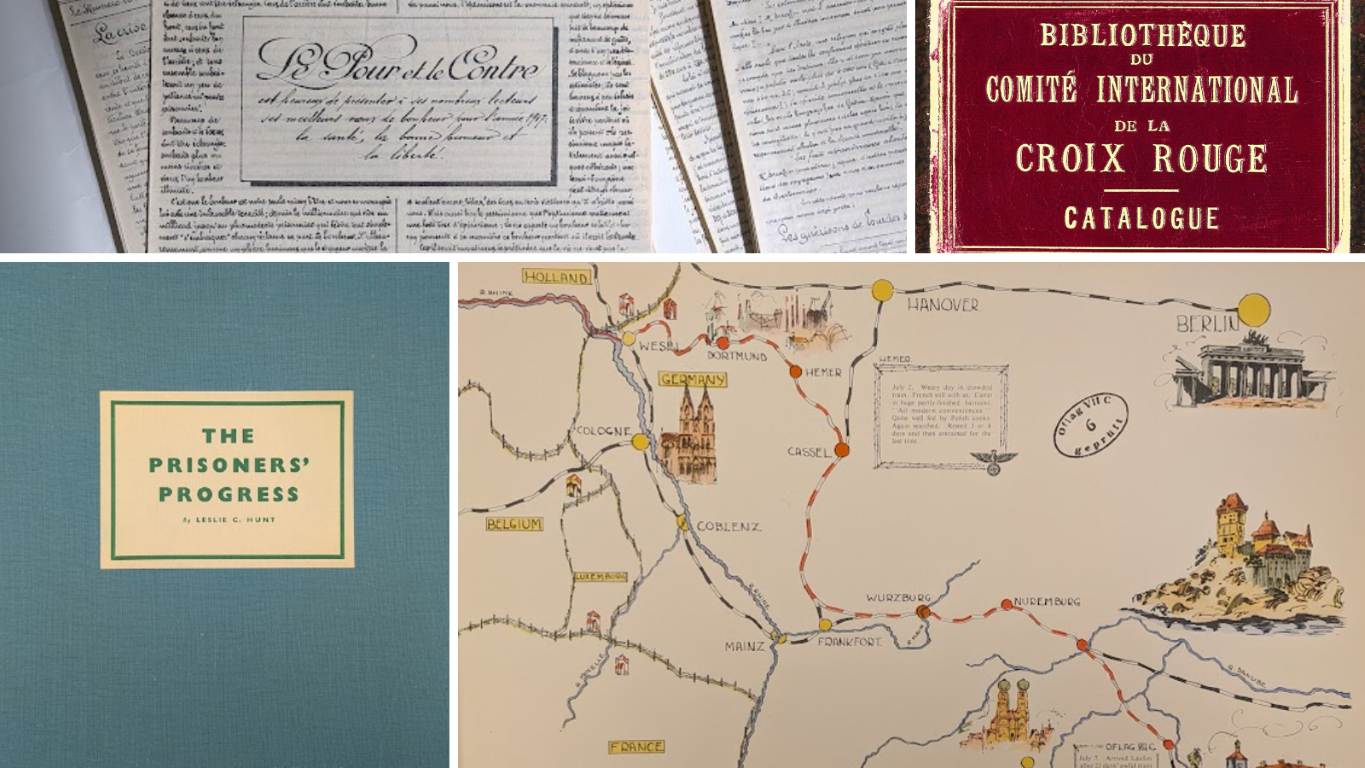
Maps, newspapers and catalogues : a look at the Library’s Heritage Collections
Later in the year, we will continue with the digitization of selected heritage collections. The ‘Ancien Fonds’ collection is the ICRC’s very first library collection. It includes close to another 4’000 publications, spanning from the mid-19th century to the end of the First World War. With detailed illustrations, fragile paper, and many folded tables that resist unfolding, it will be a challenging but rewarding collection to digitize.
Learn more about the ‘Ancien Fonds’ collection here
Our ‘Prisoners of War’ (POW) heritage collection comprises a little over 700 items on wartime captivity. It covers mostly the First and Second World Wars, with a few incursions into the 19th century. Most publications were collected by the ICRC to support the work of its tracing agencies during the two World Wars and, in their aftermath, the development of the legal protection of POWs.
The collection includes regulations and agreements on the treatment of POWs, published reports of visits to POW camps, camp journals, documentation on relief sent to camps (including examples of educational and recreational books), or testimonies by former POWs. It also comprises a series of maps, some recently rehoused and included in the collection for coherency and better preservation.
Learn more about the ‘Prisoners of War’ collection here
How do we prepare collections for digitization ?
A digitization project involves many steps, with seemingly small but consequential decisions at every turn. We keep our ultimate aims of global access and long-term preservation front of mind to guide us, though we sometimes need to adjudicate between the two. Preparation in the library officially began in September 2025. It concluded in March 2026 for the first two collections, and is ongoing for our heritage collections. Below is a look at the different steps involved, introduced with three questions directly lifted from the library team’s weekly digitization meeting.
“Is everything in the catalogue ?”
Clear, clean descriptive library catalogue records, at the right level of granularity, are what make digitized publications findable. The first step in preparation is therefore to create, complement, complete, or correct our existing records, item by item. Working with a small team and a large volume of items, we have to make some pragmatic compromises on our descriptions’ level of detail. We’re hoping to revisit and enrich them at a later stage.
We try and reconstruct our predecessors’ thinking : there is a logic behind how library materials have been collected, organised, and described in the past. Our task is to understand it, resolve inconsistencies, fix mistakes, and keep the collections coherent. Our biggest surprise so far has been the sheer number of existing translations of ICRC publications not previously described, only preserved through a single copy in our repository. Hundreds of such translations will become visible in our catalogue by the end of the year. This first step also involves a few treasure hunts (on a good day) and wild goose chases (on the less good ones) to locate missing items or understand the context around others.
“We’re going to need to do a second round, aren’t we ?”
Once we have clear descriptive records, we can turn our attention back to the physical objects themselves. Preparation for digitization is a chance to review their condition and improve their storage where necessary. Here, we are very grateful for the support of our in-house preservation specialist, shown in the photograph on the right below repairing a map from our POW heritage collection.
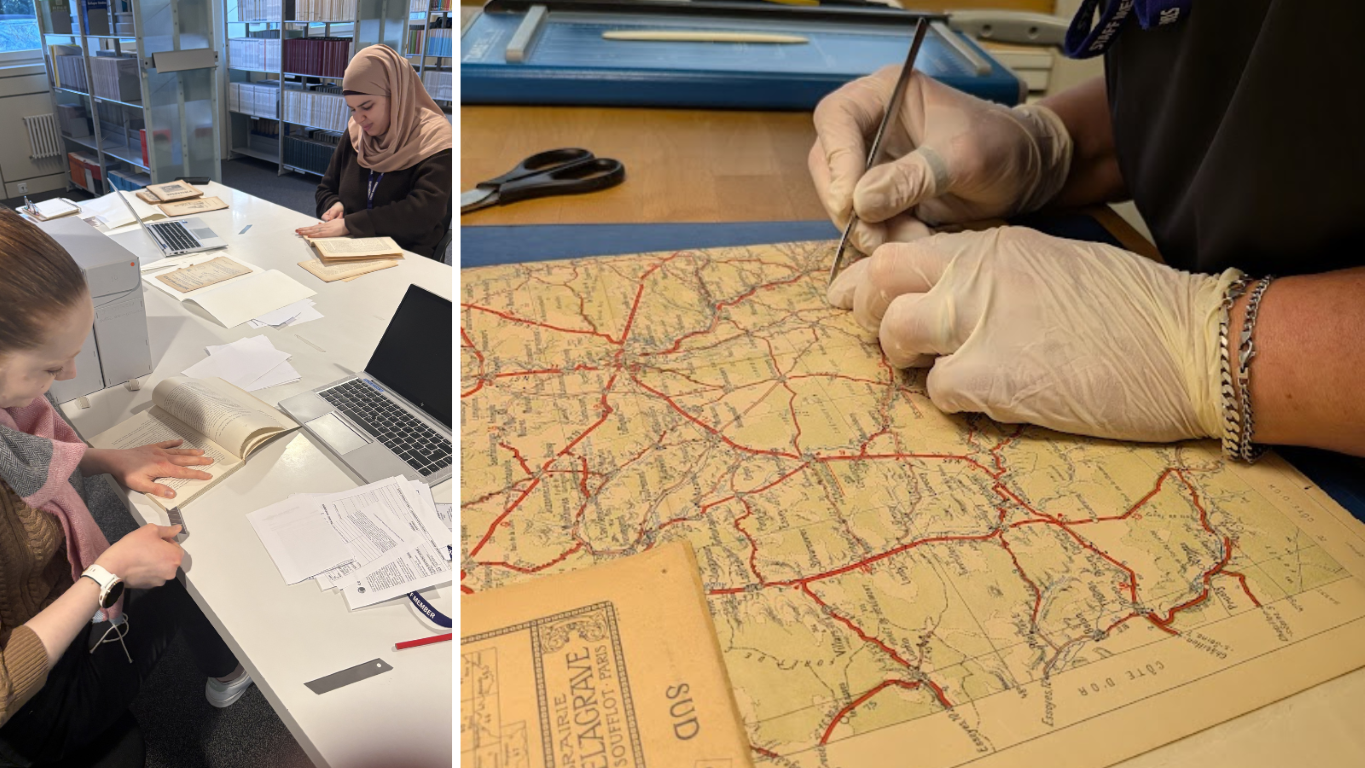
Cutting pages and repairing maps
At this stage, we rehouse fragile books, brochures and newspapers in acid-free cardboard boxes and folders. We take care of uncut pages, remove non-paper supports that need to be stored separately (the 80-90s and their flurry of VHS tapes and CD-ROMs…).
Inevitably, the second round then turns into a third, as we optimize location for transport and digitization offsite.
“Are you good with estimates ?”
Number of publications, number of pages, weight of boxes: preparation for a digitization project is also a numbers game. These estimates serve both internal planning and resource allocation (as our work is a small part of a larger project) and the work of the external provider handling the scanning. A general rule of thumb: there are always more pages in a collection than you would expect, and then still quite a few more. Beyond numbers, we provide our digitization provider with scanning instructions, addressing issues such as the presence of semi-transparent paper (please use contrast), blank pages (please scan if included in pagination), or folded illustrations (please unfold and scan as one view).
Eventually, everything comes together in a spreadsheet: the location of each item within the collection, a file name based on a unique identifier, and bibliographic elements for identification by the scanning operator and for quality control. This step guarantees we will always have a link between a physical item in our collections and the matching digital surrogate. Reference code(s), title, date, language(s), and sometimes author(s): every piece of information has a purpose in the process. Documenting language, for example, serves to select the right dictionary for optical character recognition (OCR). Once the textual layer correctly processed, it will become possible to run full-text searches through the digitized materials.
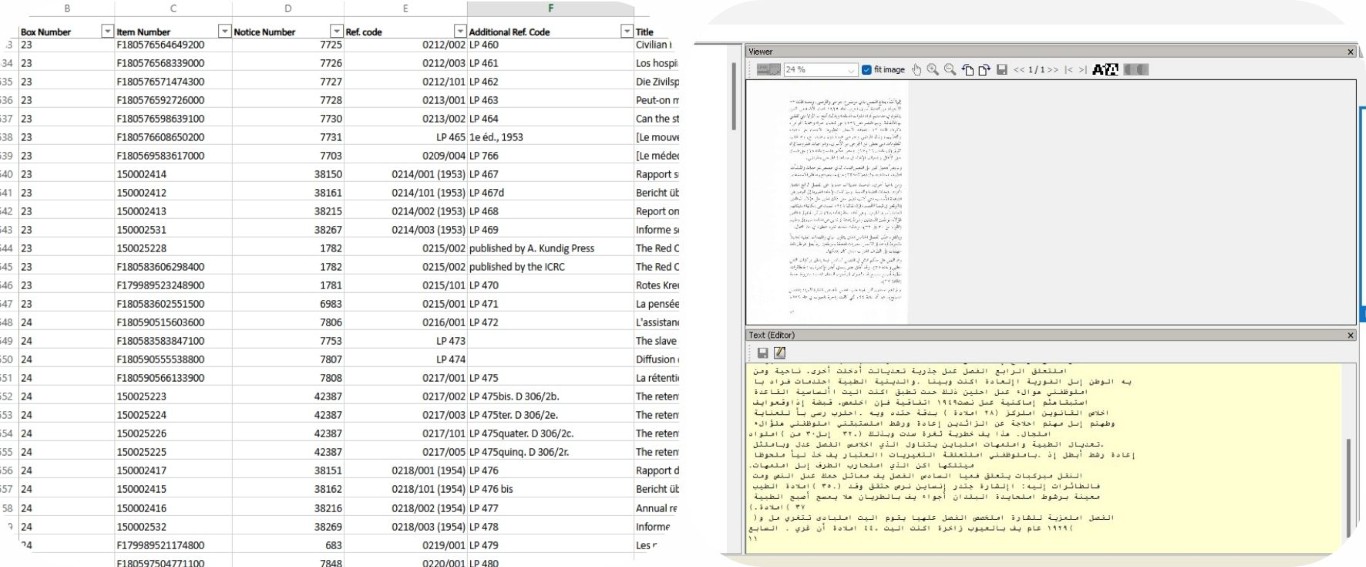
Behind the scenes: tracking sheets and quality control
What comes next?
The first two collections were transported for scanning offsite at the end of April 2026. We are now moving into a testing phase for the transfer and quality control of the digitized documents. We hope to make the first digitized collections available in our online catalogue in the fall, starting with the translations of IHL treaties and the institutional repository of ICRC publications. The heritage collections will then follow in 2027.
Our past experiences have shown us that the digitization itself is only the first step. Watch this space for news, and if you have any related research needs, please do not hesitate to comment or email the team at library@icrc.org. Plans are also starting to take shape for a future unified portal designed to bring together ICRC archival and library holdings all in one place, with new ways to search, explore and connect them.
Last but not least, a sincere thank you to all the colleagues involved, from programme management to IT and procurement, for the work completed so far and for the work ahead.
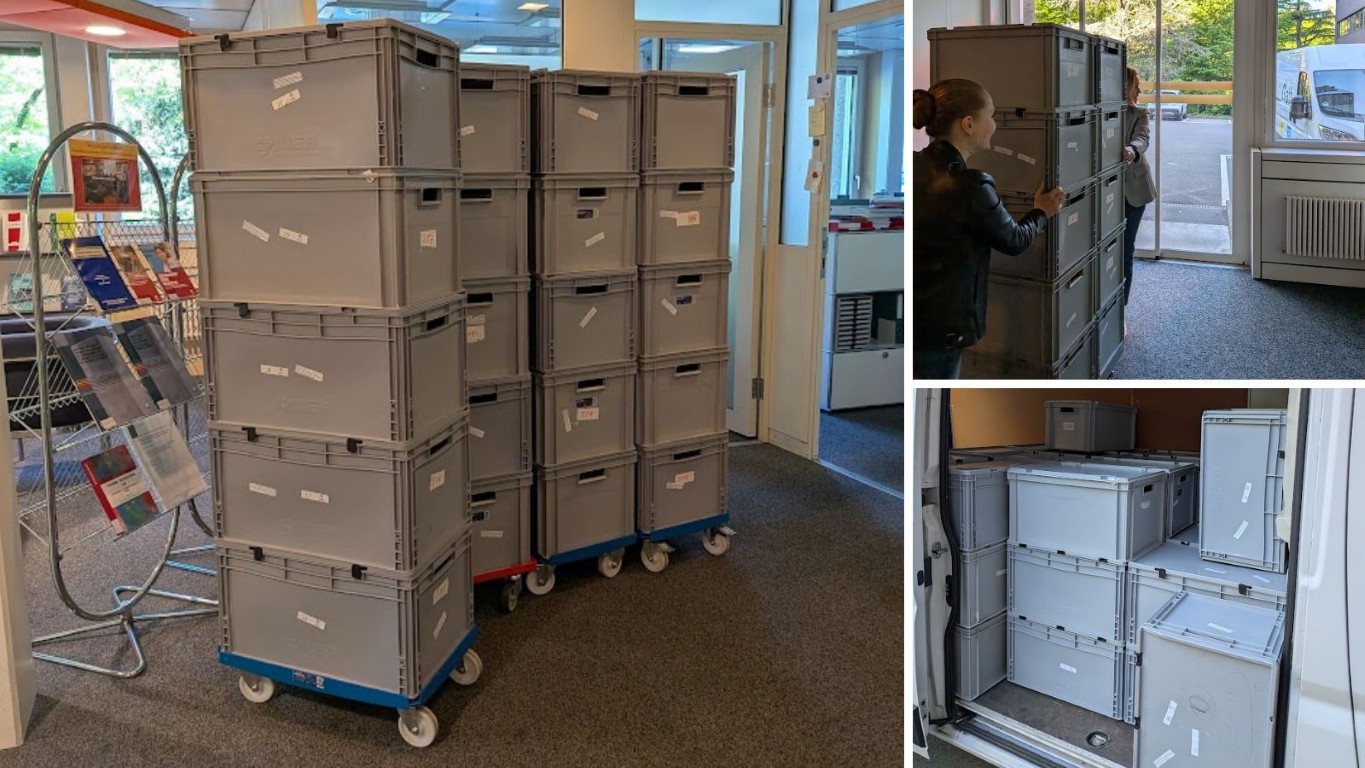
From shelf to truck to scanner, and soon back again
[1] With a few expected caveats. For example, some “grey literature” ICRC documents kept in the library fall outside the scope of the project for the time being, but may very well be included in the future.
Comments