
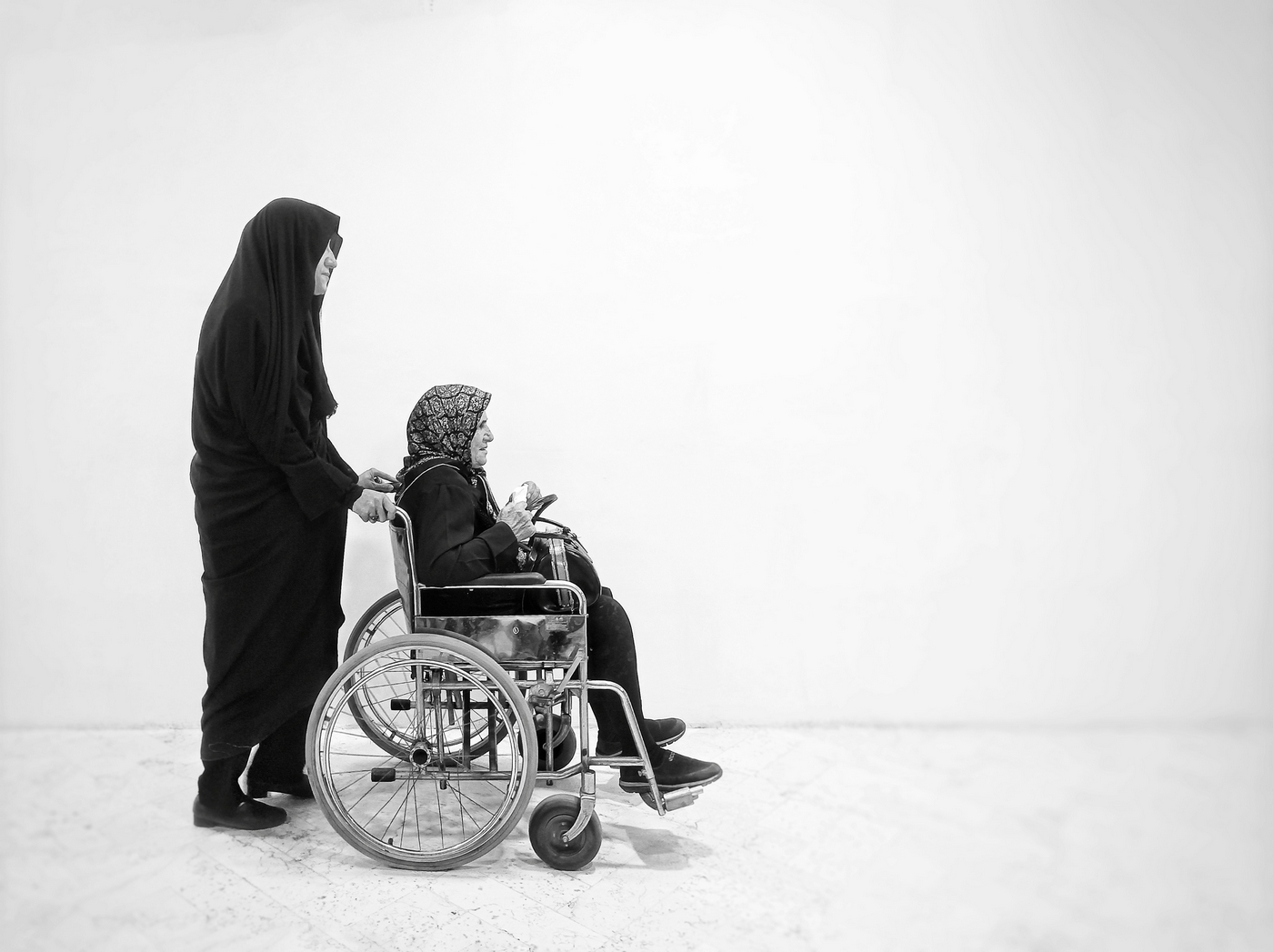
Civilian protection is often assessed by whether a person has been warned, evacuated, registered, sheltered or reached with relief. For many persons with disabilities, each measure depends on a wider chain: support persons, assistive devices, accessible communication, transport, medication, electricity, rehabilitation and local services. This post introduces the dependency-chain test and links it to existing international humanitarian law (IHL) rules on proportionality, precautions, warnings, evacuation, displacement, non-discrimination and relief.
Lassi Murto is a Finnish disability-rights advocate, Chair of SMA Finland and Programme and Thematic Advisor at Abilis Foundation. He lives with spinal muscular atrophy and uses personal assistance in daily life. Writing in a personal capacity, he argues that IHL does not need a new legal category for every support relationship. Disability-inclusive interpretation, informed by the Convention on the Rights of Persons with Disabilities (CRPD), can instead help reveal what existing rules require when civilian safety depends on relationships, devices, services and infrastructure around the person.
A civilian with a disability may be harmed not only when violence reaches the body, but when conflict breaks the chain that keeps the body safe.
That chain can include a caregiver, personal assistant, wheelchair, hearing aid, medication, transport, electricity, rehabilitation, communication device, interpreter, trusted local organization or family member who knows how support works. For many persons with disabilities, protection is not delivered to an isolated individual. It travels through relationships, devices, services, environments and routines.
Civilian protection has a dependency-chain problem.
Protection does not stop at the body
IHL protects persons with disabilities according to their legal status and circumstances. Those who are civilians remain protected against direct attack unless and for such time as they directly participate in hostilities. Persons in the power of a party to the conflict are entitled to fundamental guarantees, including humane treatment without adverse distinction. Customary IHL Rule 138 also recognizes that persons with disabilities affected by armed conflict are entitled to special respect and protection.
Persons with disabilities who are civilians are therefore already within the law’s protection. The harder question is whether protection practice sees the relational and material conditions through which their safety is maintained.
This is not a marginal question. The ICRC’s 2024 Challenges Report recalls the World Health Organization’s estimate that persons with disabilities make up about 16 per cent of the world’s population, with potentially higher proportions in areas affected by armed conflict. Yet protection is still often imagined around the individual body: a person to be warned, evacuated, registered, sheltered, medically assisted or referred.
For many persons with disabilities, that frame is too narrow. A person who cannot leave without assistance is not protected by an evacuation message alone. A powered-wheelchair user is not protected by a shelter without charging access. A person dependent on medication is not protected by safe passage if the medicine cannot move with them. A deaf person is not protected by an inaccessible warning. A person with an intellectual disability is not protected by an incomprehensible registration process. A person dependent on a caregiver is not protected if evacuation separates them.
The person may be visible. The chain may remain invisible.
I live with spinal muscular atrophy and use personal assistance every day. My safety is located not only in my body, but in assistance, electricity, transport, communication, medication, equipment, accessible environments and people who know how support works. When one part fails, a transport problem can become a health risk, a communication barrier a protection risk, a broken device can mean immobility, and the loss of an assistant can mean confinement in practice.
This lived experience is not the source of the legal rules, but it helps reveal what their implementation can miss. Dependency is not an exception to civilian life. It is one of the ways civilian life is organized.
An interpretive bridge already exists
Armed conflict breaks dependency chains directly and indirectly. It destroys roads, power, water, communications and health infrastructure; displaces families; closes pharmacies; interrupts rehabilitation; restricts movement; damages assistive devices; and collapses administrative systems. Even without direct targeting, support systems may be degraded, blocked or broken.
Protection analysis should therefore ask not only where persons with disabilities are, but what must remain connected for protection to become real. This is the dependency-chain test:
When armed conflict disrupts infrastructure, services and movement, does protection still reach the relationships and systems through which persons with disabilities remain safe?
Can a person understand and act on warnings? Can they leave with an assistive device? Can a support person reach them? Can evacuation transport carry a wheelchair, communication device or medical equipment? Can medication, batteries, feeding supplies or repair parts move through disrupted supply chains? Can shelter include the support person? Can registration capture essential relationships without creating risk? Can a person who communicates differently express need, consent, refusal or complaint?
These questions do not demand a separate legal category for every support relationship. They make existing obligations operationally honest.
The legal bridge is already available. For States Parties, Article 11 of the CRPD requires all necessary measures, in accordance with obligations under international law, including IHL, to ensure the protection and safety of persons with disabilities in armed conflict and other situations of risk. The CRPD does not replace IHL. It can help inform how states interpret and implement IHL by directing attention to the barriers, environments and support systems that shape risk. The ICRC’s disability-inclusive IHL position likewise emphasizes better interpretation and implementation of existing rules rather than a new body of law.
Warnings and evacuations must work for the people at risk
Consider warnings. In international armed conflicts governed by Additional Protocol I, Article 57(2)(c) requires effective advance warning of attacks that may affect the civilian population, unless circumstances do not permit. Customary IHL Rule 20 applies in both international and non-international armed conflicts. The ICRC has emphasized two dimensions of effectiveness: whether as many civilians as possible can be reached and whether they have enough time to act.
For persons with disabilities, warnings may need several accessible formats, including Braille, sign language, text messages, large print and simplified language. Time allowed before an attack may also need to account for people who require assistance, must assemble medical supplies, move slowly or need support to act. Issuing a warning is not enough if the people at risk cannot receive, understand or act on it.
Evacuation engages several rules. Article 57(2)(a)(ii) addresses precautions in the choice of means and methods of attack. Article 58(a) and (c) address, to the maximum extent feasible, removal of civilians and civilian objects from the vicinity of military objectives and other necessary precautions against the effects of attacks. Corresponding customary duties are reflected in Rules 17, 22 and 24, which apply in both international and non-international armed conflicts. The ICRC identifies accessible transport, sufficient time, support persons and the ability to take assistive devices as practical features of disability-inclusive precautions and evacuations.
Article 17 of the Fourth Geneva Convention requires parties to endeavour to conclude local agreements for the removal of specified civilians from besieged or encircled areas. Although the treaty uses the dated term ‘infirm’, the ICRC’s 2025 Commentary explains that the provision includes persons with disabilities and expressly identifies accessible communication and transport, accompaniment by support persons, and retention or replacement of assistive devices as feasible measures.
Movement alone is not the measure of successful evacuation. If a person is moved but separated from assistance, communication, medication or equipment, evacuation may relocate danger rather than reduce it.
Protection after movement: shelter, family links and relief
A physically reachable shelter may still lack accessible toilets, charging points, quiet space, privacy for personal care, medication storage, room for support persons or communication support. Protection cannot be measured only by entry, but by whether a person can remain safely and with dignity.
The applicable displacement rule depends on context. In occupied territory, Article 49(3) of the Fourth Geneva Convention governs evacuations undertaken by the Occupying Power. In a non-international armed conflict to which Additional Protocol II applies, Article 17(1) governs displacement ordered by a party. Customary IHL Rule 131 applies in both international and non-international armed conflicts. When displacement occurs, all three require measures to ensure satisfactory conditions of shelter, hygiene, health, safety and nutrition and to avoid separating members of the same family.
The Fourth Geneva Convention separately protects family links. Article 25 safeguards the exchange of family news, while Article 26 requires parties to facilitate enquiries by families dispersed owing to war, with the aim of renewing contact and, if possible, meeting. These provisions do not extend family-link protections to every caregiving relationship. But when a family member also provides communication, mobility, feeding, medication or personal care, separation can break the mechanism through which another civilian remains safe.
This framework suggests an operational question for registration. Can systems capture essential support relationships, separation, lost assistive technology, communication method and the ability to consent, refuse assistance or complain safely? Otherwise, they may record the person while losing the conditions that make protection usable.
The same principle applies to relief. In international armed conflicts to which Additional Protocol I applies, Article 70 governs humanitarian and impartial relief actions conducted without adverse distinction. In non-international armed conflicts to which Additional Protocol II applies, Article 18 contains a corresponding rule. Customary IHL Rule 55 requires parties to allow and facilitate rapid and unimpeded passage of impartial humanitarian relief for civilians in need, subject to their right of control. These rules do not prescribe a single distribution model. Customary IHL Rule 88 also allows different treatment grounded in differing needs. Home delivery, priority arrangements, accessible information, transport support or trusted intermediaries may therefore be needed to turn formal availability into effective access.
Foreseeable harm beyond the first impact
Rehabilitation and assistive technology expose the limits of body-centred protection. Rehabilitation responds to new injury, but also sustains people already living with disabilities. Wheelchair repair, prosthetics, hearing aids, communication and respiratory devices, pressure-relief equipment and rehabilitation services may be essential to survival, not merely quality of life.
The legal analysis must distinguish interrupted services from objects that are damaged, destroyed or seized, because different rules may apply. Assistive devices are civilian objects unless they meet the definition of a military objective and must not otherwise be made the object of attack. Their loss may nevertheless create further civilian harm: a destroyed wheelchair can create immobility; lost communication equipment can make warnings inaccessible; damaged electricity infrastructure can interrupt charging, respiratory support or medicine refrigeration.
This is where reasonably foreseeable indirect or reverberating effects become important. In the ICRC’s view, such civilian harm must be considered in proportionality and precautions assessments. What is reasonably foreseeable remains context-dependent and must be assessed ex ante, using the information reasonably available at the time. A disability-inclusive analysis can reveal causal chains that might otherwise be missed: the first impact may be on a power line, road, pharmacy or device, while the protection consequence emerges through lost mobility, communication, treatment or assistance.
The dependency-chain test does not predetermine the legal outcome of an attack. It improves the factual picture relevant to target verification, proportionality and precautions. The 2022 report of the UN Special Rapporteur likewise warns that disability-related harm is often invisible and that data gaps undermine a full assessment of foreseeable civilian harm.
From consultation to operational knowledge
A dependency-chain approach also matters for do-no-harm. Humanitarian actors may increase risk by separating persons from caregivers, distributing aid in inaccessible ways, replacing devices without understanding their use, moving people to shelters that cannot support them or creating complaint mechanisms they cannot access. Good intentions are not enough if the response does not understand dependency.
Organizations of persons with disabilities (OPDs) are crucial. They often know which persons are least visible, which barriers are most dangerous, which shelters are inaccessible, which communication channels fail and which services cannot be interrupted. For States Parties, Article 4(3) of the CRPD requires close consultation with and active involvement of persons with disabilities, through their representative organizations, in implementing the Convention and in other decision-making processes concerning them. Separately, the ICRC and the UN Special Rapporteur recommend involving persons with disabilities and OPDs in IHL training, military manuals, planning, practical protocols and humanitarian operations.
OPDs should not be treated only as outreach partners after decisions have been made. They should contribute to protection analysis, scenario exercises, programme design, monitoring and evaluation. This is not only more inclusive. It is more accurate.
A dependency-chain lens can improve practice. Protection actors can map critical dependencies. Health teams can identify device, medication and repair needs early. Shelter teams can plan for support persons, charging, privacy and accessibility. Distribution and communication teams can adapt delivery and test warnings. Accountability pathways should not assume literacy, hearing, speech, digital access or independent mobility. Coordination structures can include OPDs as sources of knowledge, not merely beneficiaries of consultation.
The point is not to make humanitarian response impossibly complex. It is to stop simplifying the civilian until protection becomes false.
No humanitarian operation can preserve every relationship, device or service. Resources are limited, conditions change and parties may obstruct access or violate the law. But complexity is a reason to identify the dependencies whose interruption predictably creates grave protection risks, not to classify them as secondary.
For persons with disabilities, the difference between life and danger may lie in a battery, ramp, assistant, caregiver, interpreter, spare part, repair service, transport arrangement, phone charger, quiet space or trusted local contact.
Protection must learn to see these as part of the civilian environment.
The dependency-chain test asks humanitarian actors and parties to conflict to look at protection differently. Not only: is the person alive, registered, evacuated or sheltered? But also: what chain made safety possible, and has conflict broken it?
Protection is not only the distance between a civilian and a weapon. For many persons with disabilities, it is also the continuity of the chain that keeps the civilian reachable, mobile, communicative, supported and alive.
Civilian protection becomes more honest when it protects not only the person in danger, but the conditions through which that person can actually be protected.
Related articles
- Elizabeth Rushing, Nawaf Kabbara, Veronica Ngum Ndi and NG’AA Michael Mwendwa, Persons with disabilities in armed conflict, July 13, 2023
- Alexander Breitegger, Disability-inclusive international humanitarian law (IHL): ICRC views, July 6, 2023
- Victoria Riello, ‘Nothing about us without us’: including civilians with disabilities in the aftermath, November 15, 2022
- Helen Durham and Gerard Quinn, Lifting the cloak of invisibility: civilians with disabilities in armed conflict, April 21, 2022