

November 6th marks the International Day for Preventing the Exploitation of the Environment in War and Armed Conflict. For this occasion, we have put together a selection of books on this subject from our library collections. Enjoy the discovery!
ICRC publications
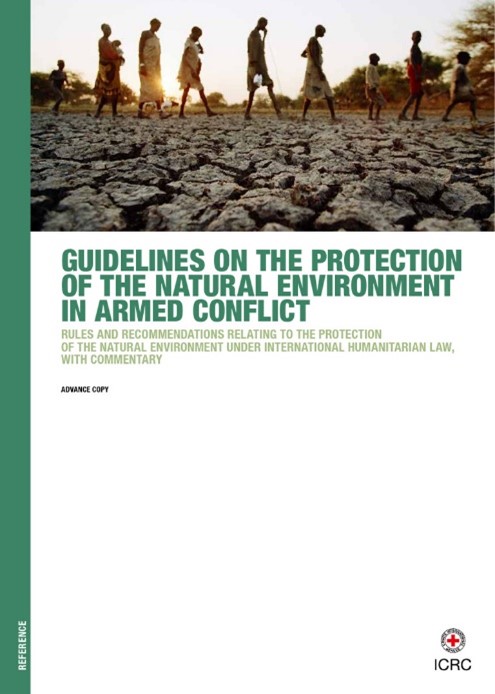 Abstract: The Guidelines on the Protection of the Natural Environment in Armed Conflict set out rules and recommendations relating to the protection of the natural environment under international humanitarian law (IHL). A concise commentary accompanies each rule or recommendation to aid understanding and to clarify its source and applicability. The Guidelines are a reference tool for States, parties to armed conflicts and other actors who may be called upon to interpret and apply IHL. They are intended to facilitate the adoption of concrete measures to reduce the environmental impact of armed conflict and can be incorporated into military manuals and national policy and legal frameworks. Ultimately, better respect for IHL can limit the impact of armed conflict on the natural environment and the deeply interlinked consequences for conflict-affected populations who depend on it.
Also available in Arabic, Chinese, French, Portuguese, Russian, Spanish, and Ukrainian.
Protecting the environment in armed conflict / International Review of the Red Cross, No. 924, December 2023.
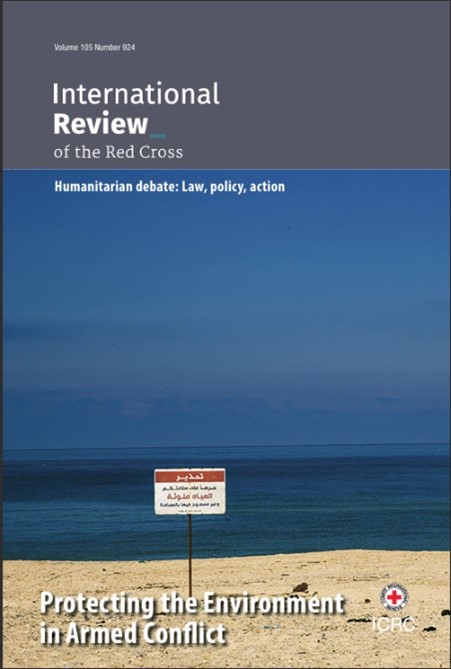
Abstract: In the context of the historical development of international humanitarian law (IHL), the specific protection of the environment is relatively recent. Still, in the almost fifty years since the first treaty rules emerged explicitly protecting the environment during armed conflict, modern understandings of the relationships among ecological and human health, on one hand, and the multi-layered and diverse threats that armed conflicts pose to the environment, on the other hand, have significantly advanced. This issue of the International Review of the Red Cross delves into the many ways that conflict can adversely impact the environment. The articles within it develop thoughtful analysis regarding how the existing international legal framework protects the environment during armed conflict.
Of date palms and dialogue: enhancing the protection of the natural environment under international humanitarian law and Islamic law / Ahmed Al-Dawoody and Kelisiana Thynne, International Review of the Red Cross, No. 925, April 2024.
 Abstract: Conflict-related environmental damage remains a huge challenge. This article provides a brief overview of international humanitarian law (IHL) rules that protect the natural environment in armed conflict and notes some convergences with the rules developed by classical Islamic jurists (those who lived from the seventh century up to the last quarter of the nineteenth century) affording protection to the natural environment. Today, a significant number of International Committee of the Red Cross operations take place in Muslim-majority countries, and some Muslim interlocutors, in particular Islamic non-State armed groups, use Islamic law as their normative framework. For better respect for IHL in relevant Muslim-majority States or territories, considering an Islamic legal approach to the protection of the natural environment alongside IHL would allow the parties to conflicts in such countries to better understand their obligations and should enhance the protection of the natural environment in armed conflict.
War in cities: why protecting the natural environment matters even when fighting is taking place in urban areas / ICRC, 2024. 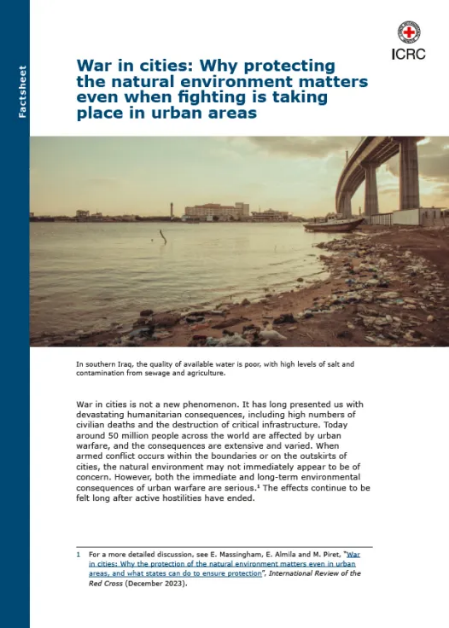
Abstract: Cities contain many natural features, biodiversity and ecosystems. Those provide a multitude of particularly interconnected services to people, which are commonly referred to as “ecosystem services”. These include provisioning (food and clean water), regulating (flood control and pollution filtering), and cultural (recreation, such as parks) and supportive services (nutrient cycling). Fighting in cities will harm these ecosystems and destroy biodiversity, and in turn affect the well-being and health of local populations and their ability to inhabit the area, sometimes even long after the conflict has ended. The contamination of the air, soil, subsoil and watercourses caused by war in cities will be significant due to toxic and harmful constituents inside weapons and explosives used during hostilities in urban settings; fire, debris and rubble that result from such hostilities – especially when facilities containing toxic and hazardous substances are damaged; damage to water, sanitation and electrical infrastructure that services a city. This document lays out the legal and policy framework protecting the environment in armed conflict. It also describes the measures that can and should be taken by states and other actors, including non-state armed groups, as well as humanitarian, community or corporate actors to reduce environmental degradation.
Also available in French and Spanish.
Protection of the environment in IHL
Protection of the environment in relation to armed conflict: 50 years of effort, and no end in sight / Michael Bothe, Environment and security, vol. 1. issue 1-2, September 2023.
Abstract: The debate about environmental protection in relation to armed conflict began around 1970 due to the meeting of two political movements: on the one hand, becoming aware of the environmental problem including concern for future generations and, on the other, a need to develop the law of armed conflict, filling some loopholes left by the Geneva Conventions of 1949 and reflecting experiences of conflicts which had happened since that time. There was (and is) a tension between the military interest of winning a war and the environmental interest of preserving the planet for future generations. Protocol I additional to the Geneva Convention adopted in 1977 constituted a victory for the military interest by defining the threshold of impermissible environmental damage in a way which is a far cry from satisfying the need of environmental preservation. But a lively discourse had started which has brought progress, but is far from yielding satisfactory final results. Major elements are the application of the rules concerning the protection of the civilian population and civilian objects to environmental protection, the principle of due regard for the environment, the recognized need to establish zones protected for the sake of environmental preservation, intensive activities of environmental fact-finding, the challenge of maintaining necessary environmental governance under the condition of armed conflict and environmental restoration as part of peacebuilding after the conflict.
Greening the economy of armed conflict: natural resources exploitation by armed groups and their engagement with environmental protection / Daniëlla Dam-de Jong, Hague Yearbook of international law, 2019.
 Abstract: The exploitation of natural resources, and notably extractives, to fund armed conflict has been identified as one of the six principal pathways for direct environmental damage resulting from armed conflict. Armed groups, including those fighting in a non-international armed conflict and de facto independent non-state territorial entities (DFINSTE), are often involved in these practices. Yet, they sometimes also play a valuable role in protecting the environment in territories under their control. This article explores the normative foundations for the vast practice by armed groups with respect to natural resources exploitation and examines the engagement of these actors with the core standards for environmental protection under international law across three different settings. It concludes that a clear legal basis for natural resource exploitation by armed groups is currently lacking, but that recognition of some rights to exploit natural resources is necessary for the purpose of protecting the inhabitants of territories under control of these groups. It further finds that it is essential that the international community clearly sets out its expectations with respect to environmental protection by armed groups more generally and, where possible, engages with these groups to green their practices.
Enhancing the protection of the environment in relation to armed conflicts: the Draft Principles of the International Law Commission and Beyond / Anne Dienelt and Britta Sjöstedt (special ed.), Goettingen journal of international law, Vol. 10, no. 1, 2020.
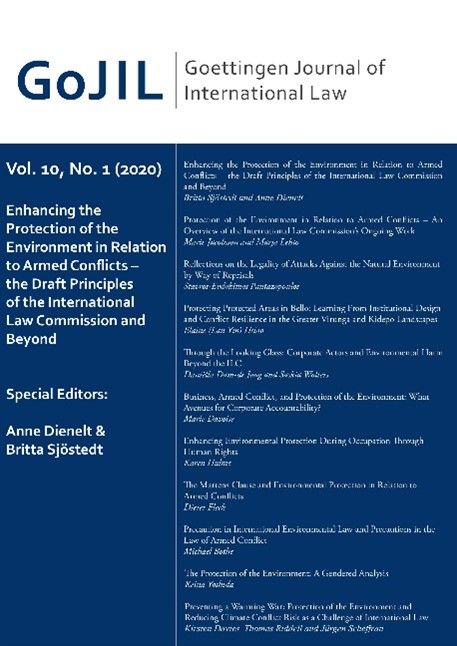
Abstract: In 2011, the UN International Law Commission (ILC) took up the topic Protection of the Environment in Relation to Armed Conflicts. Since the inclusion of the item on the ILC’s agenda, the Commission has published five reports by the two special rapporteurs, Dr. Marie Jacobsson (2011-2016) and Dr. Marja Lehto (2017-). In 2019, the plenary adopted 28 Draft Principles on first reading. Nevertheless, it was clear from the beginning that the ILC would not be able to exhaustively deal with the topic for two main reasons. First, the Commission has a limited mandate. Second, some related issues touch upon controversial and political matters. Consequently, the ILC has been reluctant to include some of these issues in its workflow. Therefore, the adoption of the Draft Principles should be regarded as a starting point for shaping and developing the legal framework for environmental protection in relation to armed conflicts. As a part of that process, Hamburg University and Lund University organized an international workshop in March 2019 in Hamburg. Several members of the ILC, including two special rapporteurs, academic legal experts, and practitioners, attended the workshop to discuss the Draft Principles. The discussion also focused on some issues not covered by the ILC, such as the implications for gender and climate security. The engaging dialogue in Hamburg has inspired the publication of this Special Issue of the Goettingen Journal of International Law (GoJIL) to ensure that the outcomes and ideas of the workshop reach a wider audience. It has also contributed to maintaining the momentum of this topical area of international law by inviting contributions from researchers not present during the workshop in Hamburg.
Protection of the environment under international law during occupation: international humanitarian, human rights and environmental law / Waad Abualrob, 2025.
 Abstract: This book examines the relationship between International Environmental Law and Human Rights Law regarding the protection of the environment in times of occupation. Times of occupation create a tangible threat to the environment, alongside human, animal, and plant rights. This book uses international law to grapple with unprecedented environmental challenges, from water, air and soil pollution and severe damage to natural resources to the complexities of regulating emerging environmental challenges during extraordinary situations. Using international case studies alongside the prominent and evolving role of international law agreements, in particular Multilateral Environmental Agreements (MEAs), this book offers a comprehensive analysis of the legal tools available to navigate environmental challenges under occupation. The book also discusses occupying power obligations under public international law and the demands of protecting the environment in occupied territory.
The environmental consequences of war: legal, economic, and scientific perspectives / ed. by Jay E. Austin and Carl E. Bruch, 2000.
Abstract: Over the last three decades we have witnessed the environmental devastation caused by military conflict in the wake of the Vietnam War, the Gulf War, and the Kosovo conflict. This book brings together leading international lawyers, military officers, scientists, and economists to examine the legal, political, economic and scientific implications of wartime damage to the natural environment and public health. The book considers issues raised by the application of humanitarian norms and legal rules designed to protect the environment, and the destructive nature of war. Contributors offer an analysis and critique of the existing law of war framework, lessons from peacetime environmental law, means of scientific assessment and economic valuation of ecological and public health damage, and proposals for future legal and institutional developments.
This book provides a contemporary forum for interdisciplinary analysis of armed conflict and the environment and explores ways to prevent and redress wartime environmental damage.
Case studies and historical perspectives
Environmental damage in Ukraine as environmental war crime under the Rome Statute: the Kakhovka Dam breach in context / Shah Maruf, Journal of international criminal justice, vol. 22, no. 1, March 2024.
 Abstract: The Russian invasion of Ukraine has caused irreparable damage to the natural environment. Despite being a topic of wide discussion, an analysis of whether the attacks causing such damage can be tried at the International Criminal Court (ICC) as an environmental war crime (EWC) under Article 8(2)(b)(iv) of the Rome Statute remained grossly inadequate. Even after the Kakhovka Dam destruction in June 2023, the most significant incident of environmental damage since the war started, no comprehensive analysis of the incident from an EWC perspective was made. The present article fills this void and thoroughly analyses whether the dam breach can qualify as an EWC under Article 8(2)(b)(iv), the most ecocentric provision in the entire international criminal law (ICL) framework. After providing an overview of the environmental damage caused and a synopsis of the EWC, this article applies the EWC provision to the incident and discusses the prospects and the challenges of characterizing it as an EWC.
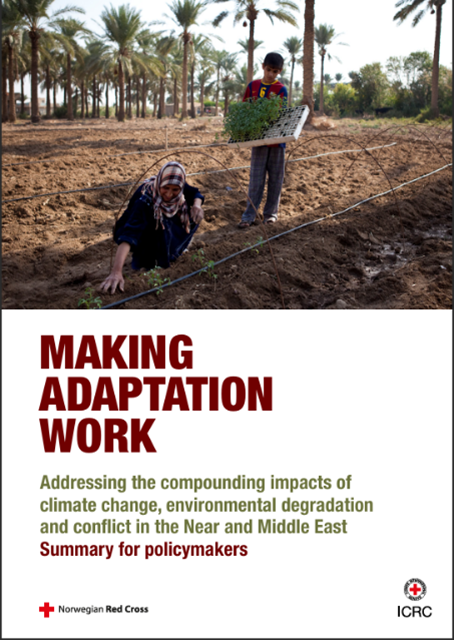
Making adaptation work: addressing the compounding impacts of climate change, environmental degradation and conflict in the Near and Middle East: summary for policymakers / ICRC and Norwegian Red Cross, 2023.
Abstract: The combination of environmental degradation, climate change and armed conflict severely undermines all aspects of human security and exacerbates humanitarian needs. This is a summary for a report that explores how the humanitarian consequences of environmental degradation and climate change are aggravated by armed conflict in the Near and Middle East, using examples from Iraq, Syria and Yemen, and building on the ongoing efforts of the International Committee of the Red Cross (ICRC) and Norwegian Red Cross. The report’s overarching goal is to give humanitarian actors greater insight into the main risks faced by communities in the region and how to better respond to their needs. It also aims to identify opportunities for and barriers to strengthening community resilience to growing climate and environmental risks in area affected by armed conflict, and determine their lasting impact.
Scorched earth: environmental warfare as a crime against humanity and nature / Emmanuel Kreike, 2021.
 Abstract: The environmental infrastructure that sustains human societies has been a target and instrument of war for centuries, resulting in famine and disease, displaced populations, and the devastation of people’s livelihoods and ways of life. Scorched Earth traces the history of scorched earth, military inundations, and armies living off the land from the sixteenth to the twentieth century, arguing that the resulting deliberate destruction of the environment—”environcide”—constitutes total war and is a crime against humanity and nature. In this sweeping global history, Emmanuel Kreike shows how religious war in Europe transformed Holland into a desolate swamp where hunger and the black death ruled. He describes how Spanish conquistadores exploited the irrigation works and expansive agricultural terraces of the Aztecs and Incas, triggering a humanitarian crisis of catastrophic proportions. Kreike demonstrates how environmental warfare has continued unabated into the modern era. His panoramic narrative takes readers from the Thirty Years’ War to the wars of France’s Sun King, and from the Dutch colonial wars in North America and Indonesia to the early twentieth century colonial conquest of southwestern Africa. Shedding light on the premodern origins and the lasting consequences of total war, Scorched Earth explains why ecocide and genocide are not separate phenomena, and why international law must recognize environmental warfare as a violation of human rights.
Read a book review of this title published in the International Review of the Red Cross.
Ecological consequences of the Second Indochina War / Stockholm International Peace Research Institute, 1976.
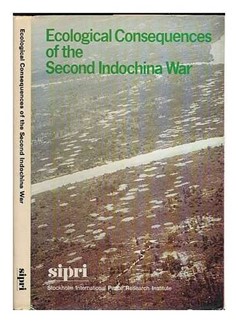
Abstract: The Second Indochina War has introduced into the military lexicon the new word ‘ecocide’. This war was by no means the first in which ecological disruption has occurred. But it stands out in modern history as a war in which international anti-environmental actions were a major component of the strategy and tactics of one of the adversaries. This military assault on the natural resources of Indochina comes at a time in human history when man has begun to realize the awesome dimensions of his routine demands on and abuses of nature. It comes at a time when the world is awakening to a recognition of the inextricable interdependence of man and nature, to man’s obligate dependence for his well-being and very survival upon a finite and increasingly misused globe. As a result, it becomes crucial to examine the Second Indochina War as a case study of modern environmental abuse.
Further readings on environmental issues in the ICRC Library collections
Comments