

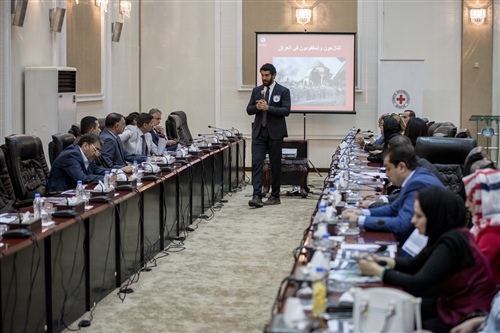
In 2025, the ICRC’s Advisory Service celebrates its 30th anniversary[1]. For three decades, this specialized team has played a pivotal role in helping States translate IHL obligations into concrete national legislation, ensuring that the laws of war are not just abstract ideals but part of domestic legal frameworks.
To mark this milestone, this contribution proposes a short overview of the Advisory Service’s history and highlights its origins, objectives and achievements.
Origins
The ICRC’s attempts to sensitize and support States or national societies in implementing IHL in national legislation did not appear as a sudden idea. This aim had been present at least since the 25th International Conference in 1986[2]. In September 1994, Switzerland convened an intergovernmental experts workshop to study practical means to promote respect for IHL. The experts issued 9 recommendations. One of them pleaded for the establishment of an Advisory Service. Another expert workshop confirmed this need in early 1995[3].
Fully aware that it might be asked to commit itself to such a new endeavor, the ICRC’s governance already debated the creation of an Advisory Service at the end of 1994 and validated its future creation in May 1995.
The 26th International Conference took place in Geneva from 3 to 7 December 1995. It followed the recommendations of the experts meeting and endorsed the creation of an Advisory Service at the ICRC in its resolution: International humanitarian law: From law to action[4].
The creation of the Advisory Service happened at a time when international law was flourishing[5]. While the ICRC supported this trend, there was a more straightforward reason: it considered that the promotion and implementation of IHL was fundamental for its application. Many States needed technical support to implement IHL at the national level, and the ICRC was eager to offer them this service. These trends were complementary, not contradictory approaches. The 26th International Conference recommended that the ICRC create the Advisory Service and prepare a report on the customary rules of IHL. It shows that the ICRC was asked and ready to act in both directions at the same time.
Practically, the ICRC aimed at creating a light and decentralized structure that would be integrated within the existing organizational set up, both at headquarters and in delegations. The Advisory Service innovated by creating a new structural model with supra-regional positions, the first “decentralized lawyers” based in the field and overseeing a whole region.
The team in Geneva started its work in July 1995. The first regional legal adviser, based in Moscow, started in October the same year. In 1996, the set up expanded with new positions filled in Abidjan, Amman, Delhi and Bogota.
Themes and objectives
From its inception, the Advisory Service team has worked to ensure that all States parties to international humanitarian law treaties have national legislation in place that fully complies with the requirements of these treaties and contributes to their effective implementation.
Historically, the first theme in which the Advisory Service played a significant role was the universal adherence to IHL treaties. This includes the 1949 Geneva Conventions, the 1977 Additional Protocols and all other IHL-related treaties.
The protection of the Red Cross and Red Crescent emblems and other protected symbols, as well as the promotion of national laws to regulate the use of these emblems and punish their misuses, was also one of the main objectives that the Advisory Service has pursued since its creation[6].
Quickly after its establishment, an increasing number of States requested the ICRC’s expertise and support in drafting and adopting national legislation for the repression of war crimes and other IHL violations. Therefore, the ICRC created an ad hoc working group to establish a clear institutional line and confirmed the institution’s willingness to support States in this task[7]. In parallel, and complementing these efforts, the ICRC also promoted the implementation of the Rome Statute of the International Criminal Court[8].
The importance of gearing IHL diffusion efforts towards judicial authorities was already discussed at the beginning of the Century. It was also mentioned at the 31st International Conference in 2011[9]. In 2015, the Advisory Service organized an expert consultation that gathered judges, prosecutors and other law professionals. It aimed at better understanding the role of the judicial sector in applying IHL.
Following recommendations from an intergovernmental meeting in 1995[10] and the 26th International Conference in 1995[11], the creation and support to IHL national committees was also identified as an objective consubstantial to the Advisory Service[12]. Among the many activities carried out to achieve this objective, the ICRC has organized 5 universal meetings of IHL national committees and an array of regional ones.
As time passed, the team focused its work to promote and implement IHL on different institutional priorities. For instance, the ICRC has been advocating for the missing and their families for more than a century, but the file acquired renewed importance over the past 25 years. Since 2003, the ICRC expanded its activities by clarifying its aims and concrete action, as well as organizing expert meetings and international conferences on the issue, pleading for further action[13]. In this context, the Advisory Service closely worked with the ICRC’s missing project team on preventive measures or on model laws on the Missing. This theme has remained prominent over the past few years[14].
Over time, many other topics became the object of attention of the organization’s efforts to promote and implement IHL. Following the launch of the Health Care in Danger initiative in 2012, the Advisory Service dedicated more resources to this important issue. Over the past 15 years, themes such as the protection of children, women, cultural property, environment, the use of weapons or the work on addressing sexual violence became significant objectives, whenever the ICRC identified them as institutional priorities, or following resolutions of International Conferences.
In 2016, the Advisory Service strengthened its skills on the interplay between IHL and Islamic law with a new dedicated position. This led, among other things, to the organization of the first global expert workshop on IHL and Islamic law in 2018. Although the promotion of IHL with universities was part of the Advisory Service’s initial mandate, eventually, it strengthened this work in 2020, when it welcomed an advisor in charge of fostering the relations with universities and research centers.
Translating the objectives into practices
Dialogue with all relevant stakeholders – States authorities, IHL experts and practitioners, legislators, judicial authorities, IHL national committees, etc. – is key to achieve these numerous objectives and strengthen the promotion and national implementation of IHL.
Therefore, together with direct relations with States, the Advisory Service has often organized its own events or participated in external expert meetings. The latter has been crucial in the ICRC’s strategy to ensure IHL is adequately reflected in domestic legal frameworks, policies, institutional practices and educational curricula.
A look into the archives shows that hundreds of expert global, regional or national meetings were organized all over the world, including expert workshops to prepare International Conferences, or the universal meetings of national IHL committees in 2002, 2007, 2010, 2016 and 2021. Through this persistent commitment, the Advisory Service has reached thousands of civil servants, practitioners, experts or students, paving the way for a growing general knowledge and experience on IHL implementation.
Other ways to promote the dissemination of IHL and to provide technical support to States have also played a prominent role. For instance, the Advisory Service has produced more than 100 publications encompassing all its working themes in various formats adapted to the needs of its stakeholders, such as model laws, guidelines, factsheets or handbooks.
Thanks to its documentation center and database on national implementation, the Advisory Service keeps track of both the evolution of adherence to international treaties and the development of national legislation.
These activities could not exist without the commitment of highly skilled professionals. The staffing of the Advisory Service has evolved in parallel with the evolution of the ICRC’s budget and funding. It slowly increased over the years, especially in delegations, but also faced several financial crises and reductions. While most of the legal advisers were Swiss in 1995-1996, the Advisory Service also benefited from the internationalization of the ICRC. Nowadays, legal advisers in numerous delegations work with the support of a dedicated team in Geneva specialized in promoting and implementing IHL through the three branches of the State (the executive, the judiciary and legislators), as well as through universities and Islamic scholars, to name but a few. Eventually, it is worth mentioning that in 30 years of existence, it has only had four official heads of unit[15], three of them being women.
Achievements
One of the biggest challenges related to the Advisory Service might be the difficulty to assess its impact and determine to which extent its work has ultimately improved knowledge and respect on/for IHL.
However, indicators exist. Even though statistics and figures cannot comprehensively reflect the expanse of the Advisory Service’s achievements, they still highlight significant positive evolutions in the universalization of IHL treaties and their implementation in national legislations, as well as in the promotion of IHL more broadly.
To date, in addition to the database on national implementation and the online community for IHL national committees, the Advisory Service had produced more than 100 publications, including:
- 53 factsheets
- 11 model laws
- 16 reports
- 8 guidelines
- 10 ratification kits
- 3 handbooks
- 4 legislative checklists
Among these publications, 91 are directly related to the national implementation of IHL, 10 to treaty accession and 8 on IHL and other legal regimes. These figures do not include the numerous academic contributions published by the Advisory Service’s team. Thanks to all the above, States and other stakeholders, such as National Societies or universities, are now better equipped and supported in their efforts.
The Geneva Conventions of 1949 are the first treaties of international law to have been universally ratified. Thanks in part to the work of the Advisory Service, all States in the world have ratified one or more of the three dozen IHL treaties promoted by the Advisory Service, which constitutes more than 2’300 ratifications/accessions in 30 years.
Nowadays, 122 States on all continents have an IHL national committee or similar body. Most of them were created after the start of the Advisory Service’s work and often with its support and technical guidance. The most recent one, in Chad, was created on 23 October 2025.
These few figures demonstrate that the activities and commitment of the Advisory Service have made a concrete contribution to the promotion and implementation of IHL throughout the world.
Conclusion
The history of the Advisory Service at the ICRC is the story of a long and coherent development and evolution.
Its creation in 1995 was a response to a growing recognition that the effective implementation of IHL at the national level is essential for its respect and enforcement. Over the years, the Advisory Service has become a trusted partner for States, offering technical expertise, fostering dialogue, and providing tools to address the evolving challenges of modern conflicts.
While the Advisory Service has consistently implemented a clear mandate, its objectives and themes have evolved by including issues related to the ICRC’s new or renewed institutional priorities.
A look at the concrete activities carried out –technical support, organization of events, the drafting of publications or the management of the national implementation, among others– shows their remarkable continuity, and therefore relevance.
States have constantly praised the Advisory Service. Over time, their requests have become more and more sophisticated and technical. The Advisory Service provides expertise and guidance to both States with limited resources and others with large legal setups.
The Advisory Service’s achievements speak for themselves: the universal ratification of the 1949 Geneva Conventions, the broad establishment of IHL national committees, and the creation of a wealth of resources, including model laws, guidelines, and databases. These milestones underscore its pivotal role in bridging the gap between the principles of IHL and their practical application at the national level.
[1] Advisory Service on IHL, https://www.icrc.org/en/advisory-service-ihl
[2] XXVth international conference of the Red Cross, Geneva, October 1986, Report of the International Humanitarian Law Commission, p. 4, https://library.icrc.org/library/docs/CI/CI_1986_006_FRE_008.pdf ; XXVth international conference of the Red Cross, Geneva, 23-31 October 1986, report, p. 153, https://library.icrc.org/library/docs/CI/CI_1986_RAPPORT_ENG.pdf ; “National Measures to Implement International Humanitarian Law: a new move by the ICRC”, International Review of the Red Cross, n°263, 1988, https://international-review.icrc.org/sites/default/files/S0020860400061623a.pdf
[3] “Document de travail établi par le Gouvernement suisse sur la base des neuf recommandations issues d’une réunion préparatoire tenue à Genève (26 – 28 septembre 1994)” ; “Réunion du groupe d’experts intergouvernemental pour la protection des victimes de la guerre (Genève, 23-27 janvier 1995) : Recommandations”, Revue internationale de la Croix-Rouge, n°811, 1995. All articles are available online : https://international-review.icrc.org/fr/revues/ricr-no-811-revue-internationale-de-la-croix-rouge-02-1995
[4] International humanitarian law: from law to action: report on the follow up to the international Conference for the Protection of War Victims : report of the President of the Intergovernmental Group of Experts for the Protection of War Victims (Geneva, 23-27 January 1995) : Commission I : war victims and respect for international humanitarian Law (item 2 on the provisional agenda), Geneva, 1995, https://library.icrc.org/library/docs/CI/CI_1995_140_ENG_146.pdf; Report of the twenty-sixth International Conference of the Red Cross and Red Crescent, p. 123, https://library.icrc.org/library/docs/DIGITAL/CI_1995_RAPPORT_ENG.pdf
[5] The international community had just established ad-hoc tribunals (ICTY in 1993 and ICTR in 1994); 50 years after Nuremberg, international criminal law was reborn with the establishment of the ICC in 1998; human rights law was flourishing, within and beyond the UN system; new IHL treaties were signed or enhanced (CWC in 1993, Protocol on Blinding Laser Weapons in 1995, Ottawa treaty in 1997, Second Protocol to the Hague Convention of 1954, etc.)
[6] Implementing the rules of international humanitarian law, importance and difficulties. Diagnosis of the present situation on the continent, 29 October 2001, speech given by Maria Teresa Dutli, head of the Advisory Service, at a governmental experts meeting on the implementation of IHL and related inter-American Conventions.
[7] For instance, in 2001, the Advisory Service published Punishing Violations of International Humanitarian Law: A Guide for Common Law States https://www.icrc.org/en/publication/0792-punishing-violations-international-humanitarian-law-national-level-guide-common-law
[8] See, for instance, War Crimes under the Rome Statute of the International Criminal Court and their source in Internatoinal Humanitarian Law, https://www.icrc.org/sites/default/files/document/file_list/war-crimes-comparative-table.pdf
[9] Plan d’action quadriennal pour la mise en œuvre du droit international humanitaire, Résolution 2, XXXIème Conférence internationale de la Croix-Rouge et du Croissant-Rouge, Genève, 2011, https://www.icrc.org/fr/doc/resources/documents/resolution/31-international-conference-resolution-2-2011.htm
[10] International humanitarian law: from law to action: report on the follow up to the international Conference for the Protection of War Victims : report of the President of the Intergovernmental Group of Experts for the Protection of War Victims (Geneva, 23-27 January 1995) : Commission I : war victims and respect for international humanitarian Law (item 2 on the provisional agenda), Geneva, 1995, https://library.icrc.org/library/docs/CI/CI_1995_140_ENG_146.pdf
[11] International humanitarian law: from law to action: report on the follow up to the international Conference for the Protection of War Victims: report of the President of the Intergovernmental Group of Experts for the Protection of War Victims (Geneva, 23-27 January 1995): Commission I: war victims and respect for international humanitarian Law (item 2 on the provisional agenda), Geneva, 1995, https://library.icrc.org/library/docs/CI/CI_1995_140_ENG_146.pdf
[12] Paul Berman, “The ICRC’s Advisory Service on International Humanitarian Law: the challenge of national implementation”, op. cit.
[13] ICRC report: the missing and their families. Summary of the Conclusions arising from Events held prior to the International Conference of Governmental and Non-Governmental Experts (19-21 February 2003), 16 January 2003, https://www.icrc.org/en/doc/assets/files/other/icrc_themissing_012003_en_10.pdf; See also The Missing. ICRC Progress report, 2006, https://www.icrc.org/sites/default/files/external/doc/en/assets/files/other/icrc_002_0897.pdf
[14] For example, the 2nd universal meeting of IHL national committees in 2007 mainly focused on this issue.
[15] We are not counting maternity covers and ad interim positions.
Comments