
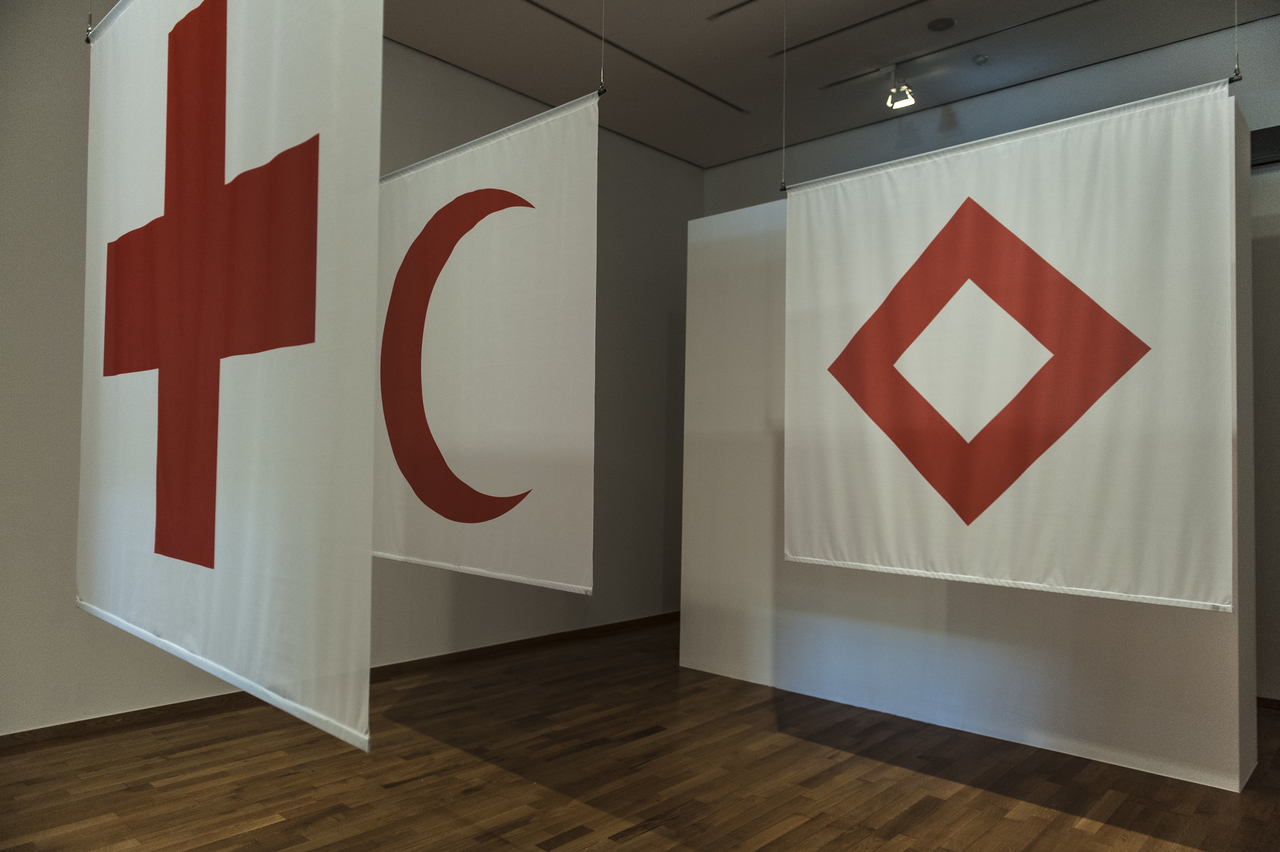
Genève, Musée Rath. Inauguration de l'exposition "Humaniser la guerre? CICR - 150 ans d’action humanitaire." Les différents emblèmes protecteurs - croissant rouge, croix rouge et cristal rouge. Geneva, Rath Museum. Inauguration of the exhibition "Humanizing war ? ICRC - 150 Years of Humanitarian Action." The protective emblems: red crescent, red cross and red crystal. Les trois emblèmes de la croix rouge, du croissant rouge et du cristal rouge protègent les blessés, les services de santé des armées ainsi que le personnel médical en temps de guerre. Ils ont également pour vocation d'identifier les collaborateurs du CICR et les volontaires des Sociétés de la Croix-rouge et du Croissant-Rouge dans leur travail quotidien en faveur des victimes de la violence armée, des catastrophes natuelles ou d'autres situations d'urgence humanitaire. L'emblème de la croix rouge sur fond blanc est choisi en 1864 comme signe de protection des services médicaux des armées et des Sociétés de secours aux militaires blessés. En 1876, l'Empire ottoman adopte comme signe protecteur un croissant rouge sur fond blanc. Ce nouvel emblème est reconnu définitivement en 1929. En 2005, un nouvel emblème, le cristal rouge, est adopté pour les Sociétés nationales qui ne peuvent pas utiliser la croix rouge ou le croissant rouge. L'exposition "Humaniser la guerre?" retrace l'évolution du CICR ainsi que l'évolution des challenges auxquels l'institution est confrontée. L'exposition fait partie du projet des "150 ans d'action humanitaire" du CICR. Les interactions humaines entre bélligérants, victimes et employés du CICR sont au coeur de cette exposition. The three emblems of the red cross, the red crescent and the red crystal, protect the wounded in times of war and safeguard military medical services and health workers in the field. These symbols also serve to identify ICRC staff and volunteers of the Red Cross and Red Crescent National Societies in their daily efforts to help victims of armed violence, natural disasters, and other humanitarian emergencies. The red cross emblem on a white background is chosen in 1864. As a protective symbol, it shields both army medical services and relief societies that aid the wounded. In 1867, the Ottoman Empire adopts the red crescent on a white background as a protective sign. The new emblem is recognized in 1929. Another emblem, the red crystal, is adopted in 2005 for use by National Societies that cannot use the red cross or red crescent. The “Humanizing War?” exhibition takes a look at the evolution of the ICRC as well as the evolution of the challenges it faces. The exhibition is part of the “150 years of humanitarian action” project. At the heart of this exhibition are the human interactions that take place between the belligerents, the victims and the ICRC employees.