

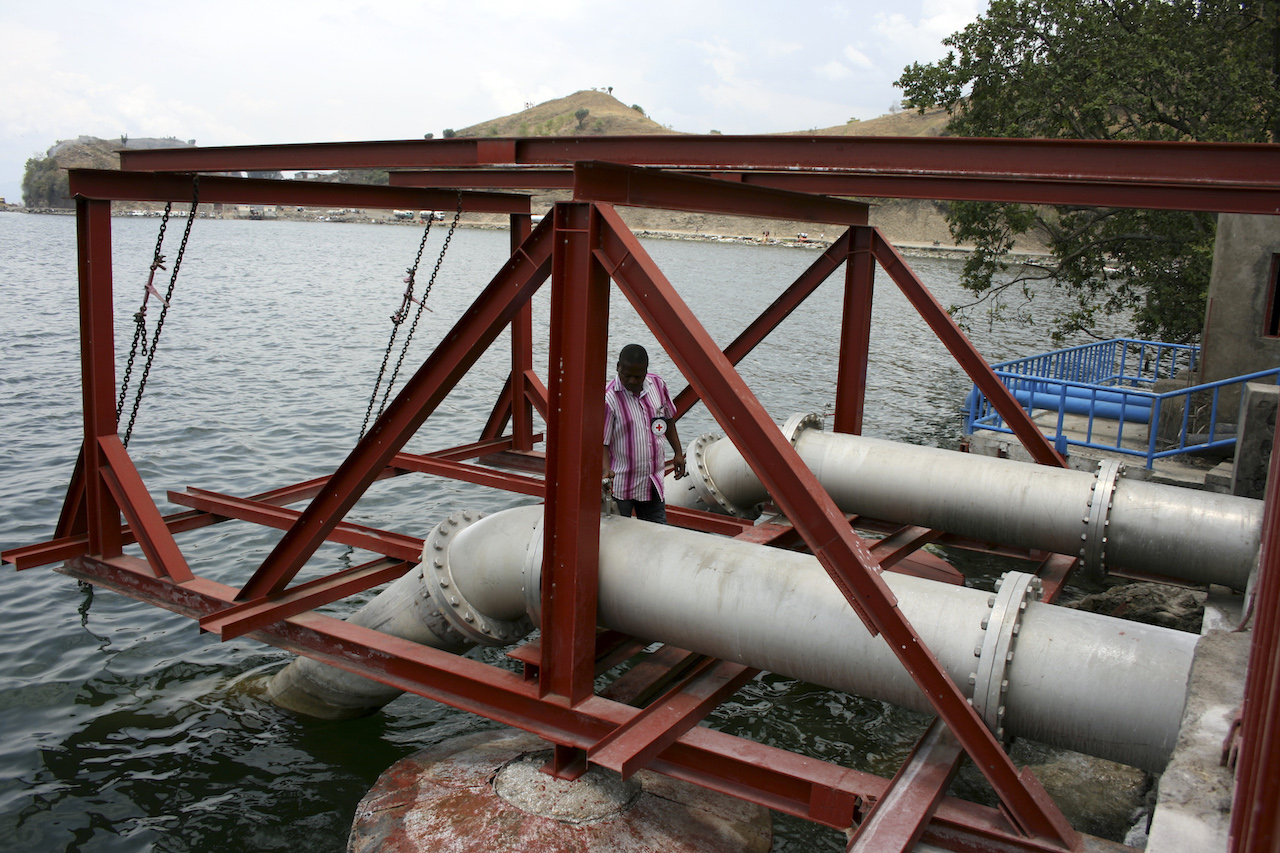
Ville de Goma, quartier de Mabanga Nord. La station de pompage construite par le CICR et REGIDESO entre 2012 et 2015 est la seule source d'approvisionnement en eau de la ville de Goma. Goma city, North Mabanga district. The pumping station built by the ICRC with REGIDESO between 2012 and 2015 is the only water supply of Goma city. Entre 2012 et 2015, le CICR a construit la station de pompage, seule source d’approvisionnement en eau dans la ville de Goma. Depuis les années 1990, le CICR s’est impliqué dans le développement et la réhabilitation des infrastructures de production et de distribution d’eau potable à Goma, en collaboration avec REGIDESO, la régie de distribution d’eau de la République démocratique du Congo. Ensemble, ils entretiennent un réseau de distribution d’eau de plus de 80 kilomètres. Le lac Kivu est la seule ressource en eau de Goma. Cette eau nécessite d’être traitée pour la rendre potable et limiter la transmission de maladies. Estimée à 100'000 habitants en 1990, la population urbaine de Goma est dix fois plus nombreuse en 2017. La forte pression démographique couplée avec les effets des conflits récurrents dans la région sont à la base de déplacements continus des populations civiles. Dans les quartiers ouest de la ville, des points d’approvisionnement en eau potable ont été installés rendant l’accès aisé pour la population. D’autres points d’approvisionnement en eau potable ont été installés près du lac pour éviter la consommation de l’eau non traitée. Between 2012 and 2015, the ICRC built the pumping station, the only water supply of Goma city. Since 1990, the ICRC is involved in the development and rehabilitation of drinking water supply and production infrastructures in Goma, in collaboration with REGIDESO, the water board of the Democratic Republic of the Congo. Together, they maintain a water distribution network of more than 80 kilometers. Kivu lake is the only water resource in Goma. This water needs to be treated to turn it into drinking water and limit the transmission of diseases. Estimated to 100’000 inhabitants in 1990, Goma city’s urban population reached 1’000’000 in 2017. There is a continuous civilian population displacement due to the high demographic pressure and the effects of recurrent conflicts in the region. In the west districts of the city, drinking water supply points were installed, making access to water easier for the population. Other drinking water supply points were installed near the lake to avoid the consumption of untreated water.