
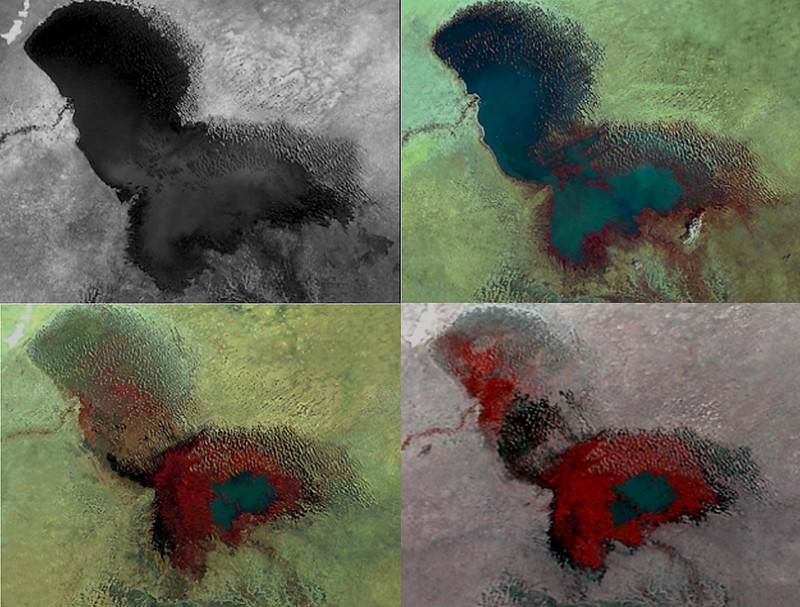
DCA01 - 20010302 - WASHINGTON, DC, UNITED STATES : In this montage of images taken 02 March, 2001 from the NASA Internet site shows Lake Chad, shown in the years clockwise from upper-L 1963, 1973, 1987 and 1997. Lake Chad, once one of the African continent's largest bodies of fresh water, has dramatically decreased in size due to climate change and human demand for water. Once a great lake close in surface area to North America's Lake Erie, Lake Chad is now a ghost of its former self. According to a study by University of Wisconsin- Madison researchers, working with NASA's Earth Observing System program, the lake is now 1/20th of the size it was 35 years ago. Found at the intersection of four different countries in West Africa (Chad, Niger, Nigeria and Cameroon,) Lake Chad has been the source of water for massive irrigation projects. In addition, the region has suffered from an increasingly dry climate, experiencing a significant decline in rainfall since the early 1960's. The first image , taken with the Argon satellite in October 1963, and three subsequent Landsat satellite images taken in January 1973, January 1987, and January 1997, show the progression of the lake as it shrinks. The red color represents vegetation on the lake bed where there was once water. EPA PHOTO NASA/NASA/kb/fm