

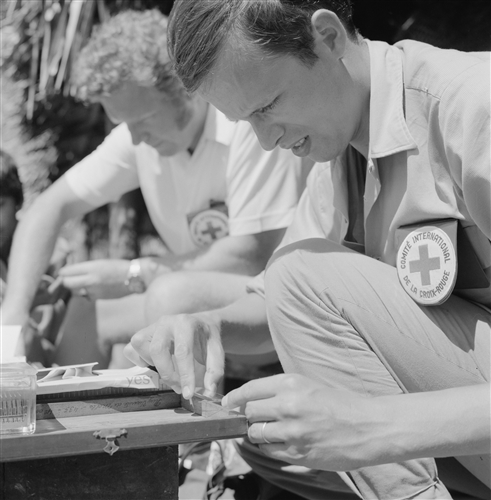
Amazonie brésilienne. Prélèvement de sang et analyse du taux d'hémoglobine dans une tribu d'Indiens Kayapo par les docteurs Bakker et Habersang. Brazilian Amazon region. Blood sampling and hemoglobin analysis in a tribe of Kayapo Indians by Dr. Bakker and Habersang. Mission médicale en Amazonie brésilienne Le 10 mai 1970, une mission de la Croix-Rouge, composée de trois médecins (allemand, néerlandais et suédois), ainsi que du délégué général du CICR pour l’Amérique latine et d’un ethnologue suisse, quitte Genève, emportant avec elle plus d’une tonne de matériel. Elle a pour tâche d’enquêter sur les conditions d’existence et de santé des populations indigènes dans différentes régions d’Amazonie brésilienne. Après une halte à Rio de Janeiro, où un médecin de la Croix-Rouge brésilienne se joint à elle, l’équipe s’envole pour Santa Isabel do Morro (« Ilha do Bananal »). Du 16 mai au 7 août, elle parcourt quelque 22 000 km, accomplissant le circuit de base suivant: « llha do Bananal » (environ 550 km au nord de Brasilia), « Parque Nacional do Xingu », Guiaba (Mato Grosso), Vilhena (à la frontière entre l’Etat de Mato Grosso et le territoire de Rondonia), Porto Velho (Rondonia), Guajara-Mirim et retour à Porto Velho, Manaus, Tabatinga et retour à Manaus, Boa Vista, « Parque Nacional do Tumucumaque », Belem, Maraba, Santa Isabel. A partir de ces différents points, l’équipe ne cesse de rayonner, effectuant des expéditions de plusieurs jours en avion, en bateau ou à pied. Jouissant d'une entière liberté de mouvement, les médecins de la Croix-Rouge entrent en contact avec plus de 20 tribus, réparties dans une trentaine de villages et représentant plus d'un tiers de la totalité de la population indienne (50 000-70 000) de l'Amazonie brésilienne. Auprès de toutes ces tribus, ils prélèvent des échantillons sanguins afin de les analyser en laboratoire. Dans chaque village, ils donnent des consultations et distribuent des médicaments et du matériel sanitaire, notamment à Bananal, Haut Xingu, Guiaba et Guajara-Mirim. Source : Rapport d’activités du CICR, 1970 Medical mission to the Brazilian Amazon region. On 10 May 1970, a team of three doctors (one German, one Dutch, and one Swedish), as well as the ICRC Delegate-General for Latin-America, and a Swiss ethnologist, leave Geneva for Brazil with more than a ton of equipment. Their mission is to enquire into the living and health conditions of the indigenous populations in various regions of the Brazilian Amazon. In Rio de Janeiro the team is joined by a doctor from the Brazilian Red Cross. On 16 May the team takes off for Isabel do Morro (llha do Bananal). From that day until 7 August it travels some 12,500 miles taking in: llha do Bananal (about 350 miles north of Brasilia), the Parque Nacional do Xingú, Cuiabá (Mato Grosso), Vilhena (on the border between the Mato Grosso and Rondonia), Porto Velho (Rondonia), Guajará-Mirim (then back to Porto Velho), Manaus, Tabatinga (and back to Manaus), Boa Vista, Parque Nacional do Tumucumaque, Belem, Maraba, Santa Isabel. From these various places the team covers much ground in expeditions lasting several days, by plane, canoe, or on foot. Having full freedom of movement, the Red Cross doctors make contact with more than twenty tribes in some thirty villages and representative of more than a third of the 50,000—70,000 Indian inhabitants of the Brazilian Amazon region. From all these tribes the doctors take blood samples for laboratory analysis. In each village, they examine many people and administer more medical supplies, particularly at Bananal, Upper Xingú, Cuiabá and Guajará-Mirim. Source: ICRC Annual Report, 1970