Nowadays on the global stage, the states of the Gulf Cooperation Council: Saudi Arabia, Qatar, the United Arab Emirates, Oman, Bahrain, and Kuwait are shaping a new collective role, in which influence, funding, and humanitarian engagement intersect in powerful ways. Today on the show we’re focused on the—at times—complex and nuanced humanitarian role these states play on the global stage. Then turn to an interview with Mamadou Sow, head of the International Committee of the Red Cross’s delegation to the Gulf States, to explain how we work with these to support humanitarian action and ensure that the laws of war and the obligations of states engaged in conflict are upheld.
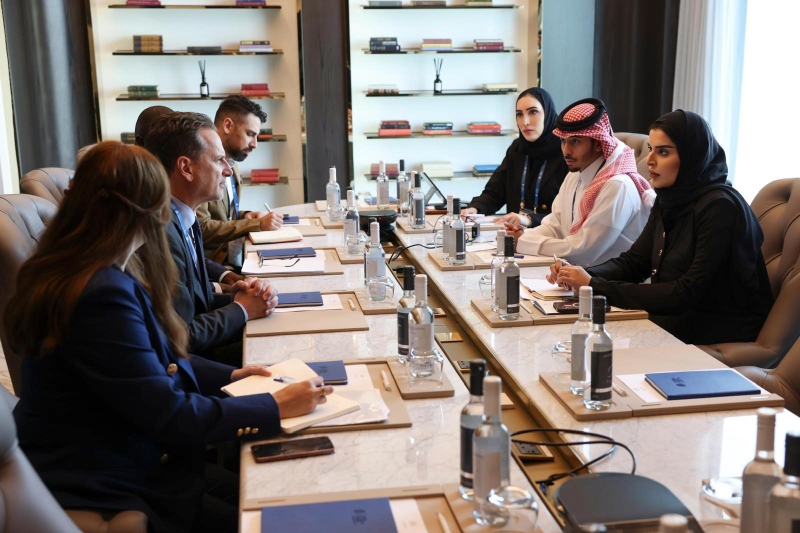
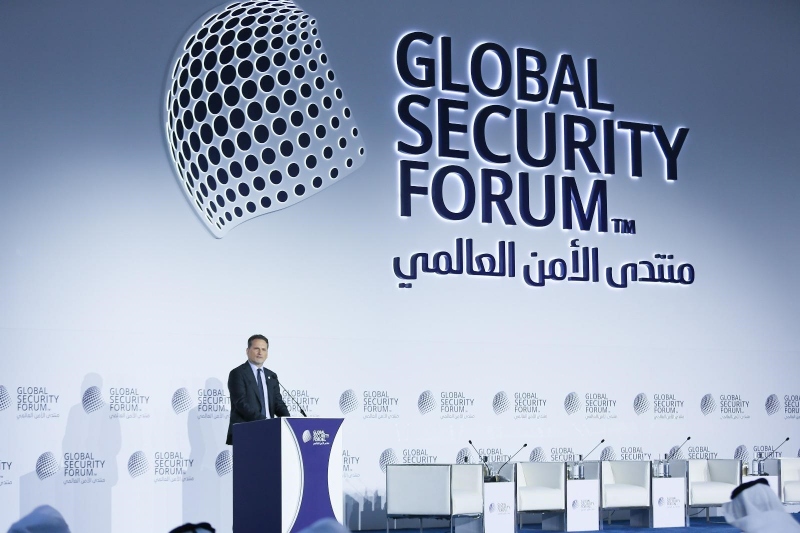
The Director-General of the International Committee of the Red Cross (ICRC), Pierre Krähenbühl, visited Doha to participate in the 2025 Global Security Forum (GSF), where he delivered opening remarks immediately following the address by the Prime Minister of Qatar. This prominent placement underscored the ICRC’s key role in global security dialogue and humanitarian diplomacy.
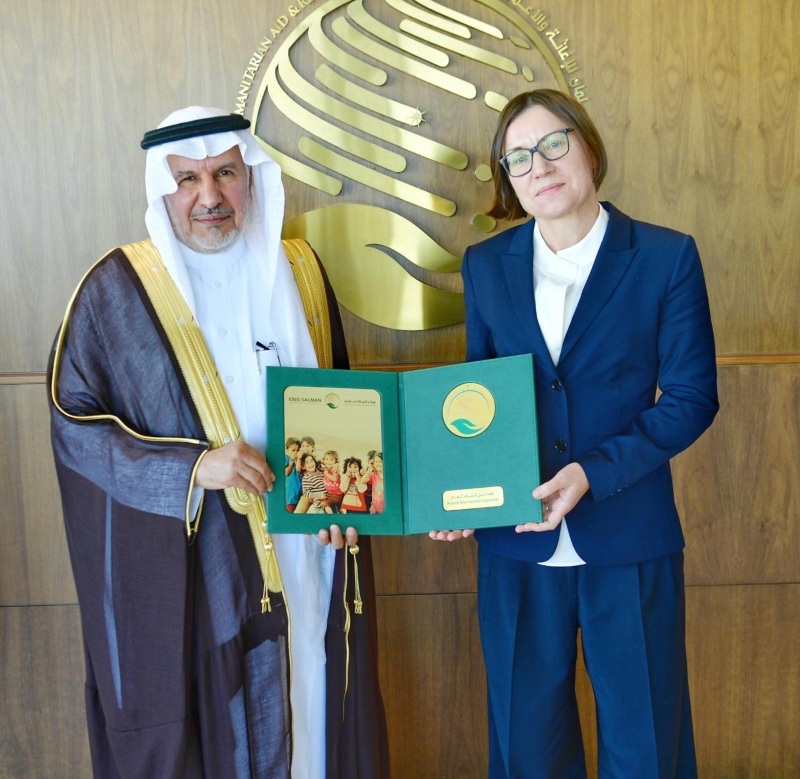
ICRC President Mirjana Spoljaric visits Saudi Arabia’s Relief General Supervisor, Dr. Abdullah Rabeah in Riyadh in 2024.Important Links
ICRC in the Gulf Cooperation Council Countries
ICRC at GCF 2025: Putting the Humanitarian Voice at the Heart of Cybersecurity
Episode Transcript for the Hearing Impaired
BONESSI: If you’ve ever taken a course on international affairs, you’ll know that states tend to use soft power, like providing aid to other countries or helping to negotiate tough crises, to have influence on the global stage.
Today, that stage features the Gulf States more prominently than ever de-escalating tensions, mediating conflicts, facilitating hostage releases, leveraging global partnerships, and leading humanitarian responses. These states are shaping a new collective role, in which influence, funding, and humanitarian engagement intersect in powerful ways.
[News Report] “Though bringing peace to the region seems as elusive as ever, peace efforts spearheaded by Qatar are still ongoing.”
[News Report] “A world away from the mud and blood of the Ukrainian fields, Jeddah in Saudia Arabia appear to be set to become the location for a special gathering. A peace summit led by Kyiv will take place here.”
BONESSI: Today on the show we’re focused on the—at times—complex and nuanced humanitarian role these states play on the global stage. Then turn to an interview with Mamadou Sow, head of the International Committee of the Red Cross’s delegation to the Gulf States, to explain how we work with Gulf States to support humanitarian action and ensure that the laws of war and the obligations of states engaged in conflict are upheld.
I’m Dominique Maria Bonessi and this is Intercross, a podcast about war and the people caught in the middle of it.
[INTERCROSS SONIC INTRO]
BONESSI: In early September, we saw a strike on Qatar…
[News Report] “Cellphone video show people running in the normally quiet and peaceful Qatari capital.”
BONESSI: Visiting scholar with the Middle East Institute in Washington, D.C, and a retired Professor Emeritus at the Bush School of Government and Public Service at Texas A&M University, Greg Gause says the attack…
GAUSE: “Makes it more difficult for Qatar to continue in its mediation role over the Gaza conflict.”
BONESSI: He added the attack sent a chilling effect over other Gulf States involved in this kind of work.
GAUSE: “It also, I think, um, emphasizes that if they try to get involved in mediation of Arab Israeli issues, that uh, they too could become targets.”
BONESSI: Later in the month during the United Nations General Assembly meetings, we saw these same states come together to support a solution and way forward in the Hamas-Israel conflict.
[News Report] “Great Britain, Australia, Canada, among others have formally done the same. In support of a roadmap for Palestinian statehood co-written by France and Saudi Arabia.”
BONESSI: Greg says none of the Arab states are neutral on the Palestinian question, but…
GAUSE: “The further away you get from the Middle East the more you can see these actors as purely humanitarian, but there the concentration of their efforts also dissipates the further away from their immediate region”
BONESSI: Ultimately Gause says, there are two main reasons as to why the Gulf States engage in this work. The first…
GAUSE: “The granting of humanitarian aid, I think it is meant to kind of establish a profile for these countries more broadly. That could fall under the soft power rubric.”
BONESSI: And the second, he says the reason Gulf States, especially Qatar and the United Arab Emirates, want to be seen as global players…
GAUSE: “Is because of money. They don’t have much else. They’re extremely small countries, very small citizen populations, but fabulously wealthy because of hydrocarbons.”
BONESSI: Now we’re going to talk more about the reasons these states are global players and the ICRC’s role with Mamadou Sow, head of the ICRC’s delegation to the Gulf States. Mamadou has been working with the ICRC for almost two decades in places like Rwanda, Afghanistan, and South Africa. To break the ice with Mamadou, I asked him about how he came to work with the ICRC.
MAMADOU: I often say that, my journey with the International Committee of the Red Cross began before I was born and raised in Senegal, in a Muslim family, and a community that valued solidarity where everyone, growing up felt responsible for everyone else. And, like my grandfather used to say serving others is an honor. So that, sense, of shared duty to others really never left me. And then, as a teenager, I met an American family, the Petersons. I guess they saw potential in me and they invited me to come and study in the United States.
And that really changed everything for me. I lived with them. I studied at Cape Cod Community College, and later on I moved down south to North Carolina. I went to North Carolina Central University. It was an HBCU. And again, I discovered a whole other world, and really that American experience, coupled with the generosity of the Petersons and my own upbringing, really all came together with messages that reinforced each other. And that is: generosity really knows absolutely no boundaries of race, of faith, of nationality.
When I encountered the ICRC, it was like coming home—an organization that also believes humanity has no boundaries. It’s not just a workplace. It’s a way of living those values—compassion and really the conviction that all of us share, that every human life really matters.
BONESSI: Your delegation is important for a dialogue with the Gulf States. But there have been no active conflicts in Saudi Arabia and in Qatar. Why are we speaking with these Gulf countries?
MAMADOU: You are right. There is absolutely no war in Riyadh, in Abu Dhabi. But the Gulf countries today are not just on the margins of humanitarian action. They are increasingly at the center. And GCC countries like Saudi Arabia, Qatar, the UAE, Kuwait, Bahrain, Oman—they play a critical role in global diplomacy, in mediation, in humanitarian action and financing. They influence outcomes—be it in Yemen, in Gaza, in Sudan, Syria, and even areas beyond this region—and that’s really why we are here. We are here to engage not just where war is happening, but where discussions about war and peace are made. So our role is to ensure that humanitarian concerns are heard in the same rooms where political and security agendas are set. So what makes the ICRC a privileged partner for them, as they told me, is really threefold. I can think of three things.
One is, of course, our incredible presence that we have in the field—being active in 130 conflict zones worldwide. Second is the level of acceptance that we have, and this is crucial. And third, the trust that populations have in us. The armed groups respect and trust us. We engage with almost 500 armed groups worldwide, so when others cannot talk, we still can move. We, in that sense, become a bridge. I can give you the example of Gaza. All of us are following it very closely. In the past two years, millions have faced devastation on historical scales.
The ICRC stayed throughout with more than 400 colleagues, providing food, repairing water systems, and field hospitals—very active in Gaza. But beyond that visible aid that we give, there is an invisible work, and that’s the dialogue that we have with all sides. We engage with Israeli authorities, but also with Hamas representatives; the mediations in Doha. All of them to remind them, of course, of the obligation under international humanitarian law, and that trust allows us to act.
You don’t need to look further—just look at the release operation. You see what neutrality means. The same happened in Yemen, where we reunited more than a thousand detainees between the Saudis and the Yemenis. In the DRC, recently we were able to transfer some disarmed fighters and their families, Goma and Kinshasa.
So why in the Gulf? Because it’s really where influence meets compassion. And when these two meets, I think humanity wins and we really want to be there at the table discussing with them.
BONESSI: I think a lot of people can easily understand how we create trust or build relationships with. States, you know the US, Qatar, Saudi Arabia, it seems very easy.
It seems like it’s a lot more difficult. And obviously as conflicts have been increased over the past 10 years, we’ve also seen an increase in the number of armed groups.
We don’t know. Every armed group, armed groups pop up sort of at random. So how do we as the ICRC build that trust with those groups that could disappear or fizzle out within a couple of weeks or months
MAMADOU: There, there are many groups with different identities, different personalities. Some are very ideological, some are community based groups very organic. They sprung from the community. So they also keep in mind the interest of the communities. And you have some that are very dogmatic and ideological and have these global views on jihad and so on.
So by and large, the key to gaining trust for us with armed groups is to be very strict in our mandate. To do what we do and be predictable. What the groups do, in my experience is they observe us first to see if we doing what we say we are doing.
The trust that we that we muster with them, it’s usually acquired in a progressive manner, in a evolutive manner, but it’s never static. So, you gain the trust, but then you have to maintain that trust and you maintain that trust by remaining very neutral.
You don’t get involved in the politics of this conflict. You maintain proximity with the beneficiaries because the beneficiaries at the end of the day they are our first line of protection and defense. They are eyes [00:06:00] in our ears. They are those who support matters the most to us.
So when we have the hearts and minds of communities we have made already a great steps toward gaining the trust of the part fighting parties.
BONESSI: I’m gonna shift gears a little bit to what the ICRC is doing with the Gulf states right now. What kind of activities are we doing with the Gulf states currently?
MAMADOU: So we are quite present now in the Gulf, in all six countries, with permanent presence in five out of the six. Our work is—really, unlike many organizations here—our work goes beyond fundraising. It’s really about co-creating. And it’s also about humanitarian diplomacy. For example, in Kuwait, we work very closely with the authorities on the missing file.
Kuwait has a long-standing experience in dealing with missing, because they have their own missing caseload from the war with Iraq, and so we engage with them on this file and also on international humanitarian law. In Saudi Arabia, we collaborate on detention-related issues, on innovation, on digital protection. The Saudis are investing massively in cybersecurity, and we have an awesome engagement on that front. With Qatar, as we’ve discussed earlier, we coordinate efforts around mediation and also humanitarian action in places such as Gaza, the DRC, and so on. In Bahrain, we visit places of detention, and this is also quite unique. We do this in Saudi Arabia for the Yemen-related detention conflict detainees, but in Bahrain we visit places of detention. And over the years we’ve really held their arms through tremendous progress on the detention file. In Oman—Oman is a beautiful country, a very unique country, very quiet, very discreet country—but with tremendous generosity in terms of the way they offer their services in a very discreet manner, in terms of de-escalation but also on mediation. We are also there in Oman working with Omani authorities, and in the UAE, of course the Emiratis are quite strong on many topics including cybersecurity, but also in usual humanitarian diplomacy, in a sense that the Emiratis have an interesting footprint around the world in terms of interests—economic interests, especially in Africa.
They have a lot of partners in Africa and we want to leverage those partnerships to carry our humanitarian message.
BONESSI: With all this work, what sort of impact is the ICRC able to have with these states?
MAMADOU: So the impact—you can measure it in different ways. You can measure financially. Today, by the end of this year, I am hopeful that at least three—it could be more—but at least three will be in our Donor Support Group.
This is something that we don’t take for granted. I think that we are an organization that is a global organization, and we do want to have the financial support that is as broad as possible. And with that financial support, of course, comes political support—the recognition of the value that we stand for, and our mandate.
The other success is the sophistication now, or the maturity, of our dialogue with them. As I said, they understand now the importance of humanitarian action. They spend a quite amount of resources, both supporting countries where there are conflicts or natural disasters, but they themselves have skin in the game in terms of mediation.
But what they see, which is so beautiful, is that everywhere they go to mediate a conflict, at the end of the day they see that we are the organization that is more on the ground, more trusted, with more recognition from the parties. And so they turn to us for partnership.
And the last area where we can measure the success we have here is that we are able, progressively, to tap into this very rich ecosystem of knowledge, of institutions that are here—think tanks that are here—but powerful entities that are here, and individuals and states, to pass the messages that matter to people who are affected by armed conflict.
It’s hard to quantify, but you can see, for example, when the Saudis convened this very important gathering in Jeddah of the warring parties of Sudan. At the end of the day, they put out the Jeddah Declaration, which is something that we worked very closely with them on, and it was a strong foundation for us to come back to the parties to say, “Okay, now you guys have agreed to this declaration. You have agreed to humanitarian principles, to uphold human dignity. Now we will hold you accountable to this.” That opens the door for that level of dialogue. We are quite proud of what we are able to achieve.
Obviously, we are just getting started. We believe the next phase of our engagement here in the GCC will be even more fruitful than the previous phase. Because the first phase, we spent a lot of time to be known, to be present, to be accepted, and so on. Now that we have been accepted, now we want to really co-create and co-deliver with them in a way that doesn’t compromise our principles.
BONESSI: Right. And do we see the Gulf States embracing the rules of war more now that you have this acceptance? And what do they have to gain from embracing these rules? What does any state really have to gain from embracing the rules war?
MAMADOU: What we see now the GCC countries are increasingly aware that respecting the rules of war respecting international humanitarian law is not just a moral duty, it is of strategic interest for countries. And I think this an important shift. Respecting IHL is not just about charity, it’s also in the interest of countries to do, and this we reached the level in our dialogue with them, for them to be fully aware of that upholding the law they know it enhances their credibility as mediators. And they wanna be great. They wanna be mediators and global actors. Well, it starts with that, leading by example, respecting it but also making sure that you have the whole ecosystem in country when it comes to IHL.
So yes, they know that they need to be compliant in order to go and offer the services of on mediation and to be great global actors. It allows them also to project a sense of stability in a neighborhood that is very turbulent.
And this region is quite turbulent. Another striking example is the rallying of GCC countries, behind the global initiative, to galvanize, political commitment for IHL today, all of them have joined , the UAE, the Saudis and Qatar are even co-chairing some specific work streams.
They see that actually seen from a different angle IHL is not something that is being dictated by the west. They believe that actually a lot of the values that underpin international humanitarian, values that are deep in the Islamic and cultural practices.
It shows that IHL also is a universal body of law. In a world where we are losing faith, in the laws of war, we do believe that the Gulf can help restore faith in, in humanity.
BONESSI: Do you have any final words to impart to this audience of US, thinkers and shakers and policy makers that you might be able to enlighten them a little bit more about this?
MAMADOU: Yes, for sure. The center of gravity of humanitarian action once perhaps was in some parts, neutrality was a Swiss thing, was Scandinavian, but Oslo, you know, process and so on.
Yes, for sure. Listen, it’s not just your audience. It’s also a lot of my friends who will not like what I’m about to say, but the center of gravity of humanitarian action once, perhaps, was in some parts. Neutrality [00:15:00] was a Swiss thing, was Scandinavian—the Oslo process and so on.
But I do firmly believe that the future of humanitarian action will be decided not just in the battlefield, but it will be shaped in places of influence. And the Gulf is not the only one, but it’s one of those places of influence. Washington—reassure your friends—Washington is one of them, Paris is one of them, Brussels is one of them, but the Gulf is definitely a big one. Our neutrality—it gives us access where others cannot go, and the Gulf diplomacy and the weight give us also a bridge to others where victims cannot go and say their piece.
And so we come and represent the voices of victims of armed conflicts. So I think together we can form what I will call the diplomacy of restraint. And that’s really our ambition: a space where influence meets integrity, and it’s important—and where the power to help becomes more important than the power to harm.
This is something the Gulf now want to embody. And we know—we’ve seen it with Gaza. We’ve seen it with Yemen and Sudan and Ukraine. The world is fractured by perceptions. And yet our neutrality, in the midst of this, is not passive.
So yes, my final word is that when you hear about neutrality, it’s the new relevance for us, because without trust nothing moves, and trust is really the currency on which the ICRC was built.
Thank you for your time. Thank you for the good work that you’re doing, Dominique and thank you for having me.
BONESSI: Thank you so much, Mamadou. I really appreciate your time.
That was Mamadou Sow, ICRC’s head of delegation for the Gulf States.
If you liked this episode please rate, review, and subscribe to Intercross wherever you get your podcasts.
If you want to learn more about our involvement with the Gulf States, please visit us at intercrossblog.icrc.org or following the delegation on X o Instagram @ICRC_GCC. You can also follow Intercross on X @ICRC_DC.
See you next time on Intercross