

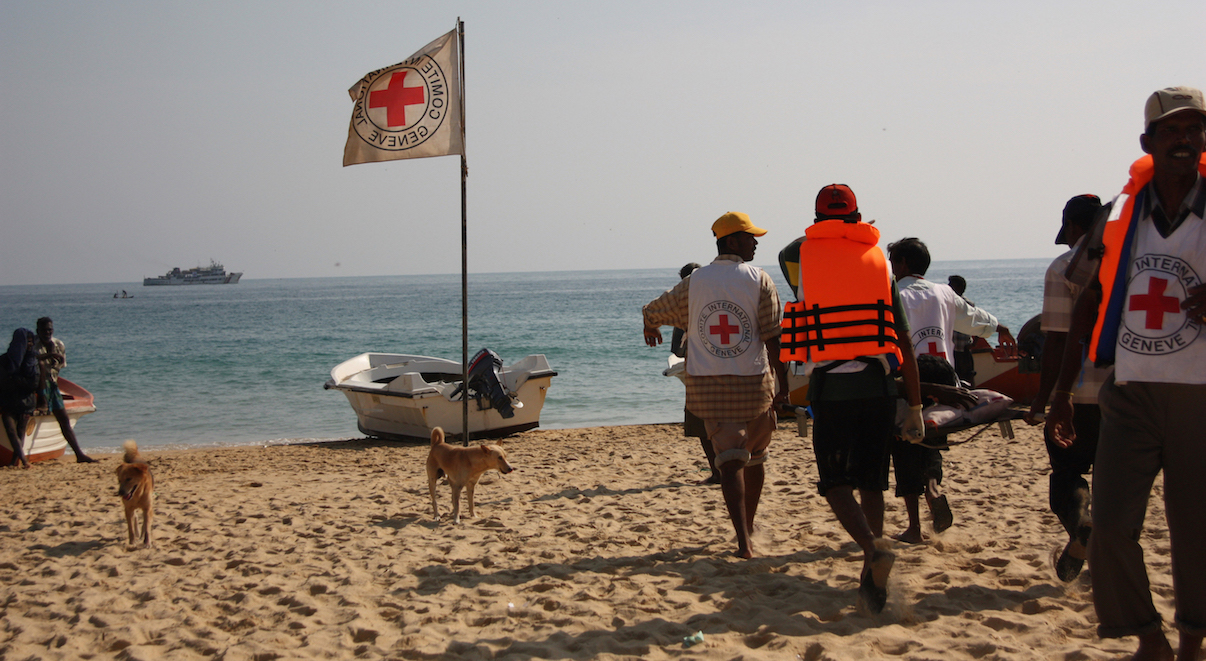
Puttumatalan. Une équipe du CICR évacue des civils blessé par ferry jusqu'à Trincomalee. Puttumatalan. ICRC team evacuating wounded civilians by ferry to Trincomalee. Extract from 17-03-2009 Operational update Sri Lanka: ICRC continues to help civilians as crisis escalates Fighting continues between Sri Lankan government forces and the Liberation Tigers of Tamil Eelam (LTTE), prompting growing fears for the lives of those trapped in the conflict area. The ICRC has been bringing a little hope, evacuating the sick and wounded and escorting boats carrying food and limited medicines - ICRC activities in January and February 2009. Tens of thousands of people confined to a rapidly-shrinking area have headed for the coast to escape the fighting, in search of safety, food and medical care. But numbers in the coastal belt held by the LTTE have increased drastically over recent weeks, and clean water is scarce. The area is affected by shelling every day, and the cramped conditions and the lack of water and proper sanitation are putting people at risk of epidemics. "The humanitarian situation is deteriorating by the day," said Paul Castella, head of the ICRC’s Colombo delegation. "Many of these people are forced to shelter in trenches. They are in considerable physical danger. After having been forced to move from place to place en masse for weeks or even months, they depend entirely on food from outside the conflict area." The sick and wounded continue to arrive at Putumattalan, where local people have helped set up a makeshift medical facility in a community centre and a school. Medical staff from the ministry of health do their best to cope with a constant influx of people injured by the fighting, but there are not enough medical supplies to meet the needs. With the agreement of the government and the LTTE, the ICRC has continued to evacuate patients from Putumattalan (which is in the LTTE-held area) to Trincomalee (in the government-held area). The ICRC-chartered Green Ocean ferry has evacuated over 4,000 sick and wounded people, together with their carers, since evacuations started on 10 February. The evacuees included over 1,400 people in need of surgery, so an ICRC medical team consisting of a surgeon, an anaesthetist and a nurse are helping Trincomalee Hospital to handle the influx. Since mid-February, the ICRC has on 12 occasions facilitated the movement of food shipments from Trincomalee to Putumattalan, delivering a total of over 700 tonnes of flour, dhal, sugar and oil provided by the government and the World Food Programme. On three occasions it was possible to deliver some medicines provided by the ministry of health, but the quantities were too limited by comparison with the needs. "With patients continuing to arrive at the improvized medical facility in Putumattalan, it is essential that evacuations take place regularly and without interference. It is encouraging to see food and medicines going into the conflict area, but they must be delivered regularly if they are to have an impact," said Morven Murchison, who coordinates the ICRC's health activities in Sri Lanka. The civil and military authorities have helped with the medical evacuations and the food shipments, as have local people. Offloading food onto the beach in Putumattalan may involve up to 275 people transporting the food in fishing boats and carrying it ashore. These are dangerous and complex operations. The fighting is one hazard, but bad weather and heavy seas often make things worse. With the help of the Sri Lanka Red Cross Society, the ICRC was able to give 130 sick and wounded evacuees personal hygiene kits, emergency household kits, kitchen utensils and baby-care parcels. These people received medical treatment at hospitals in Trincomalee and Vavuniya.