
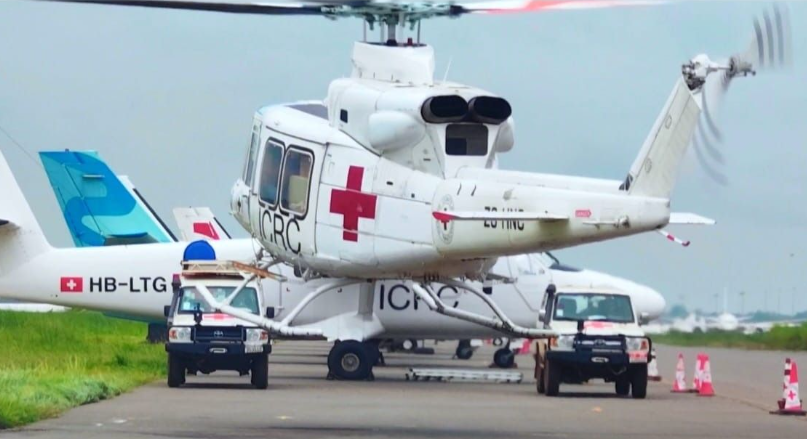
With 12 planes and 3 helicopters, the International Committee of the Red Cross runs one of the most complex humanitarian flight operations in the world.
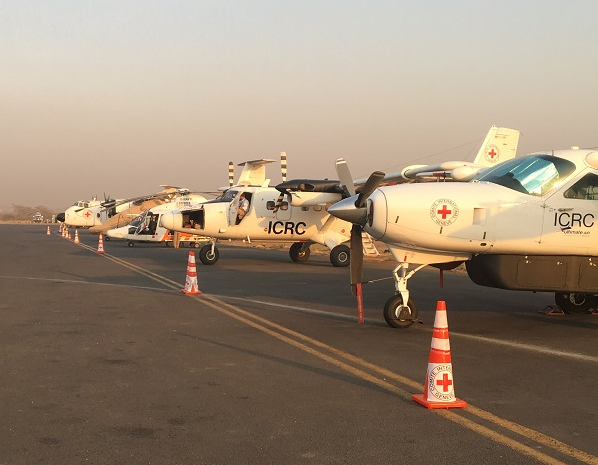
From delivering life-saving aid to reuniting children torn apart from their families in war and safely maneuvering the skies with war-wounded patients, the ICRC’s pilots are involved in every aspect and of the organization’s humanitarian work, says ICRC’s Head of Air Ops Laurent Camisa. The aircraft, ranging from safe and reliable Dash 8 Turboprops to smaller, low-flying Dornier 228s with unpressurized cabins to Bell 412 helicopters, allow the ICRC access to areas of conflict and violence that might be inaccessible via other modes of transportation due ongoing fighting or poor to non-existent road conditions.
Having been hired by the ICRC in 2016 as an air operations manager in South Sudan, Camisa has worked in various context through Africa for the humanitarian organization, whose principles of independence, impartiality and neutrality are meant to help those caught in violence and conflict in places like Gaza, Ukraine, and Sudan. Intercross sat down with Camisa to hear more about how our fleet of aircraft, operating in the world’s most dangerous places, shows our principles in action.
[This interview has been edited for brevity and clarity.]
Intercross: Can you first talk a little bit about how the ICRC charters aircrafts and why charter them rather than owning them outright?
Camisa: We charter planes on long-term contracts, a standard practice for humanitarian organizations including Doctor Without Borders and the World Food Program. Aircraft, crew, maintenance and insurance [ACMI] contracts, provide the ICRC with the necessary aircraft, pilots, maintenance, and insurance without owning them outright. So we have a list of 60-70 different companies with most of our contracts run out of the Africa region. Not all of them will answer the bid, but then the ones that will then we will basically do a selection table based on all the offers that we have and then we will select the most suitable operator for the type of mission that we want. So what we do is we go into long-term contracts with them, so they provide us with the aircraft and they provide us with the crew as well. We basically pay for a turn-key solution and in return we manage their plane by planning flights for the ICRC but conducted by a third-party operator.
Intercross: So chartering flights on long-term contracts rather than owning them outright is more cost-effective and efficient, is that fair to say?
Camisa: That would be fair in the sense that you know airline businesses are businesses. So if ICRC had its own plane, its own fleet, we would have to have our own maintenance program and so on. Therefore, we would have a business entity, which is not what the ICRC is. We’re a humanitarian organization. We spend money, we don’t make money, and an airline would try to make money to be able to sustain. So by having basically a ACMI contracts, we have that flexibility of not having all the risks associated with inflation, fluctuations and so on that a normal airline would have, while benefiting basically from the fact that a third party takes all those risks, we simply pay for a service that is rendered to us. So long as we have an agreed price, which is normally, you know, benchmarked when we do the tendering [solicitation].
Intercross: The work of the ICRC is built on trust. At times other than transporting life-saving aid, we’re also transporting people who have been separated from their loved ones due to conflict. Some of these people may have never been on a plane or helicopter. How is it that your team gains their trust that they would feel comfortable enough to get on an airplane or a helicopter and fly with you?
Camisa: The ICRC has built its reputation over decades. So the emblem is well perceived in most of the contexts where we operate our aircraft, you know, 90-95% in the Africa region. So, the emblem is recognized by people. I mean even the pilots we have flying the planes, especially in Juba, South Sudan, the six or seven air operations officers and managers we have are all originally from different regions of South Sudan and all have stories about relatives that have been helped by the ICRC at some point.
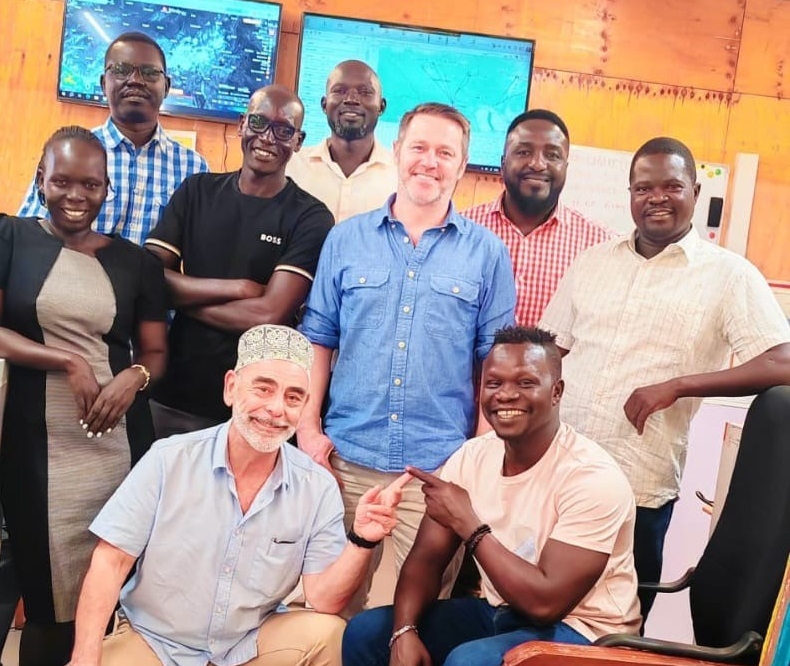
Laurent Camisa (middle) with the South Sudan Air Ops team. (ICRC)
What you need to understand is that we have a lot of interlocutors that we work with and in each of these countries where we operate, we usually have representatives of the national societies. So that the, for instance, if you’re in Somalia, it will be the Somalia Red Crescent that will be there. If you’re in Mali, it will be the Malian Red Cross that will be there. Through them we’ve built partnerships, we develop networking and we will have these local representatives represent ICRC on our behalf in remote locations, where we would be susceptible to going and operate our planes. These people, their responsibility is in fact to say, you know, we can send an aircraft to come and provide you with assistance and then they would explain basically our mandate to these people. So, this is in terms of acceptance, our network team are the ones on the ground that that are basically there to do this for us.
Intercross: And then on top of that also avoid flying in areas where bullets are flying or other planes are attacking ground targets. I can’t imagine how that flight planning works. Sounds nightmarish. How do you plan for that? How do you ensure the pilot, other ICRC staff, and beneficiaries on the plane stay safe?
Camisa: Just to be clear we would never send in a plane or a helicopter while there’s active fighting. We have duty of care for our pilots, their equipment, and the medical team that travels usually on board these air assets. So we have several mechanisms in place that we use to validate a flight to go from location A to B. We have what we call a green light process, which is basically we look at the weather to make sure the weather is suitable. We look at the airstrip condition to make sure that the airstrip is also landable. In South Sudan, during the rainy season, you have many airstrips that you can’t land on because they’re damped, they’re wet and it’s mud. So you have to send a helicopter. So knowing what the condition of the airstrip is is part of our green light process and the third green light is security in and around the surroundings.
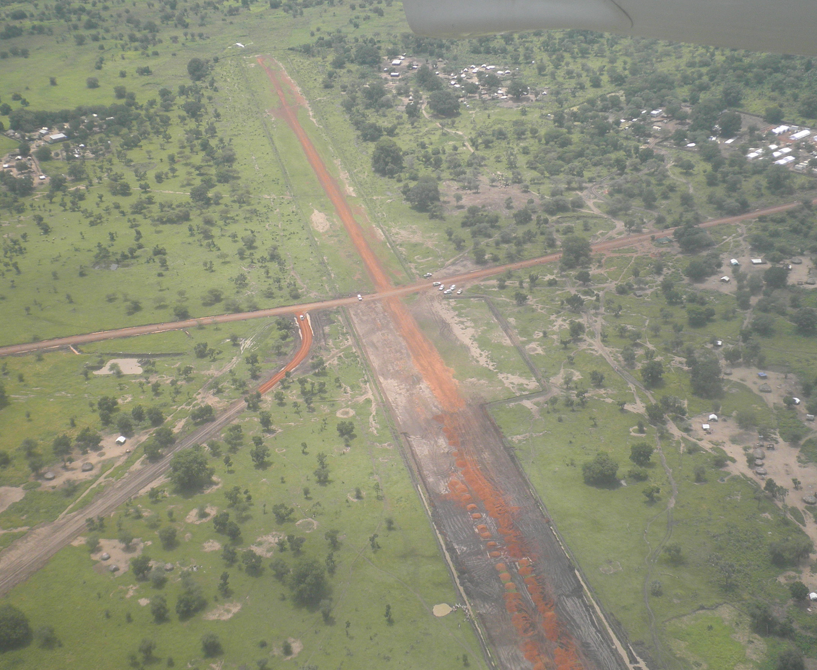
Muddy landing strip in eastern South Sudan (ICRC/Laurent Camisa)
So we have people in the field where we intend to send a helicopter that will say we have the green light of the ambassador of the region to send in the helicopter because of XYZ. So those are what we call the three green light processes, which we try to obtain those the night before the flight, but then early in the morning of the flight, we also confirm before we let the flight go nothing has changed overnight and the security is deemed secure enough to send the helicopter. Sometimes while the plane or the helicopter is on route, there could be tension coming up, so then again we have mechanisms in place where before landing the flight crews will have to get the last green light to land, which is basically very high-frequency [VHF] radio communication direct to the helicopter or the aircraft confirming that it is safe to fly. If we don’t have the green light, then the helicopter will turn back or carry on to its next destination.
Intercross: We talked a little bit about the importance of neutrality in your work and then there’s all been a lot of work that we’ve done where we’ve had to transfer detainees or persons deprived of their liberties in places like Yemen, the Democratic Republic of the Congo, and the Central African Republic. Often times we get very little notice of when these releases and transfers of detainees will happen. Can you go into a bit more detail with me on this? You previously talked about flight planning and the greenlight process, how does it work when you have hundreds of people to transport? Seems like a lot of sleepless nights.
Camisa: Neutrality is not just in principle; it’s the foundation of what makes such operations possible. Without neutrality, neither side would cooperate when you do a prisoner exchange. So, you know, the detainees would be at risk and our ability to operate would be compromised as well.
Now the logistic aspect of it is relatively complicated. In terms of communication, we have to make sure that our flights are being perceived as humanitarian flights. So we need to have the ICRC logos on these aircrafts, all of our air assets, they all are marked with ICRC, the big Red Cross underneath the wings also you can see ICRC. If we charter a plane, a Boeing 737, for instance, we have to identify that plane also as an ICRC aircraft. Even on flight planning, most of these flights are transborder flights, so on the flight planning we have to make sure that they’re being identified as humanitarian flights so they’re not being misinterpreted. We need to make sure that the local authorities are made aware that at that time, between 11:50 and 12:10, for instance, an ICRC aircraft with ICRC logos on it will be arriving at this airstrip so that they know that not to be mistaken for another type of aircraft.