

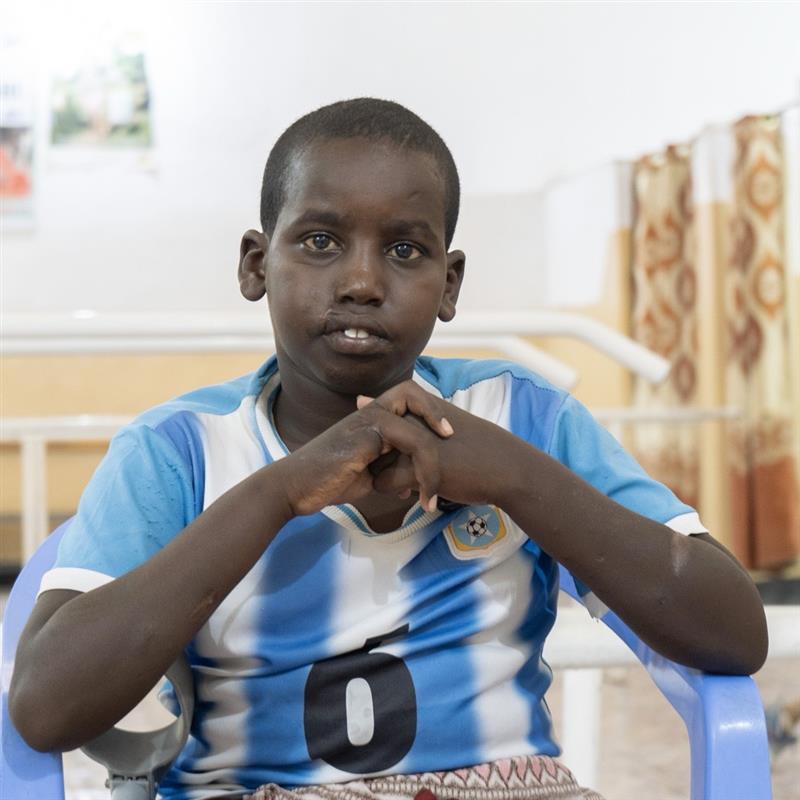
Seven kids leave home for school. Only six come back.
That morning in April 2025 started like any other in Adan Yabaal village, in Middle Shabelle region in eastern Somalia. 10-year-old Yusuf Muhyidin, a boy who loved nothing more than playing football with his friends, set off for school with six others. The ground looked normal, at least to a child’s eyes. Suddenly, without warning, the ground beneath them exploded.
What they stepped on was not a weapon fired in anger or retaliation. It was something buried under the ground; silent, invisible. Left behind in an area that has long known fighting, with a community repeatedly caught in the crossfire of a conflict not of its making. One of the seven children never made it home. Another, Yusuf, lost his leg. Today, he is learning to walk again – this time with the help of a prosthetic limb, working to give him a semblance of what he had before.
This is the grim reality of war’s lingering impact.
In Somalia, decades of cyclical fighting have scattered landmines and explosive remnants of war across the very ground that communities call home. These explosive ordnance continue to kill and maim and block access to essential services including healthcare, and destroy livelihoods, long after fighting has ended.
They can be anywhere – in populated areas, in deserted ones, along footpaths and roads. They are often impossible to see or may look like harmless waste or scrap metal. And most of them remain extremely unstable, capable of exploding at the slightest movement, including a person passing over them.
For Yusuf’s community, it was not just a person. It was seven children on their way to school.
“He was in the hospital for four months. They operated on him and removed shards from the explosion. They were uncountable. It was a lot,” his father, Muhyidin Ali, recalls.
The injury did not only cost Yusuf his leg. It uprooted his entire family. To be closer to the medical care and rehabilitation services he needed, they were forced to leave Adan Yabaal and relocate to a displacement camp in Mogadishu where they found refuge.
The road to recovery for Yusuf is long. Four months at the International Committee of the Red Cross (ICRC)-supported Keysaney Hospital, and three more and counting at the Somali Red Crescent (SRCS) Physical Rehabilitation Centre in Mogadishu, relearning how to walk.
Yusuf’s father carries his own message that echoes obligations set by international humanitarian law on states and parties to a conflict: a plea to minimise the risks and consequences on civilians1.
“Keep children away from dangerous places,” he says. “Create awareness in the community. Be vigilant of hidden objects. Stay away from roads where things are buried.”
The ICRC advises communities in affected areas to never touch, kick, or tamper with suspicious devices and report findings to relevant authorities.
To find out more about our work on risk awareness and safer behaviour relating to landmines and remnants of war, here is a comprehensive guide: Explosive Ordnance