

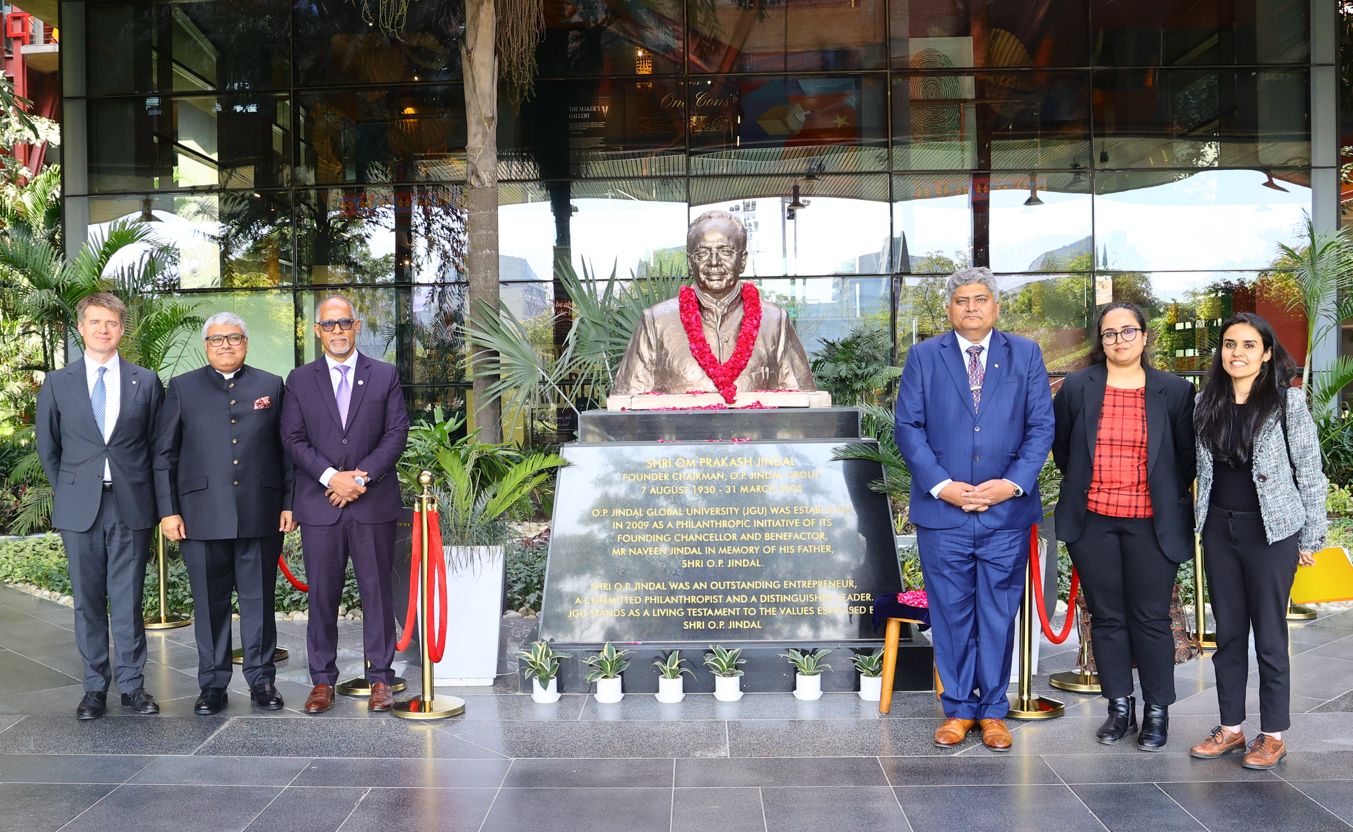
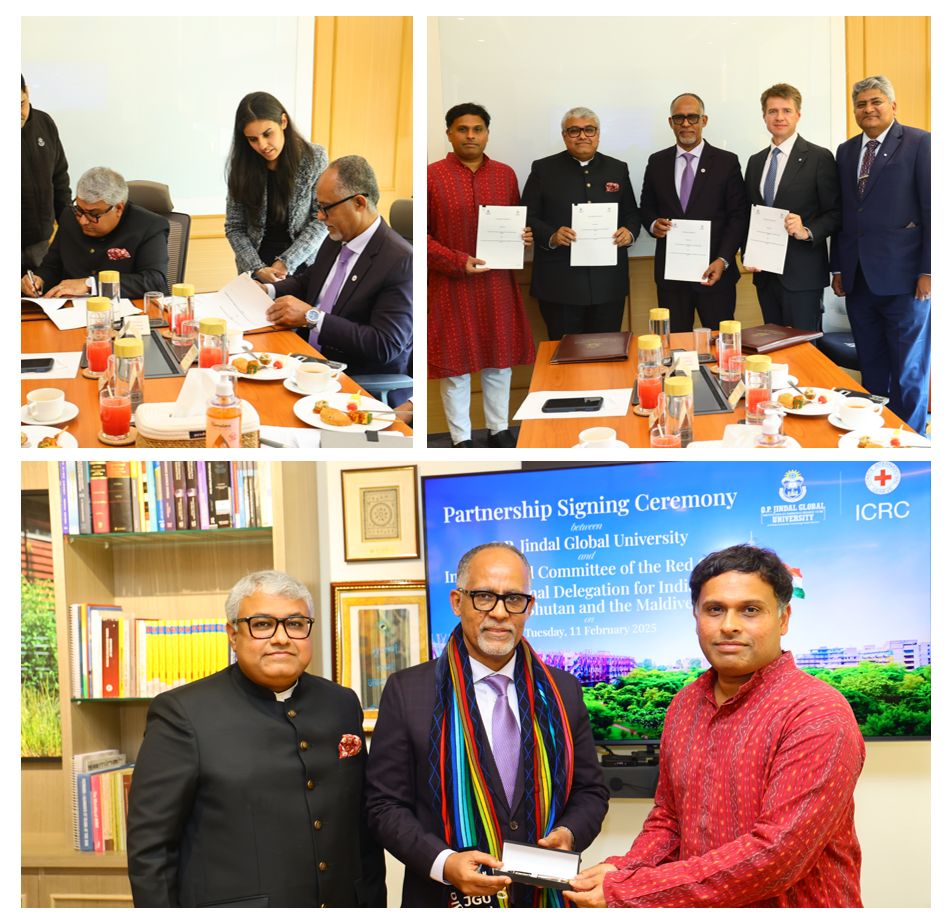
OP Jindal Global University (JGU) and the International Committee of the Red Cross (ICRC) renewed their partnership and signed a Partnership Agreement in February 2025. This agreement was signed to foster collaboration and support in research, academic programs, and internships, with a special focus on promoting and disseminating and building respect for International Humanitarian Law (IHL), through education and awareness initiatives.
The ICRC delegation was led by Kedir Awol Omar, ICRC Head of Regional Delegation (India, Nepal, Bhutan and the Maldives) and Cmdr. Sandeep Bali, Head of Prevention Team. The JGU delegation was led by Prof. Dabiru Sridhar Patnaik, Registrar of JGU, and Dr. Sreeram Chaulia, Dean of the Jindal School of International Affairs and Director General of the Jindal India Institute.
“This is an opportunity that Jindal University has created; it will increase the students’ horizons,” said Mr. Kedir Awol Omar.
“This collaboration, formalized through the partnership agreement, represents our shared commitment to advance the values of humanity, dignity, and justice on the global stage”, said Cmdr. Sandeep Bali addressing the agreement signed.
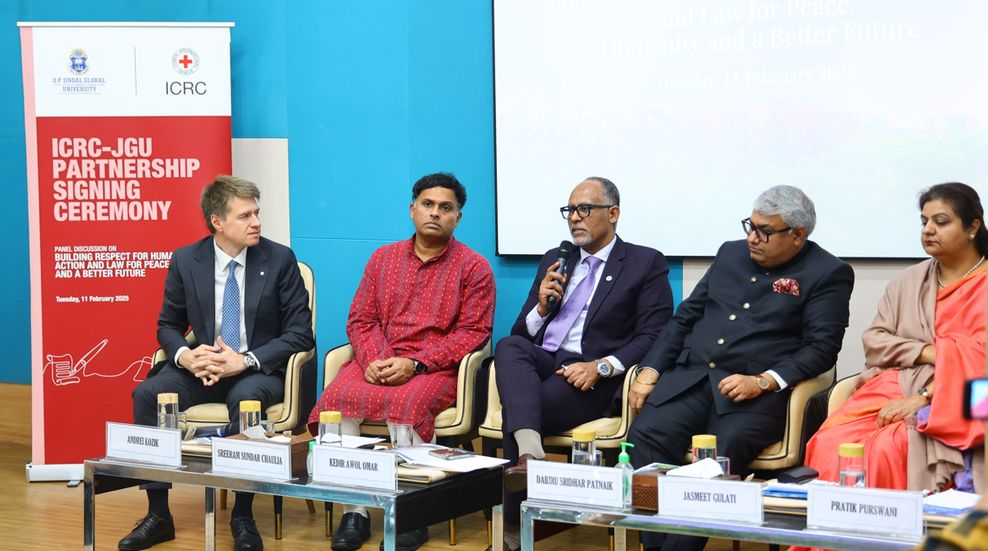
Following the signing of the agreement, an informative and spirited panel discussion was held on “Building Respect for International Humanitarian Action & Law for a Better Future”.
The panel, moderated by Dr. Andrei Kozik, ICRC Regional Legal Advisor for the New Delhi Regional Delegation, included Prof. (Dr.) Sreeram Sundar Chaulia, Dean, Jindal School of International Affairs, JGU and President, Jindal India Institute; Mr. Kedir Awol Omar, ICRC Head of New Delhi Regional Delegation; Prof. (Dr.) Jasmeet Gulati, Professor & Vice Dean, Jindal Global Law School and Dr. Pratik Purswani, Lecturer, Jindal Global Law School.
Dr. Andrei Kozik set the stage for discussion by highlighting the need for collective action in a world struggling with escalating conflicts. He also emphasized the crucial roles of both humanitarian actors like the ICRC, and academic institutions like JGU in promoting peace, humanity, and dignity.
“Worldly problems will not have immediate and definitive solutions, but what we all can do together is to walk an extra mile to have a solid understanding of International Humanitarian Law so that we can defend our virtue stronger and contribute towards developing a more secured environment and a well-informed work force in all fields contributing to IHL” said Prof. Dabiru Sridhar Patnaik while talking about what can be done to ensure better respect for humanitarian law and actions.
Mr. Kedir Awol Omar then presented critical viewpoints on ICRC’s humanitarian work. “Prior to when a conflict starts, prior to when violence erupts, the ICRC engages in activities where we sensitize, teach and develop awareness of International Humanitarian Law” remarked Mr. Omar while explaining the work of ICRC. “As a growing power now, countries are looking at India to assume responsibility, to dictate and ensure respect for International Humanitarian Law”, he said as he brought attention to India’s role in uplifting IHL. He also introduced humanitarian diplomacy and the Global High-Level Initiative to Galvanize Political Commitment for International Humanitarian Law, launched by Brazil, China, France, Jordan, South Africa, and Kazakhstan, along with the ICRC.
Prof. (Dr.) Sreeram Sundar Chaulia, talked about the role that ICRC plays in today’s era and the significance of academic institutions in nurturing respect for humanitarian principles. “We are living in a more violent and fragile world, so the work of the ICRC is more critical than ever before. The stress and pressure that the ICRC is facing right now is unprecedented. It is very important that educational institutions train students better,” he said. “Because we are an educational institution, we are limitless in terms of what we can study, so we will of course study International Humanitarian Law, but also look at the broader context of what is happening in the world” he added, as he underlined JGU’s commitment to developing the necessary skills and expertise for humanitarian action, policy, and peace through education, dialogue, and dissemination of knowledge.
The panel discussion concluded on an illuminating note, with advice from Mr. Kedir Omar, particularly for students who aspire to build a future in the humanitarian field. He encouraged students to utilize the enabling environment that a university provides to build expertise, knowledge, and resilience, thereby developing into professionals who support the cause of human dignity.
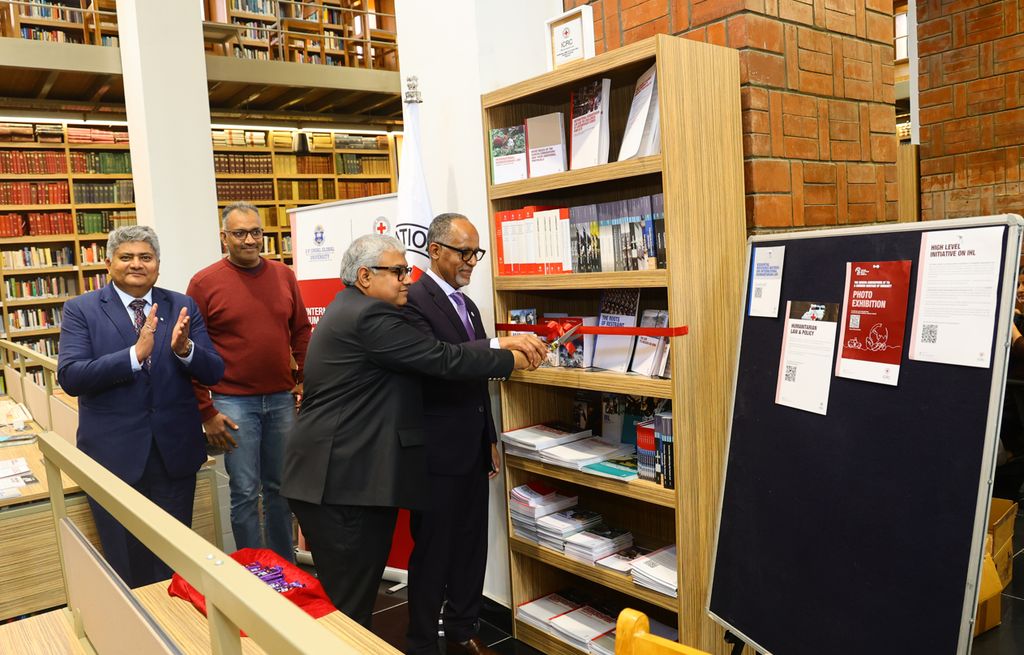
The panel discussion was followed by another landmark event: the launch of the International Humanitarian Law and Policy Resource Centre at JGU Global Library, by Prof. Dabiru Sridhar Patnaik and Mr. Kedir Awol Omar. This resource centre will serve as a hub for academic inquiry, promoting discussions and collaborations among scholars, practitioners, and policymakers. As part of its commitment to advancing awareness of IHL, the ICRC curated and arranged a physical collection of relevant IHL books and materials as well as a digital collection accessible through QR codes for this resource centre.
During the event, pamphlets were distributed, including the QR codes for accessing the digital library and essential resource materials and information on IHL, ICRC’s Humanitarian Law and Policy Blog and Podcast, and the Global High-Level Initiative to Galvanize Political Commitment to International Humanitarian Law.
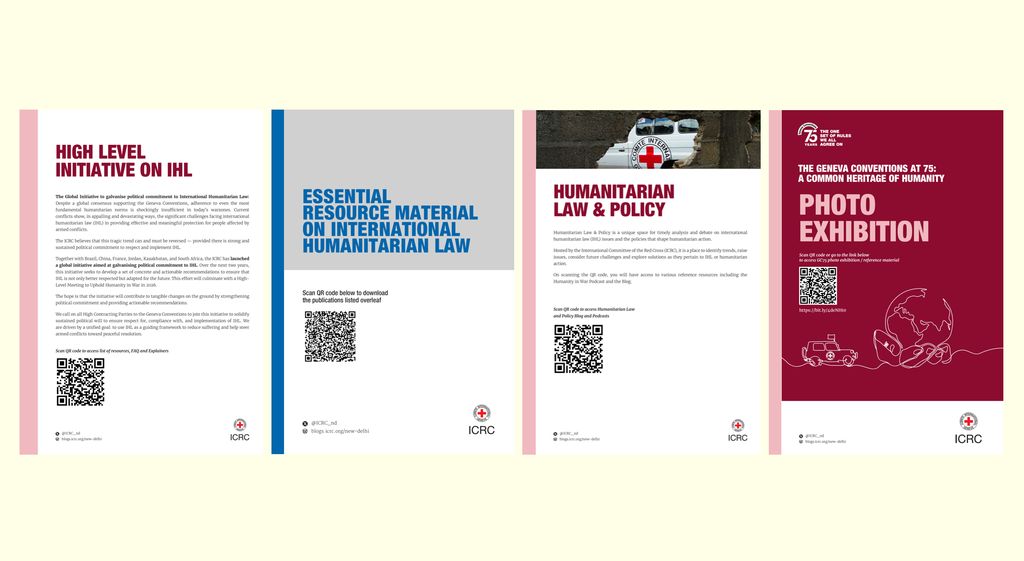
- Essential resource material on international humanitarian law (IHL)
- High level initiative on IHL
- Humanitarian Law and Policy
- Download photo exhibition – The Geneva Conventions at 75: A common heritage of humanity
“The Centre is an important step towards providing students and professionals with access to critical resources, research and training.” Said Cmdr. Sandeep Bali.
The event concluded with an engaging Photo Exhibit themed on the 75th Anniversary of the Geneva Conventions, featuring a carefully curated imagery collection that showcased the ICRC’s work in upholding International Humanitarian Law over the years, both in the field and through diplomatic engagements. Following this, JGU hosted the ICRC team for a tour of India’s First Constitution Museum, located on the JGU campus.

The panel discussion, followed by the launch of the International Humanitarian Law and Policy Resource Centre at JGU’s Global Library and the Photo Exhibit Display at the JGU campus, has strengthened the partnership between JGU and the ICRC, promoting a valuable exchange of knowledge and expertise among scholars, lawyers, students, and policy influencers. This partnership is an example of the steps that the ICRC and its academic partners take together during peacetime to build understanding and respect for International Humanitarian Law, which proves essential in preventing IHL violations and protecting and preserving human dignity during conflict.
Video – Watch proceedings of the full panel discussion -“Building Respect for International Humanitarian Action & Law for a Better Future”.