Today we’re doing something different on the podcast. We’re going to hear from our colleagues at the American Red Cross about their disaster relief response efforts in times of hurricanes. Experts with the National Oceanic and Atmospheric Administration say hurricane season isn’t just June through November any more, but year round; much like the American Red Cross’s disaster response. Today we’re going to walk you through the Red Cross’ response before, during, and after a disaster and talk about their partnerships with non-profits in vulnerable communities to ensure long-term recovery and resilience.
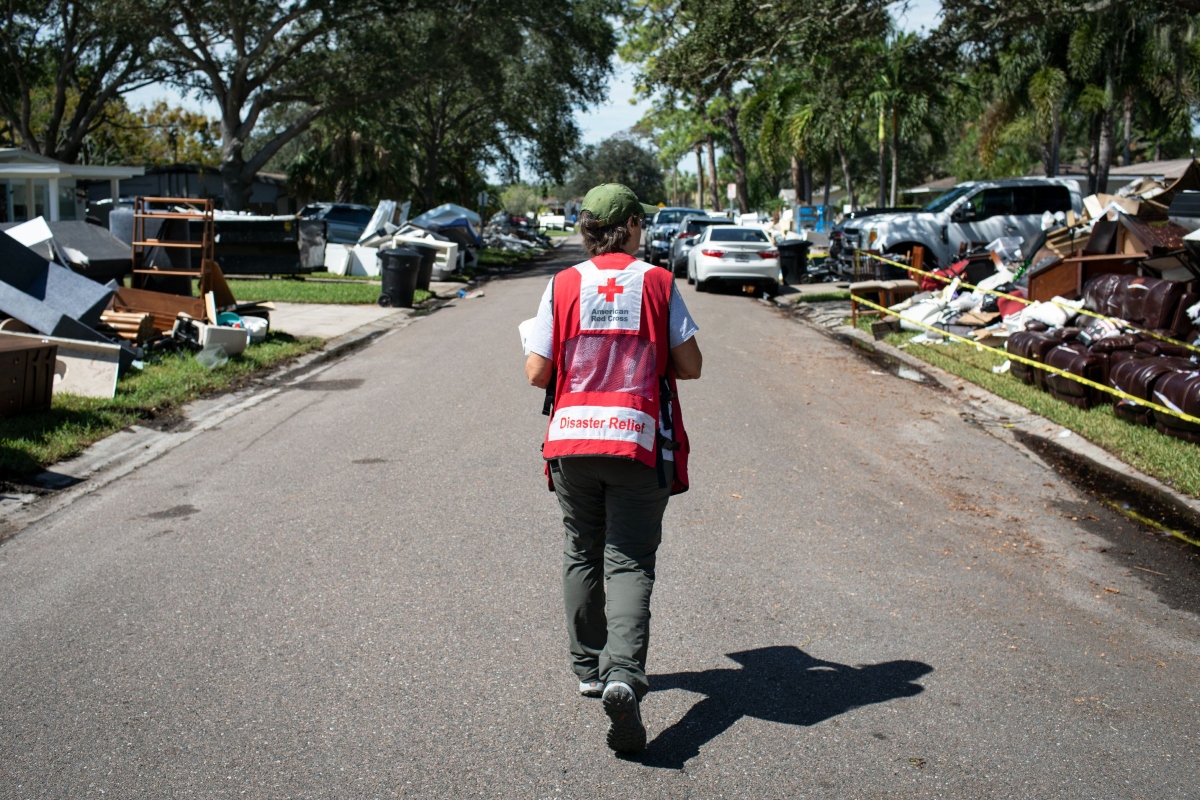
October 2, 2024. St. Petersburg, Florida.Red Cross volunteer Erica Santella delivers meals. Photo by Marko Kokic/American Red Cross
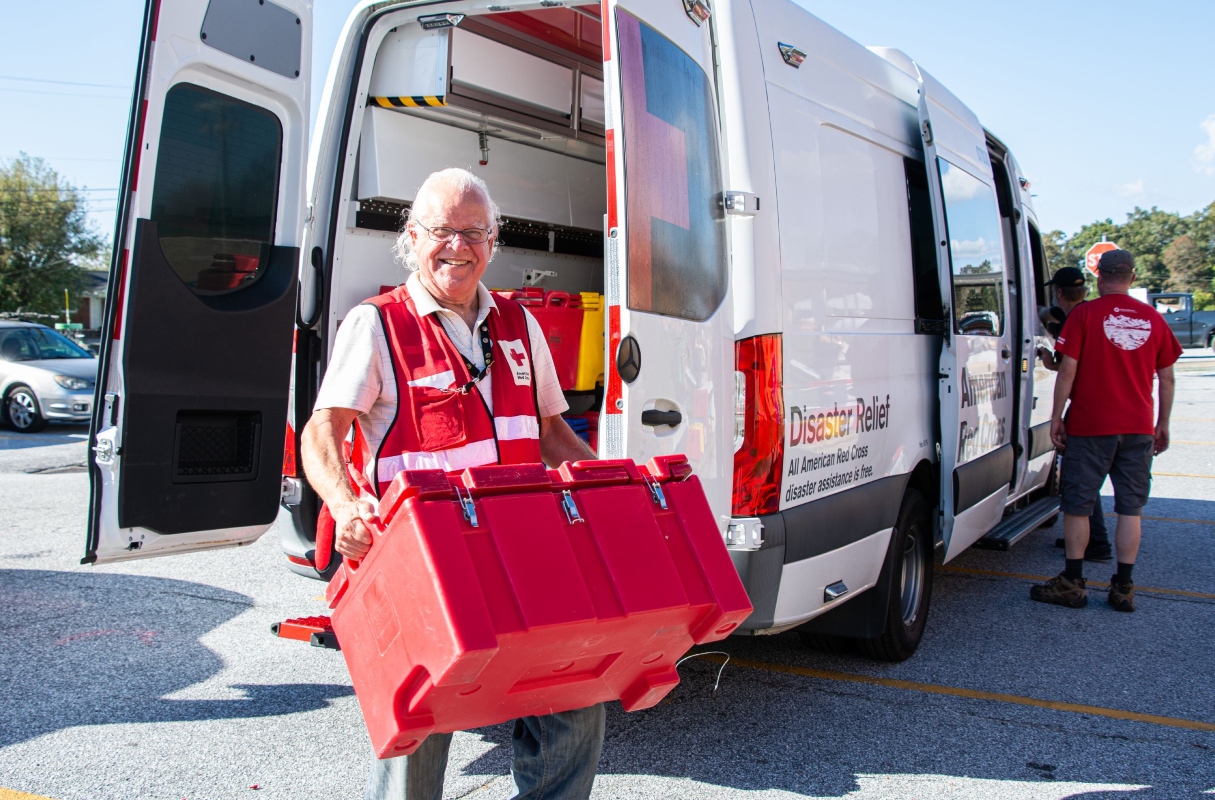
October 2, 2024. Hendersonville, North Carolina. At East Henderson High School in Hendersonville, North Carolina, Red Cross volunteer John Curd and his team unload 1,000 meals which were served to community members impacted by Hurricane Helene. The hot meals were provided by North Carolina Baptists On Mission. Photo by Danielle Desnoyers/American Red Cross
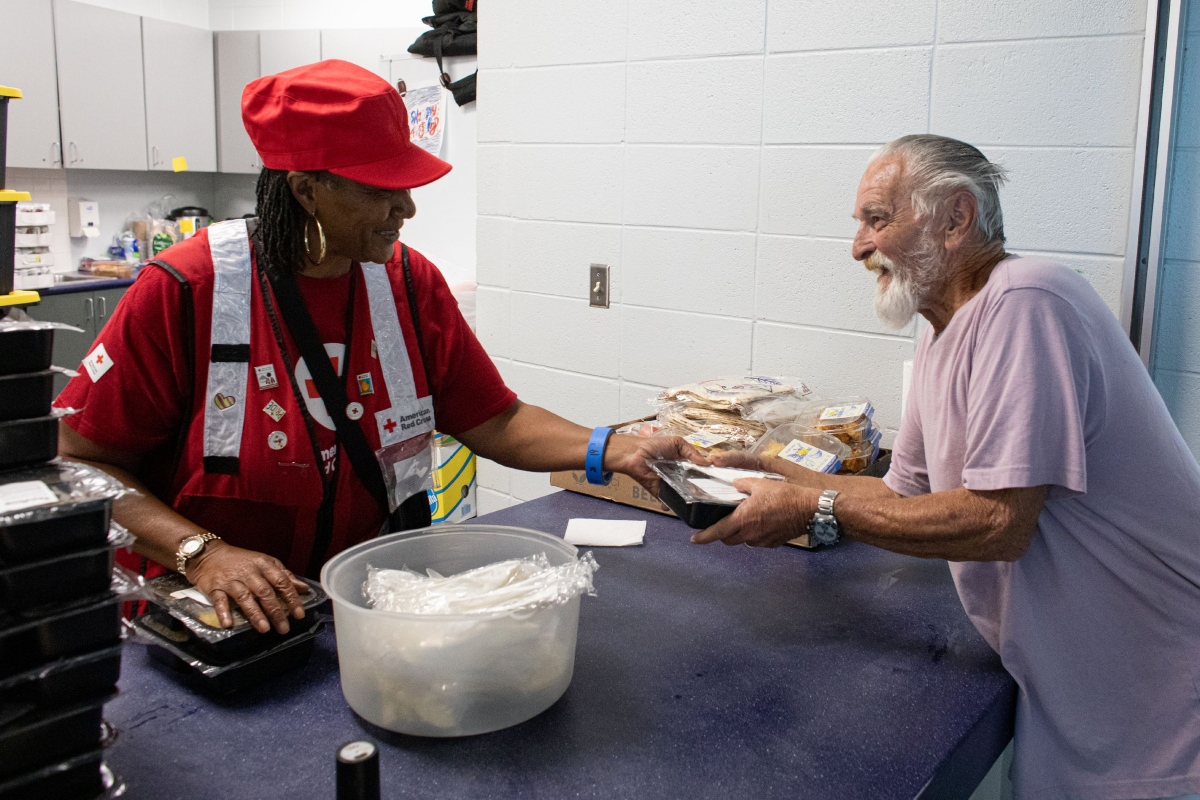
October 11, 2024. Clearwater, Florida. Red Cross volunteer Essie Hopkins serves a warm meal to shelter resident Douglas Williams at the Ross Norton Recreation Shelter in Clearwater, Florida. Douglas has nicknamed Essie “Sunshine” because of her warm personality and ability to light up a room. Douglas and Essie found comradery after learning they are both veterans from the armed forces. Essie calls Washington D.C. home. The Ross Norton Recreation Center houses residents who are displaced from both Hurricane Helene and Hurricane Milton. Through the Red Cross and many government and community partners, shelter residents have a safe place to say, warm meals, water and comfort at this location which houses more than 50 evacuees. Photo by Marko Kokic/American Red Cross
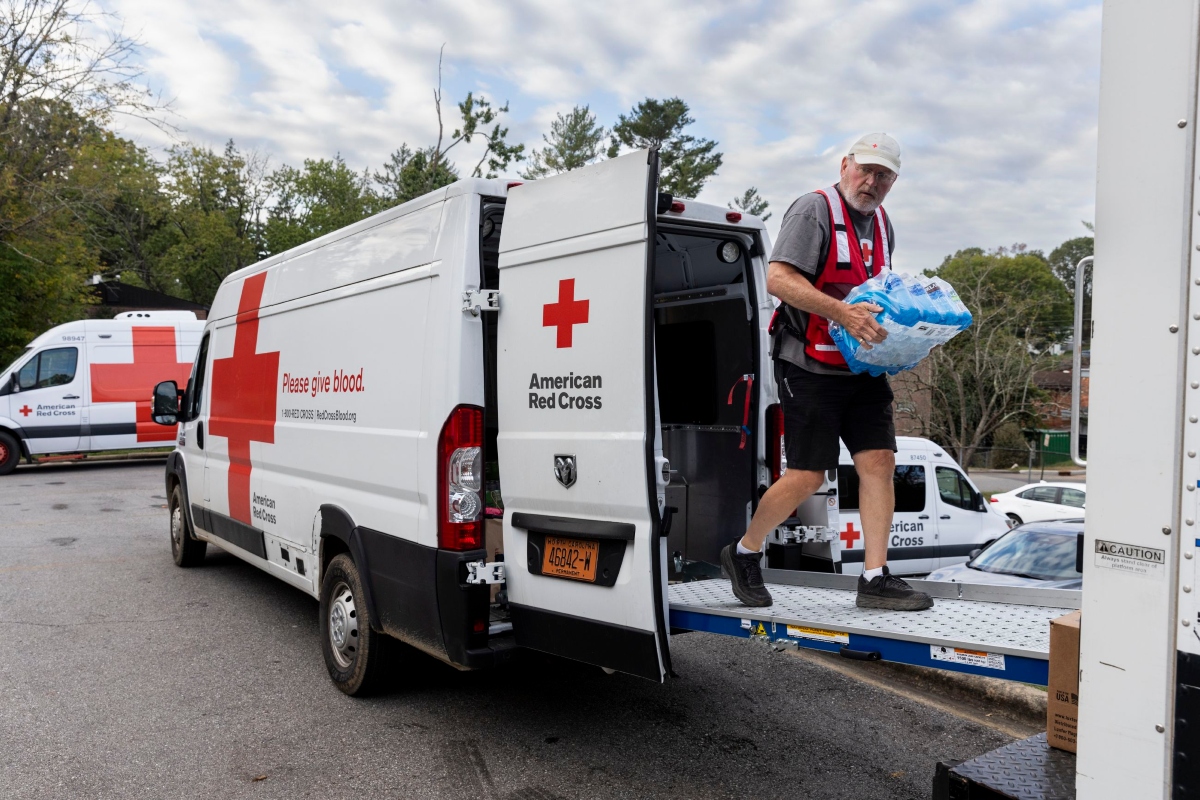
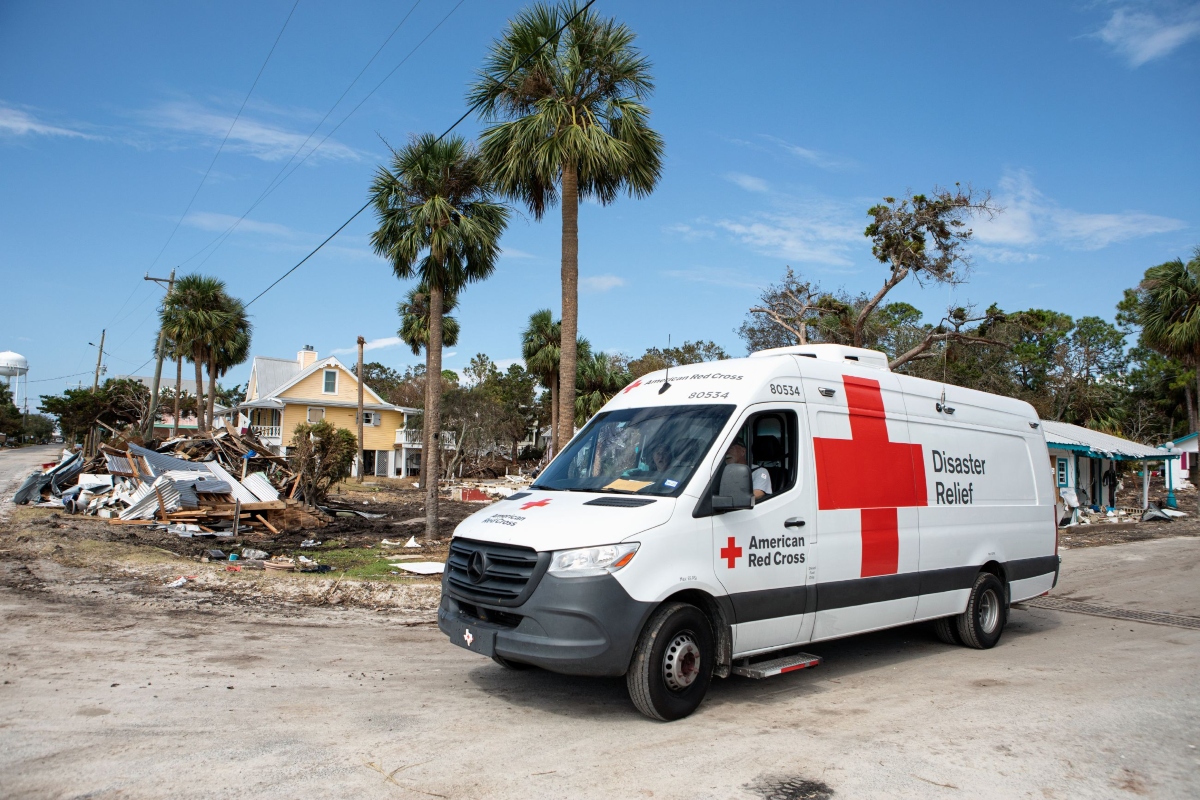
October 8, 2024. Asheville, North Carolina. American Red Cross volunteer Kyle Oesterle loaded Red Cross vehicles with supplies to deliver to those impacted by Hurricane Helene across Western North Carolina. The American Red Cross has been working around the clock with dozens of partners to continue supporting families upended by Helene. Dozens of emergency response vehicles have been on the roads providing meals, water and supplies to those living without electricity and struggling to clean up their homes. Photo by Scott Dalton/American Red Cross
Helpful Links
Hurricane Preparedness Checklist
Red Cross Providing Long-Term Recovery Support to States Affected by Hurricanes Helene and Milton
Transcript for hearing impaired
[BONESSI] Today we’re doing something different on the podcast. We’re going to hear from our colleagues at the American Red Cross about their disaster relief response efforts in times of hurricanes.
We’ll be back next month with more about the International Red Cross’s work on conflict the people caught in the middle of it.
But for now enjoy.
[Music: Cinematic Film Music – I – Bells and Piano Version.wav by GregorQuendel — https://freesound.org/s/650342/ — License: Attribution NonCommercial 4.0]
[BONESSI] In the last 5 years, there have been more category 4 and 5 hurricanes than the previous 50 years.
According to the National Oceanic and Atmospheric Administration or NOAA, that means wind speeds of more than 130 miles per hour…
[News clip from Hurricane Ian]
[BONESSI] Storm surges higher than 13 feet…
[News clip from Hurricane Harvey]
[BONESSI] And catastrophic damage costing billions of dollars each year…
[News clip from Hurricane Ida]
[BONESSI] Experts at NOAA say the hurricane season isn’t just June through November, but year round, much like the American Red Cross’s disaster response. Today we’re going to walk you through the Red Cross’s response before, during, and after a disaster, and talk about their partnerships with non-profits in vulnerable communities to ensure long-term recovery and resilience.
I’m Dominique Maria Bonessi and this is Intercross, where today at least we’re looking at new challenges of this yea —r-round hurricane season and the people caught up in them.
[INTERCROSS INTERLUDE MUSIC]
[BONESSI] Last year Hurricane Helene tore through Big Bend Florida and then made its way up to western North Carolina.
[ABC News Clip] “We begin tonight with the spiraling emergency after Hurricane Helene. The mounting death toll about 182 lives lost. Hundreds still unaccounted for.”
[BONESSI] In their daily weather forecast and disaster response planning meetings the American Red Cross was able to determine that this storm was unique in a few ways.
First Helene, began in the Gulf of Mexico, rather than most hurricanes which begin somewhere around the African coast. This dramatically cut the time first responders could prepare for landfall in the US.
[NEIL] “So where you were planning for 120 hours you may now have 36 hours.”
[BONESSI] Neil Brockway is the senior director of disaster risk reduction at the American Red Cross. Neil says, the second thing that made Helene unique was that it was coming straight up the coastline with a potential for it to go either up the east or west side of Florida.
[NEIL] So a 30 mile wobble one way or the other is changes dramatic difference in impacts. And so it really shifts how a community’s going to be impacted. And what happens if it’s 30 miles this way or 30 miles that way. And so you have to do the best that you can with the information.”
[BONESSI] Neil, along with his colleagues, say it’s about lots of anticipation and pre-planning to get resources where they think the storm is going to be. This is especially true for communities that are more vulnerable to hurricanes and struggle to recover.
[NEIL] “When resources are there to augment that response, it becomes much more effective, when you frame your response around those local community organizations. So that’s what we did in Lee County and Sarasota County.”
[BONESSI] Prior to Hurricane Helene, the Red Cross began partnering with organizations in Florida’s Lee and Sarasota Counties—and others across the U.S.–with the goal to figure out how they can better assist communities that are at a higher risk for disasters and have underlying social vulnerabilities. Neil explains…
[NEIL] “That’s health insecurity, food insecurity, housing access issues. We work with existing grassroot non-profit organizations that have those missions. And then we h elp them expand and strengthen their ability to provide their core mission in communities and at the same time, train them up. And connect them with each other to become local community disaster relief providers in collaboration with the Red Cross. So when disaster does happen, we’re able to activate this network of grassroots partners so that community is better able to take care of themselves with resources inside the community.”
[BONESSI] The program is called the Community Adaptation Program [CAP]. It’s the culmination of lessons learned from other storm relief responses like to Hurricane Maria in 2017.
[CBS News Clip from Hurricane Maria] “The eye of Hurricane Maria just came ashore in Puerto Rico the storm weakens slightly overnight to a strong category 4, but officials there predict entire towns will have to be rebuilt.”
[BONESSI] Neil was on the ground for the response to Maria which he says posed its own unique challenges.
[NEIL] “I heard many times in the early days of the responses that, we’ve gotta get people to the more rural communities in the mountains of San Juan. They said, there’s gotta be a lot of need up there…. [05;24-05;34] And we sent people up there and what we learned was that those rural communities were actually better off than some of the more populated metro areas.”
[BONESSI] And other lessons learned from Hurricane Katrina, now marking 20 years since the disaster that struck New Orleans. Dr. Gilda Ebanks is a Katrina survivor and a CAP risk reduction manager.
[EBANKS] “I know what that’s like to have communities be marginalized both before and after disasters. To be able to be part of a team that’s able to listen to what a partner wants, not coming in and telling them what they need to do, but being able to listen to what the needs are, that means the world to me”
[Pause]
[BONESSI] To understand more about the steps the Red Cross takes to respond to disasters we turn to Nigel Holderby. Based out of Springfield, Missouri, Nigel the director of external relations for the American National Red Cross. Nigel has help the Red Cross respond to tornadoes, and also several Hurricanes including Helene and Ian.
When I think of natural disasters, especially the ones that I’ve seen, I’m thinking of hurricanes. I grew up on the east coast in Connecticut, right on the water. We have a lot of hurricanes coming up and down the Long Island Sound. I think of Hurricane Katrina in New Orleans, hurricane Harvey in Houston. I mean t hese are huge ones. Hurricane Ida in the Florida panhandle How big of an undertaking is a natural disaster like this for the American Red Cross how long do you see yourselves having to be on the scene, and then when can you hand it off to that local chapter to make sure that they have the resources and the ability to be resilient in the face of , pending challenges as they continue to recover?
[NIGEL] That’s a really great question and I think that there is something to be said about a notice event and a no notice event, right? So a notice event is the hurricane, being able to recognize in advance that you’ve got this situation happening, and when you have time to plan and prepare and build those pieces together, you really are looking at how do you coordinate and connect with the local community, the emergency management Red Cross, supports in hurricane. And I’ll speak to Hurricane Ian.
I was part of the National Incident Command team that responded and went out in advance to set up support for the many evacuation centers. Over 70 emergency operation centers were activated in the state. That’s almost the entire state of Florida. Those emergency operation centers were activated and emergency management, members were calling the Red Cross to say, we are gonna set up X number of evacuation centers in this county.
[BONESSI] Can you just specify what is an emergency activation center just for people who might not know?
[NIGEL] Sure. It’s an EOC, an emergency operation center, and it’s the hub within either the county or the state where all of those response agencies come together for planning and response capacity building, managing all of the moving parts, right?
If we are setting up 15 evacuation centers, that’s all being requested from that county emergency operation center. How do we make sure that we’re in the right place and that we’re set up with the right number of people to support however many evacuations are gonna be headed that way. So those are all things that happen in advance whenever you’re talking about a hurricane, like hurricane, Ian, or , hurricane Harvey. All of those pieces are part of that preparedness piece.
We have our preparedness team that has all of the safety messaging and all of those pieces that we send out into the communications teams at that local level. And then they are sharing that, they’re doing media outreach and making sure that people are aware of where they can go to get help. We really want to always encourage, and this is an ongoing conversation. It’s not just about waiting until two days before the hurricane. It’s about having that awareness a month in advance knowing that there is time that hurricanes are more prevalent. June 1st hurricane season begins. That doesn’t mean that they’re gonna wait till June 1st. We always talk about how disasters, no timeframe, right? They do what they wanna do when they wanna do it, and that’s not anything that we can control. What we can control is how we’re preparing for what that harm could be to our families and to our communities.
[BONESSI] We’re seeing with climate change, weather patterns are a lot more intense. Weather patterns are just a lot more unpredictable. I’m wondering is that sort of what you’re seeing right now as far as the forecasting for, events that could potentially have a devastating impact?
[NIGEL] It’s really interesting that you asked that question when I started with the response, back in, in 2011 when I first started doing disaster response work. That was like a random thing, right? You have this really big event and then it might be months. You might only have two or three really big events in a year that the Red Cross would consider, like we would surge support to, to provide all of those volunteers for. The role I am in right now, the work that we do as part of the national command and general staff for the American Red Cross, our work is monitoring and being prepared and responding and surging and putting all of those things. Logistics and people material support, cots, blankets all of the things that have to go out when a, disaster happens.
We are doing that on the regular. And those are some of the things that we are seeing that disasters are happening more frequently. They are more powerful and more devastating, and they’re happening in places that people don’t always think about. Right? So flooding that’s been happening in Kentucky over and over , we saw that. For the last three years or so, we’ve seen this very significant flooding. It’s just been a Tennessee event.
You know, we were talking about Tennessee and some of those areas that. Maybe 10 years ago, we’re not seeing this level to have a tornado go through Nashville, Tennessee. It’s just not something that you see on a normal, what it would feel like to be normal. Right. So we are seeing that it is happening more and more frequently. We are seeing that just this first half of the year, we have had more responders out the door and helping in supportive communities than we did for this same period last year.
[BONESSI] When do preparations begin? How does the American Red Cross ensure local communities are ready for the next term? So what is the first, if you could walk me through that step that start walking me through those steps. It begins way before any sort of notice or No notice is given.
[NIGEL] Response preparedness is happening in communities across the country every single day. We work with our emergency managers, we work with those community partners, and we have identified thousands of potential shelter operation locations , around the country. So an agreement with different parts of, the community. So maybe it’s a school, maybe it’s a community center, but we go in advance and we have set those up so that across the country we don’t [00:19:00] have to scramble to figure out where we’re gonna open a shelter when it’s a known notice event and we are planning for that. We can just call those, folks up, those partners, and we can activate that agreement.
But then in those no notice, like with the Joplin tornado, that big, shelter at the college had just signed that agreement the week before the tornado happened. So that preparedness really paid off. They were able to open that shelter pretty quickly and get all of those things in place. We also have our warehouses around the country stocked with disaster relief supplies. So those are in places where, and that’s where my team at the national level is looking at.
So when we think about that, we were sitting there planning in advance and bringing people in and getting them into staff lodging so that they were close to where they were gonna be. We have to make sure that we’re protecting those volunteers too, setting them up, in a place where they are there to serve and help and support others. So we wanna make sure that they’re all safe. Making sure that we have what we call a feeding agreement so when this hurricane passes and it is safe, where are we getting food to go and feed our shelter locations for folks who may be in a community where the power is off, maybe they can still stay in their home. Maybe they’re cleaning up some debris, but they need some food and we’re gonna do mobile routes. And so a lot of that we just plan in advance.
So then all we have to do is. Figure out where, right? We know where after the tornado or the hurricane, right after any of that has passed, we know what that damage footprints like. We know how many people are now affected and how many people we’re gonna care for. There’s a lot of planning that goes in advance to that to make sure that we send just the right amount of people to support and that we don’t oversend people.
[BONESSI]I guess that goes to the data that you guys are able to collect on populations, weather, logistics. What kind of data are you looking at to make sense of and determine where the help is most needed as well?
[NIGEL] I have seen some really huge changes in how we’re looking at things because we’re able to make data-driven decisions. We, have, information about all of the responses that we’ve done for a period of time. Where are the high-risk communities? What is the social vulnerability in those communities?
And what are the levels of need that we believe? Then looking at historical response data from the American Red Cross where we have gone into a community when we are doing a hurricane track and we’re trying to look at what’s the likely need. We look at that historical data and say, oh, this is similar to X, Y, or Z, and this is what we did in that situation, and it went this way.
And so really being able to use the data from a previous hurricane track. Modeling and understanding what that looks like, but then also the information that we collect from every single one of our response. How many people did we end up sheltering? Because we find that not everyone comes to a Red Cross shelter or a community shelter.
Many times we have people who may evacuate to another part of the state, evacuate to another state, to friends and family. And so we have projections based on numbers of people that we typically see in a shelter so that we can determine how much food we’re gonna need to feed those people and how many cots and blankets we would need as well.
[BONESSI] A lay person sees the weather channel there is a tropical storm that’s likely to develop into a hurricane. How does the ARC surge, so what kind of alarm bells does that set in motion?
[NIGEL] Yeah. So I think that’s where we start in really inserting our communications folks into those media [00:24:30] opportunities to help people understand what is the information that they need to know about being safe, about making sure that you’re listening to the local . Evacuation orders, right?
And if you’re told to evacuate, then here’s where you need to go. Red Cross is setting up an evacuation point here in this county or in this parish., And so really being able to follow those media stories and have great relationships with our media partners so that they take that information, so people know where to go to find safety. A lot of that again, when we are watching from a distance. When we start looking at this, as soon as the National Weather Service or, the Hurricane Prediction Center starts talking about something that’s spinning. We have a call every single day.
So every morning the American Red Cross National Command and general staff hosts a readiness call or a briefing that talks about the risks in the different parts of the country.
Here’s what we’re looking at for the coming days. Here’s what’s happening today, and here’s what we did, and we are responding to currently
[BONESSI] Now we’ve, had the storm. We have made sure that we have connected with the community at a local level to inform them this is happening and the storm is here, and the storm has made landfall and what is the ARC doing in that moment? Are the volunteers taking shelter and waiting for the storm to pass, or is there action that needs to happen during the storm so that those in the midst of it can, evacuate safely. What’s happening in there?
[NIGEL] When the storm is making landfall our primary role is sheltering. And so of course I mentioned we have our volunteers. We wanna make sure that they are safe along with the people who we are providing that evacuation center for. So we’re hunkered down, that’s what we call it. You go to your shelter, you there, you’re comforting, and you’re supporting people who are in the shelter , or the evacuation center and you’re staying safe, we would have a ground stop. We put a message out to all of our volunteers. Whatever point in time it becomes unsafe for us to be on the roads. We are, paused where we are. Many of us, may sit and be in the headquarters wherever we are, headquartering and hunkered down there.
I’ll never forget, I went to Florida right before landfall for Hurricane Irma I was there and I was in the headquarters and we were in this big room and all of us were there and was making landfall and we were just working right? We were just getting prepared. As for me, I was making sure my communication strategy was up to date and I knew all of the things that we were gonna do as soon as it was safe for us to be able to go back to work.
We’re there and I just remember. Feeling the walls like just breathing, right? And so you’re just in that moment and focused on what you’re doing. The storm is raging around you, but we are not first responders, right? So we are not out there doing the evacuations with people and rescuing and doing high water rescues.
We’re just helping to provide support and in those moments, Some of the things I did during that moment were to just be online and be supporting people who were, who were on their Twitter account saying, I’m scared I’m doing this. Where do I go?I don’t know what to do. And providing some of that safety messaging through that channel, we do that, right? We have volunteers who sit in that space and just provide that little bit of comfort to say, I’m here. I see you. I know it’s scary. This is what you should do. Make sure you’re doing that right.
[BONESSI] That was Nigel Holderby, director of external relations for the American Red Cross.
If you liked this episode, please rate, review, and subscribe to Intercross wherever you get your podcast.
And, if you’d like to learn more about the American Red Cross and what you can do to prepare yourself for next natural disaster please visit: redcross.org/get-help
See you next time on Intercross.
[Intercross Interlude Music]