

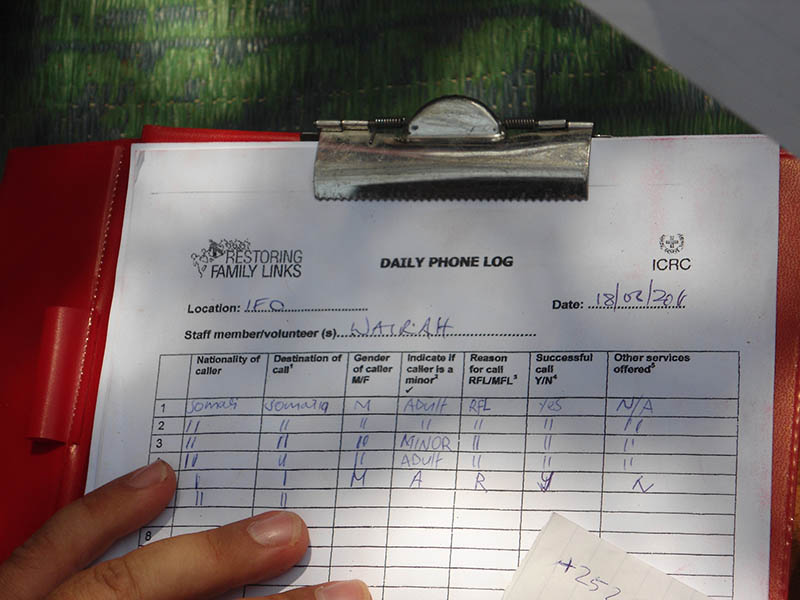
Dadaab, camp de réfugiés. Registre des appels téléphoniques. Dadaab, refugee camp. Calls register. ICRC website, Interview, 27.09.2011. Somalia/Kenya: preventing loss of family ties for refugees with a phone call In response to the recent influx of people fleeing the humanitarian crisis in Somalia, the ICRC and Kenya Red Cross Society have stepped up tracing activities in the Dadaab refugee camps in Kenya. Ivan Antonic, ICRC specialist in restoring family links (RFL), is just back from a three-week mission there to establish the first family news mobile phone service for refugees in East Africa. How does the ICRC help Somali refugees in Dadaab? One of the most urgent needs for new arrivals from Somalia is to be able to get in touch with their family members who stayed behind to let them know that they arrived safely and are well. Over the last few weeks, an average of 1,500 new refugees arrives at the camp daily. Many of them have horrific stories to tell about a rough journey and are exhausted upon arrival. Helping these people contact their loved ones is a priority for the ICRC and its restoring family links (RFL) services. RFL services in the four Dadaab refugee camps, about 70 km from the border with Somalia, began in the 1980s and give the refugees the possibility to write a Red Cross message (RCM) to their relatives in Somalia or elsewhere around the world. But you can imagine that it is very difficult to deliver written messages in some areas of Somalia right now, and it takes a long time. So the true innovation here today, is that the ICRC has decided to offer a mobile phone service for the newly arrived refugees: each of them can call a relative for two minutes anywhere in the world to let them know they are in Dadaab and doing fine. It's a very quick, efficient and cheap way of helping these people. The figures show the success of the new programme: in the past three weeks since the first phone calls were made, more than 1,800 refugees on averag